Smart Cities or Gated Communities? The Social Impact of Tech-Driven Urban Planning
Posted on 08/03/2026 15:03:24
Audience: 241
Share with friends on:
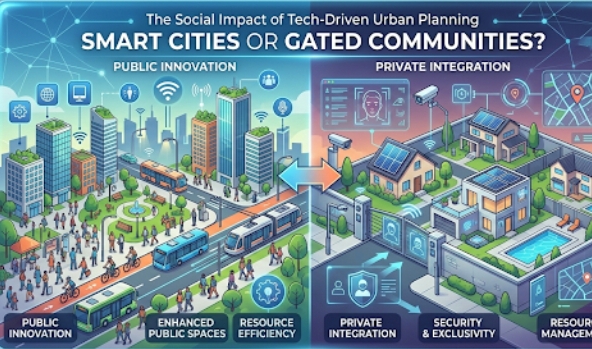
The city has always been a mirror of its era — a physical record of who holds power, who is protected, and who is left to navigate the margins. Today, that mirror is increasingly digital. As artificial intelligence, sensor networks, biometric surveillance, and data-driven governance become woven into the fabric of urban life, the cities of the twenty-first century are being redesigned not merely by architects and planners but by algorithms and investment portfolios. The result is a dual phenomenon playing out across the globe: the "smart city," promising efficiency and connectivity for all, and the gated community, offering a curated, technology-secured retreat for the few. Both are products of the same technological moment, yet they carry profoundly different implications for how human beings relate to one another, to public space, and to the idea of civic life itself.
The smart city concept, at its most idealistic, imagines technology as a great equalizer. Proponents envision real-time traffic management reducing commute times for working-class residents, AI-assisted emergency response saving lives in underserved neighborhoods, and smart energy grids cutting utility bills for low-income families. Cities like Singapore, Barcelona, and Amsterdam have pioneered ambitious digital infrastructure projects, embedding sensors into streetlights, garbage bins, and water mains to generate continuous streams of data that administrators can use to optimize city services. In theory, this produces a more responsive, more efficient, and ultimately more humane urban environment. The vision is seductive, and in certain narrow applications — traffic flow, energy consumption, public transit scheduling — the results have been genuinely impressive.
Yet the promise of the smart city rests on assumptions that rarely survive contact with social reality. Chief among them is the idea that the data collected about a city's residents will be used neutrally and in the public interest. In practice, the infrastructure underpinning smart cities is often built and owned not by governments but by private technology corporations — firms like Sidewalk Labs, Huawei, and Cisco — whose interests in monetizing data may not align with the interests of the communities being monitored. The 2020 collapse of Sidewalk Labs' ambitious Toronto waterfront project was instructive in this regard; it was abandoned in part because of fierce public opposition to the company's proposed data governance model, which critics argued would hand extraordinary surveillance power to a private entity with minimal democratic accountability. The incident exposed a fault line that runs through virtually every smart city project: the gap between the rhetoric of civic benefit and the reality of corporate data capture.
Surveillance is where the social stakes of smart urbanism become most acute. The deployment of facial recognition cameras, license plate readers, predictive policing algorithms, and "social credit" style behavioral monitoring systems does not affect all urban residents equally. Decades of research on policing and algorithmic bias have demonstrated consistently that these technologies amplify existing patterns of racial and economic discrimination. When a predictive policing system trained on historically biased arrest data is unleashed on a low-income neighborhood of color, it does not produce neutral law enforcement — it produces a feedback loop of over-policing that further entrenches inequality. In cities from Chicago to Cape Town, the "smart" infrastructure sold as a tool for safety has functioned, in practice, as a mechanism for the surveillance and control of the poor. The panopticon, once a thought experiment, has become a municipal procurement line item.
The gated community, meanwhile, represents a parallel and in some ways more candid articulation of the same social logic. Where the smart city at least gestures toward universal benefit, the gated enclave makes no such pretense — it is, by definition, a space of selective inclusion and deliberate exclusion. Originally conceived as a response to crime and urban decline, gated communities have proliferated across the United States, Latin America, the Middle East, and sub-Saharan Africa over the past four decades, driven in large part by the privatization of security and the commodification of space. What is new in the current moment is the depth and sophistication of the technology deployed within these enclaves. Today's luxury gated development may feature biometric entry systems, AI-powered CCTV, drone surveillance, app-controlled access management, and private fiber-optic networks — a self-contained smart city miniature, available exclusively to those who can afford the homeowners' association fees.
The social consequences of this model are difficult to overstate. As affluent residents withdraw into technologically fortified private communities, they take with them the tax base, civic engagement, and social capital that public neighborhoods depend upon. Schools, parks, roads, and emergency services in the surrounding areas are left to deteriorate, accelerating the very conditions of disorder and inequality that drove residents behind the gates in the first place. This dynamic has been documented with particular clarity in rapidly urbanizing regions of the Global South, where the proliferation of gated enclaves has fractured the urban fabric into disconnected islands of wealth and poverty, separated not just by walls and guards but by incompatible infrastructural realities. The gated community does not solve the city's problems; it privatizes the solution for a minority and externalizes the cost onto everyone else.
There is also a subtler but no less significant cost to consider: the erosion of the shared public realm that has historically been the foundation of democratic civic life. The street, the square, the park, the market — these spaces matter not only as functional arteries of a city but as sites of encounter between strangers, where difference is negotiated, solidarity is built, and the messy, generative friction of pluralism is experienced. When technology enables residents to move through the city in personalized, surveilled bubbles — summoning private cars, accessing gated amenities, routing around "undesirable" neighborhoods via GPS — the social encounters that public space once made unavoidable become optional. Optionality, in deeply unequal societies, is a privilege. Those who can afford to avoid the public realm do so; those who cannot are left with a public realm increasingly stripped of investment, attention, and presence.
None of this means that urban technology is inherently regressive or that smart infrastructure has no role to play in creating more livable cities. The question is never whether to deploy technology but who controls it, whose interests it serves, and what governance structures ensure accountability to the public. Cities that have pursued participatory data governance models — engaging communities in decisions about what is monitored, how data is used, and who has access to it — have demonstrated that digital urban infrastructure can be designed with equity rather than extraction as its organizing principle. Similarly, housing policy and urban planning frameworks that insist on mixed-income, mixed-use development can counteract the centrifugal forces driving wealthy residents into private enclaves, though such policies require sustained political will in the face of powerful market incentives pointing the other direction.
What the rise of smart cities and gated communities ultimately reveals is that technology does not arrive in cities as a neutral force. It arrives embedded in economic systems, power structures, and social assumptions that shape how it is built, who benefits from it, and who bears its costs. The cities of the future will be as just or as unjust as the societies that build them, and no amount of sensor data or algorithmic optimization will change that fundamental truth. If the promise of tech-driven urbanism is to be realized — not just for the wealthy few who can afford to inhabit its most polished expressions, but for the full diversity of people who make up a city — then the conversation about smart urban planning must be, above all, a conversation about power: who holds it, how it is exercised, and in whose name the city is ultimately built.
The smart city concept, at its most idealistic, imagines technology as a great equalizer. Proponents envision real-time traffic management reducing commute times for working-class residents, AI-assisted emergency response saving lives in underserved neighborhoods, and smart energy grids cutting utility bills for low-income families. Cities like Singapore, Barcelona, and Amsterdam have pioneered ambitious digital infrastructure projects, embedding sensors into streetlights, garbage bins, and water mains to generate continuous streams of data that administrators can use to optimize city services. In theory, this produces a more responsive, more efficient, and ultimately more humane urban environment. The vision is seductive, and in certain narrow applications — traffic flow, energy consumption, public transit scheduling — the results have been genuinely impressive.
Yet the promise of the smart city rests on assumptions that rarely survive contact with social reality. Chief among them is the idea that the data collected about a city's residents will be used neutrally and in the public interest. In practice, the infrastructure underpinning smart cities is often built and owned not by governments but by private technology corporations — firms like Sidewalk Labs, Huawei, and Cisco — whose interests in monetizing data may not align with the interests of the communities being monitored. The 2020 collapse of Sidewalk Labs' ambitious Toronto waterfront project was instructive in this regard; it was abandoned in part because of fierce public opposition to the company's proposed data governance model, which critics argued would hand extraordinary surveillance power to a private entity with minimal democratic accountability. The incident exposed a fault line that runs through virtually every smart city project: the gap between the rhetoric of civic benefit and the reality of corporate data capture.
Surveillance is where the social stakes of smart urbanism become most acute. The deployment of facial recognition cameras, license plate readers, predictive policing algorithms, and "social credit" style behavioral monitoring systems does not affect all urban residents equally. Decades of research on policing and algorithmic bias have demonstrated consistently that these technologies amplify existing patterns of racial and economic discrimination. When a predictive policing system trained on historically biased arrest data is unleashed on a low-income neighborhood of color, it does not produce neutral law enforcement — it produces a feedback loop of over-policing that further entrenches inequality. In cities from Chicago to Cape Town, the "smart" infrastructure sold as a tool for safety has functioned, in practice, as a mechanism for the surveillance and control of the poor. The panopticon, once a thought experiment, has become a municipal procurement line item.
The gated community, meanwhile, represents a parallel and in some ways more candid articulation of the same social logic. Where the smart city at least gestures toward universal benefit, the gated enclave makes no such pretense — it is, by definition, a space of selective inclusion and deliberate exclusion. Originally conceived as a response to crime and urban decline, gated communities have proliferated across the United States, Latin America, the Middle East, and sub-Saharan Africa over the past four decades, driven in large part by the privatization of security and the commodification of space. What is new in the current moment is the depth and sophistication of the technology deployed within these enclaves. Today's luxury gated development may feature biometric entry systems, AI-powered CCTV, drone surveillance, app-controlled access management, and private fiber-optic networks — a self-contained smart city miniature, available exclusively to those who can afford the homeowners' association fees.
The social consequences of this model are difficult to overstate. As affluent residents withdraw into technologically fortified private communities, they take with them the tax base, civic engagement, and social capital that public neighborhoods depend upon. Schools, parks, roads, and emergency services in the surrounding areas are left to deteriorate, accelerating the very conditions of disorder and inequality that drove residents behind the gates in the first place. This dynamic has been documented with particular clarity in rapidly urbanizing regions of the Global South, where the proliferation of gated enclaves has fractured the urban fabric into disconnected islands of wealth and poverty, separated not just by walls and guards but by incompatible infrastructural realities. The gated community does not solve the city's problems; it privatizes the solution for a minority and externalizes the cost onto everyone else.
There is also a subtler but no less significant cost to consider: the erosion of the shared public realm that has historically been the foundation of democratic civic life. The street, the square, the park, the market — these spaces matter not only as functional arteries of a city but as sites of encounter between strangers, where difference is negotiated, solidarity is built, and the messy, generative friction of pluralism is experienced. When technology enables residents to move through the city in personalized, surveilled bubbles — summoning private cars, accessing gated amenities, routing around "undesirable" neighborhoods via GPS — the social encounters that public space once made unavoidable become optional. Optionality, in deeply unequal societies, is a privilege. Those who can afford to avoid the public realm do so; those who cannot are left with a public realm increasingly stripped of investment, attention, and presence.
None of this means that urban technology is inherently regressive or that smart infrastructure has no role to play in creating more livable cities. The question is never whether to deploy technology but who controls it, whose interests it serves, and what governance structures ensure accountability to the public. Cities that have pursued participatory data governance models — engaging communities in decisions about what is monitored, how data is used, and who has access to it — have demonstrated that digital urban infrastructure can be designed with equity rather than extraction as its organizing principle. Similarly, housing policy and urban planning frameworks that insist on mixed-income, mixed-use development can counteract the centrifugal forces driving wealthy residents into private enclaves, though such policies require sustained political will in the face of powerful market incentives pointing the other direction.
What the rise of smart cities and gated communities ultimately reveals is that technology does not arrive in cities as a neutral force. It arrives embedded in economic systems, power structures, and social assumptions that shape how it is built, who benefits from it, and who bears its costs. The cities of the future will be as just or as unjust as the societies that build them, and no amount of sensor data or algorithmic optimization will change that fundamental truth. If the promise of tech-driven urbanism is to be realized — not just for the wealthy few who can afford to inhabit its most polished expressions, but for the full diversity of people who make up a city — then the conversation about smart urban planning must be, above all, a conversation about power: who holds it, how it is exercised, and in whose name the city is ultimately built.
Kindly join discussion on this topic on:
} Share with friends on:Related Posts
- Conversational Keywords: Writing for Natural Language Processing
- Trade Resilience: Data on Front-Loaded Shipments and New Bilateral Trade Deals
- Venture Capital in 2026: The Shift from "Growth at All Costs" to "Unit Economics"
- What Is the Force Majeure Clause Released in Bahrain Amidst the US-Israeli-Iranian Conflict
- E-Commerce Integration: Taking Your Local Trade to a Global Audience
- Authoritative Content: How to Become a Primary Source for AI Models
- Interoperability: Connecting Private Blockchains with Public Liquidity
- Social Listening for ROI: How to Spot Market Trends Before They Break
- Agricultural Yields: Impact of Climate-Related Shocks on Global Food Security
- AI Wallets: Self-Managing Digital Assets with Zero-Human Intervention