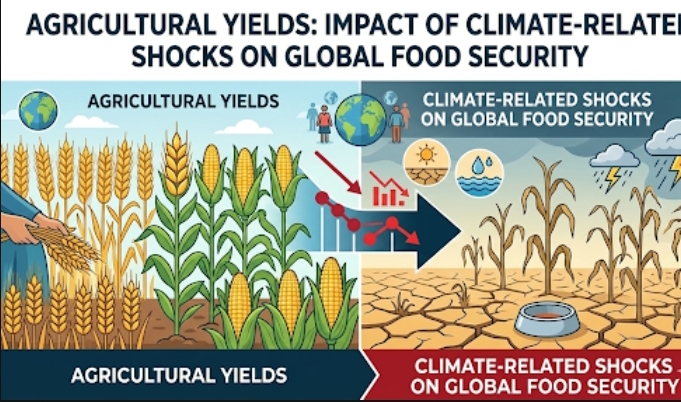
Agricultural Yields: Impact of Climate-Related Shocks on Global Food Security
Posted on 08/03/2026 08:45:26
Audience: 230
Share with friends on:
For most of recorded human history, the relationship between civilization and agriculture has been one of cautious negotiation with an unpredictable natural world. Droughts brought famines, floods destroyed harvests, and the rhythms of planting and reaping were always subject to the mercy of weather systems that no human institution could control. The twentieth century appeared, for a time, to have broken that ancient dependency. The Green Revolution — driven by high-yield seed varieties, synthetic fertilizers, irrigation expansion, and mechanized farming — dramatically increased global food production, lifting hundreds of millions out of hunger and creating a widespread confidence that technological ingenuity could perpetually outpace the demands of a growing population. That confidence is now being tested with a severity that the architects of the Green Revolution could not have fully anticipated, as climate change introduces not merely incremental disruptions to agricultural systems but structural, compounding shocks that are beginning to overwhelm the adaptive capacity of farming communities and food supply chains across the entire planet.
The most direct pathway through which climate change affects agricultural yields is temperature. Crops are finely calibrated biological systems, and their productivity is exquisitely sensitive to thermal conditions during critical growth stages. For every degree Celsius of warming above optimal growing temperatures, wheat yields decline by approximately six percent, rice by roughly three to seven percent, and maize by around seven percent — figures that, applied at the scale of global production, translate into hundreds of millions of additional tons of lost food per year. What makes these losses particularly alarming is not just their magnitude but their geography. The regions facing the steepest yield declines are predominantly in the tropics and subtropics — Sub-Saharan Africa, South Asia, and Central America — which are also among the world's most food-insecure and least economically resilient regions. The cruelest arithmetic of climate change is that the populations least responsible for historical greenhouse gas emissions are disproportionately bearing the costs of the warming those emissions have caused, watching their staple crops wither under heat stress while the agricultural systems of wealthier nations in higher latitudes have, at least temporarily, seen some productivity gains from longer growing seasons.
Temperature rise alone does not capture the full complexity of the climate-agriculture relationship, because warming operates alongside, and in interaction with, changes in precipitation patterns, the intensification of extreme weather events, and the disruption of seasonal cycles that farmers have relied upon for generations. Rainfall is becoming less predictable across many of the world's most agriculturally important regions — arriving in shorter, more intense bursts that cause flash flooding and soil erosion rather than the steady, gentle precipitation that allows crops to absorb moisture effectively, or failing entirely during growing seasons that depend on consistent rainfall. The Intergovernmental Panel on Climate Change has documented increasing frequency of compound events in which drought and heat stress occur simultaneously, a combination that is far more destructive to crop yields than either stressor in isolation and that pushes agricultural systems past thresholds from which recovery within a single growing season is impossible. The 2022 Pakistan floods — which inundated roughly a third of the country and destroyed crops valued at billions of dollars — and the simultaneous droughts devastating the Horn of Africa that same year offered a brutal illustration of how climate volatility can deliver concurrent shocks across multiple regions, stressing global food supply at multiple points at once rather than sequentially.
The impact of these climate shocks extends far beyond the fields where they occur, reverberating through the intricate global supply chains that modern food systems depend upon. The world's food supply is far more interconnected, and therefore more vulnerable to synchronized disruptions, than most people understand. A handful of nations produce the majority of the world's traded wheat, maize, rice, and soybeans, and when climate events simultaneously depress harvests in multiple breadbasket regions — as occurred during the 2010-2011 period when droughts and fires devastated Russian wheat production while floods hammered Australian crops — the resulting supply shortfalls trigger price spikes that cascade with alarming speed through commodity markets and onto the plates of the world's poorest consumers. The food price crises of 2008 and 2011 both had significant climate components and were followed by social unrest across dozens of countries, a pattern that security analysts and climate researchers have increasingly recognized as a direct link between agricultural disruption and political instability. When subsistence farmers in the Sahel lose a harvest, the consequences do not stay in the Sahel — they ripple outward in the form of migration, conflict over shrinking arable land and water resources, and the collapse of local economies that had already been operating on the narrowest of margins.
Water scarcity deserves particular attention within this broader climate-agriculture crisis because irrigation, which currently supports roughly forty percent of global food production on about twenty percent of cultivated land, is being threatened from multiple directions simultaneously. Glaciers in the Himalayas, the Andes, and the Hindu Kush — which feed the rivers that irrigate some of the world's most densely farmed and populated regions — are retreating at accelerating rates, threatening to first increase and then catastrophically reduce river flows in ways that will fundamentally reshape the agricultural geography of Asia and South America. Groundwater aquifers, which farmers have drawn upon with increasing desperation as surface water has become less reliable, are being depleted far faster than natural recharge rates across the North China Plain, northern India, the Central Valley of California, and the Middle East. The combination of diminishing glacial meltwater, collapsing aquifer levels, and increasingly erratic rainfall is creating a convergent water crisis for agriculture that no amount of improved seed technology or precision farming can fully compensate for, because plants need water in quantities and at timings that have no technological substitute.
The vulnerability of global food systems to climate shocks is also shaped by the profound transformation that industrial agriculture has imposed on the biological diversity of the food supply itself. The process of agricultural modernization, for all its productivity gains, has narrowed the genetic base of global food production to a degree that carries enormous systemic risk. Thousands of traditional crop varieties, each adapted through centuries of local cultivation to specific soils, rainfall patterns, and pest pressures, have been displaced by a small number of high-yield monocultures that were optimized for the stable climate conditions of the mid-twentieth century rather than the volatile and unpredictable conditions of the twenty-first. A pathogen or climate stress that overwhelms a monoculture variety can devastate production across entire continents simultaneously, as the ongoing threat to Cavendish banana crops from Fusarium wilt — a fungal disease spreading in warmer, wetter conditions — grimly illustrates. The erosion of agrobiodiversity is not merely an ecological loss; it is the deliberate destruction of the adaptive insurance that farming communities have accumulated over millennia, precisely the kind of insurance that a climate-disrupted world most urgently needs.
Addressing the threat that climate shocks pose to global food security demands responses that operate at multiple scales and across multiple dimensions — agronomic, political, economic, and social — simultaneously. At the farm level, climate-adaptive practices including agroforestry, conservation tillage, improved water harvesting, and the reintroduction of drought-tolerant traditional varieties are demonstrating genuine promise in field trials and community programs across Africa, Asia, and Latin America. Advances in genomic science are accelerating the development of heat-tolerant and flood-resistant crop varieties, and precision agriculture technologies are enabling more efficient use of water and fertilizer in ways that reduce both cost and environmental impact. But these technical solutions, however valuable, cannot substitute for the policy transformations that are equally necessary: meaningful reform of agricultural subsidy systems in wealthy nations that currently incentivize overproduction and resource depletion; substantial increases in public investment in agricultural research and extension services directed at smallholder farmers in the most climate-vulnerable regions; and international trade frameworks that prioritize food security over commodity speculation, particularly during periods of supply shock.
The uncomfortable truth that underlies all of these necessary interventions is that the global food system was not designed for the climate it now inhabits. It was designed for a relatively stable Holocene climate that industrial civilization has irreversibly altered, and the agricultural institutions, infrastructure, market structures, and policy frameworks that feed eight billion people were calibrated for a world that no longer exists. Adapting them to the world that does exist — and to the considerably more volatile world that current emissions trajectories are creating — is a task of civilizational scale that is proceeding far too slowly relative to the pace of the disruption itself. Food security has always been the foundation upon which every other dimension of human security rests; no society can sustain political stability, economic development, or social cohesion on an empty stomach. The challenge of the coming decades is not simply to feed a growing population in a changing climate — it is to construct food systems resilient enough to absorb shocks that are going to keep intensifying regardless of how aggressively the world now acts to reduce emissions, because the carbon already in the atmosphere has already committed the planet to a degree of warming that is irreversible on any politically meaningful timescale. Whether humanity rises to that challenge with the urgency and collective ambition it demands remains, at this precarious moment, genuinely and consequentially uncertain.
The most direct pathway through which climate change affects agricultural yields is temperature. Crops are finely calibrated biological systems, and their productivity is exquisitely sensitive to thermal conditions during critical growth stages. For every degree Celsius of warming above optimal growing temperatures, wheat yields decline by approximately six percent, rice by roughly three to seven percent, and maize by around seven percent — figures that, applied at the scale of global production, translate into hundreds of millions of additional tons of lost food per year. What makes these losses particularly alarming is not just their magnitude but their geography. The regions facing the steepest yield declines are predominantly in the tropics and subtropics — Sub-Saharan Africa, South Asia, and Central America — which are also among the world's most food-insecure and least economically resilient regions. The cruelest arithmetic of climate change is that the populations least responsible for historical greenhouse gas emissions are disproportionately bearing the costs of the warming those emissions have caused, watching their staple crops wither under heat stress while the agricultural systems of wealthier nations in higher latitudes have, at least temporarily, seen some productivity gains from longer growing seasons.
Temperature rise alone does not capture the full complexity of the climate-agriculture relationship, because warming operates alongside, and in interaction with, changes in precipitation patterns, the intensification of extreme weather events, and the disruption of seasonal cycles that farmers have relied upon for generations. Rainfall is becoming less predictable across many of the world's most agriculturally important regions — arriving in shorter, more intense bursts that cause flash flooding and soil erosion rather than the steady, gentle precipitation that allows crops to absorb moisture effectively, or failing entirely during growing seasons that depend on consistent rainfall. The Intergovernmental Panel on Climate Change has documented increasing frequency of compound events in which drought and heat stress occur simultaneously, a combination that is far more destructive to crop yields than either stressor in isolation and that pushes agricultural systems past thresholds from which recovery within a single growing season is impossible. The 2022 Pakistan floods — which inundated roughly a third of the country and destroyed crops valued at billions of dollars — and the simultaneous droughts devastating the Horn of Africa that same year offered a brutal illustration of how climate volatility can deliver concurrent shocks across multiple regions, stressing global food supply at multiple points at once rather than sequentially.
The impact of these climate shocks extends far beyond the fields where they occur, reverberating through the intricate global supply chains that modern food systems depend upon. The world's food supply is far more interconnected, and therefore more vulnerable to synchronized disruptions, than most people understand. A handful of nations produce the majority of the world's traded wheat, maize, rice, and soybeans, and when climate events simultaneously depress harvests in multiple breadbasket regions — as occurred during the 2010-2011 period when droughts and fires devastated Russian wheat production while floods hammered Australian crops — the resulting supply shortfalls trigger price spikes that cascade with alarming speed through commodity markets and onto the plates of the world's poorest consumers. The food price crises of 2008 and 2011 both had significant climate components and were followed by social unrest across dozens of countries, a pattern that security analysts and climate researchers have increasingly recognized as a direct link between agricultural disruption and political instability. When subsistence farmers in the Sahel lose a harvest, the consequences do not stay in the Sahel — they ripple outward in the form of migration, conflict over shrinking arable land and water resources, and the collapse of local economies that had already been operating on the narrowest of margins.
Water scarcity deserves particular attention within this broader climate-agriculture crisis because irrigation, which currently supports roughly forty percent of global food production on about twenty percent of cultivated land, is being threatened from multiple directions simultaneously. Glaciers in the Himalayas, the Andes, and the Hindu Kush — which feed the rivers that irrigate some of the world's most densely farmed and populated regions — are retreating at accelerating rates, threatening to first increase and then catastrophically reduce river flows in ways that will fundamentally reshape the agricultural geography of Asia and South America. Groundwater aquifers, which farmers have drawn upon with increasing desperation as surface water has become less reliable, are being depleted far faster than natural recharge rates across the North China Plain, northern India, the Central Valley of California, and the Middle East. The combination of diminishing glacial meltwater, collapsing aquifer levels, and increasingly erratic rainfall is creating a convergent water crisis for agriculture that no amount of improved seed technology or precision farming can fully compensate for, because plants need water in quantities and at timings that have no technological substitute.
The vulnerability of global food systems to climate shocks is also shaped by the profound transformation that industrial agriculture has imposed on the biological diversity of the food supply itself. The process of agricultural modernization, for all its productivity gains, has narrowed the genetic base of global food production to a degree that carries enormous systemic risk. Thousands of traditional crop varieties, each adapted through centuries of local cultivation to specific soils, rainfall patterns, and pest pressures, have been displaced by a small number of high-yield monocultures that were optimized for the stable climate conditions of the mid-twentieth century rather than the volatile and unpredictable conditions of the twenty-first. A pathogen or climate stress that overwhelms a monoculture variety can devastate production across entire continents simultaneously, as the ongoing threat to Cavendish banana crops from Fusarium wilt — a fungal disease spreading in warmer, wetter conditions — grimly illustrates. The erosion of agrobiodiversity is not merely an ecological loss; it is the deliberate destruction of the adaptive insurance that farming communities have accumulated over millennia, precisely the kind of insurance that a climate-disrupted world most urgently needs.
Addressing the threat that climate shocks pose to global food security demands responses that operate at multiple scales and across multiple dimensions — agronomic, political, economic, and social — simultaneously. At the farm level, climate-adaptive practices including agroforestry, conservation tillage, improved water harvesting, and the reintroduction of drought-tolerant traditional varieties are demonstrating genuine promise in field trials and community programs across Africa, Asia, and Latin America. Advances in genomic science are accelerating the development of heat-tolerant and flood-resistant crop varieties, and precision agriculture technologies are enabling more efficient use of water and fertilizer in ways that reduce both cost and environmental impact. But these technical solutions, however valuable, cannot substitute for the policy transformations that are equally necessary: meaningful reform of agricultural subsidy systems in wealthy nations that currently incentivize overproduction and resource depletion; substantial increases in public investment in agricultural research and extension services directed at smallholder farmers in the most climate-vulnerable regions; and international trade frameworks that prioritize food security over commodity speculation, particularly during periods of supply shock.
The uncomfortable truth that underlies all of these necessary interventions is that the global food system was not designed for the climate it now inhabits. It was designed for a relatively stable Holocene climate that industrial civilization has irreversibly altered, and the agricultural institutions, infrastructure, market structures, and policy frameworks that feed eight billion people were calibrated for a world that no longer exists. Adapting them to the world that does exist — and to the considerably more volatile world that current emissions trajectories are creating — is a task of civilizational scale that is proceeding far too slowly relative to the pace of the disruption itself. Food security has always been the foundation upon which every other dimension of human security rests; no society can sustain political stability, economic development, or social cohesion on an empty stomach. The challenge of the coming decades is not simply to feed a growing population in a changing climate — it is to construct food systems resilient enough to absorb shocks that are going to keep intensifying regardless of how aggressively the world now acts to reduce emissions, because the carbon already in the atmosphere has already committed the planet to a degree of warming that is irreversible on any politically meaningful timescale. Whether humanity rises to that challenge with the urgency and collective ambition it demands remains, at this precarious moment, genuinely and consequentially uncertain.
Kindly join discussion on this topic on:
} Share with friends on:Related Posts
- Conversational Keywords: Writing for Natural Language Processing
- Trade Resilience: Data on Front-Loaded Shipments and New Bilateral Trade Deals
- Venture Capital in 2026: The Shift from "Growth at All Costs" to "Unit Economics"
- What Is the Force Majeure Clause Released in Bahrain Amidst the US-Israeli-Iranian Conflict
- E-Commerce Integration: Taking Your Local Trade to a Global Audience
- Authoritative Content: How to Become a Primary Source for AI Models
- Interoperability: Connecting Private Blockchains with Public Liquidity
- Smart Cities or Gated Communities? The Social Impact of Tech-Driven Urban Planning
- Social Listening for ROI: How to Spot Market Trends Before They Break
- AI Wallets: Self-Managing Digital Assets with Zero-Human Intervention