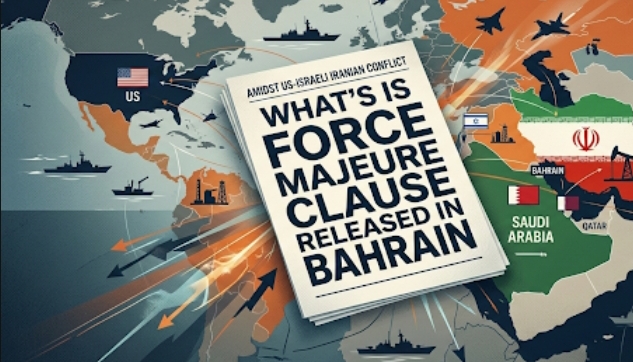
What Is the Force Majeure Clause Released in Bahrain Amidst the US-Israeli-Iranian Conflict
Posted on 09/03/2026 08:12:17
Audience: 272
Share with friends on:
At the intersection of international law and geopolitical catastrophe, few legal mechanisms carry as much weight as the force majeure clause — and rarely has its invocation carried consequences as sweeping as those now unfolding in the Gulf. On March 9, 2026, Bahrain's state oil company declared force majeure on its shipments after Iranian drone strikes set the BAPCO refinery in the Sitra area ablaze, damaging the nation's only oil refinery and rendering contractual delivery obligations impossible to fulfil. The announcement, carried by the state-run Bahrain News Agency, was not merely a corporate legal formality. It was a seismic signal to global markets that the escalating conflict between the United States, Israel, and Iran had begun to corrode the foundational infrastructure upon which the world's energy supply depends, and that the legal and economic consequences of this war would reach far beyond the battlefields of the Middle East.
To understand the significance of Bahrain's declaration, one must first understand what force majeure actually means and why its use in sovereign energy contexts is so consequential. Derived from French and meaning "superior force," force majeure is a legal clause embedded in commercial contracts that permits a party to suspend or terminate its obligations when extraordinary circumstances entirely beyond its control make performance impossible. War, natural disaster, and government action are the classic triggers. When invoked legitimately, it legally releases the declaring party from liability for non-delivery — but it simultaneously leaves the other party, the buyer or counterparty, scrambling to find alternative supply at whatever price the disrupted market will bear. In Bahrain's case, the clause was triggered not by internal failure but by Iranian military strikes on critical energy infrastructure, events that no commercial contract could reasonably have been written to absorb.
The immediate backdrop to this declaration is the conflict that erupted on February 28, 2026, when the United States and Israel launched joint airstrikes on Iran, killing Supreme Leader Ali Khamenei and dozens of senior military and government figures. Iran's retaliation was swift, unprecedented in its breadth, and deliberately aimed at the energy and military assets of Gulf states hosting US forces. For the first time in modern history, Iran targeted all six members of the Gulf Cooperation Council — Bahrain, Kuwait, Oman, Qatar, Saudi Arabia, and the United Arab Emirates — marking a dramatic departure from decades during which Tehran had avoided direct strikes on Gulf territory, preferring instead to operate through proxy groups or in other theatres. The strikes hit airports, civilian districts, and, most consequentially for the global economy, energy infrastructure across multiple nations simultaneously, exposing the profound vulnerability of the Gulf's oil and gas architecture to a state-level military campaign.
Bahrain's refinery declaration did not stand alone. On March 5, QatarEnergy — the world's largest producer of liquefied natural gas — declared force majeure on LNG shipments after Iranian drone strikes hit the Ras Laffan Industrial City and Mesaieed Industrial City facilities, forcing a complete halt of LNG production. The announcement sent an immediate and severe shock through global energy markets. LNG buyers across Asia and Europe, who depend on Qatari supply to heat homes and power industry through the tail end of winter when storage levels are historically low, were abruptly informed that contracted deliveries could not be guaranteed. The consequences were felt within hours: crude oil prices surged approximately 8% on March 2, US stock futures dropped sharply, European shares declined, and the Dow Jones Industrial Average had already shed more than 400 points in the opening days of the conflict. These were not speculative movements driven by fear alone — they were rational market responses to the recognition that the Strait of Hormuz, through which roughly 20% of global oil and gas supplies transit daily, had become a contested zone in an active war.
The broader economic cascade from these force majeure declarations extends well beyond energy prices, touching supply chains, sovereign investment flows, and the long-term architecture of global trade relationships. Saudi Arabia, the UAE, Kuwait, and Qatar — nations that collectively control some of the world's largest sovereign wealth funds and had pledged hundreds of billions of dollars in US investments during President Trump's Gulf tour in May 2025 — began quietly reviewing whether force majeure clauses could be legally invoked to suspend those sovereign investment commitments. The Financial Times reported that three of the four largest Gulf economies had jointly discussed the financial strain placed on their budgets by a conflict they did not initiate and did not want. Khalaf Ahmad Al Habtoor, the Emirati billionaire and founding chairman of Al Habtoor Group, gave public voice to what Gulf leaders were saying privately, asking in an open letter whether the billions contributed to Washington's investment pledges were supporting peace or financing a war that was exposing the region to existential risk. The question was rhetorical, but its implications for the US-Gulf financial relationship were anything but.
The ripple effects on global shipping and trade corridors compound the energy crisis with a logistical dimension that is equally alarming. The Strait of Hormuz — already the world's most strategically critical chokepoint — became effectively inaccessible to commercial traffic as the conflict intensified, forcing tankers and cargo vessels to seek longer, costlier routes around the Arabian Peninsula. The Red Sea corridor, which had already been partially disrupted by Houthi attacks in 2024, remained a risk zone. Insurance premiums for vessels operating anywhere near the Gulf skyrocketed. Capital market activity across the Middle East largely froze, with fundraising rounds and mergers suspended and Chinese investors pausing talks on Gulf-linked assets. The cascading uncertainty reached equity markets in Egypt, whose main index fell more than 8% since mid-February 2026, reflecting how deeply intertwined regional stability is with the financial health of nations far from the frontlines.
The warning from Saad al-Kaabi, Qatar's Energy Minister, that if the conflict continued, other Gulf energy producers might also be forced to halt exports and declare force majeure — and that this "will bring down economies of the world" — was not rhetorical excess. It was a precise diagnosis of systemic risk. The global economy is not structured to absorb the simultaneous removal of Gulf LNG and oil supplies from the market, particularly at a moment when European natural gas storage levels are already depleted from the winter and alternative supply from Russia remains largely sanctioned. Countries in South and East Asia that are structurally dependent on Gulf energy imports — India, Japan, South Korea, and China among them — face acute vulnerability. India's External Affairs Minister S. Jaishankar addressed Parliament directly on the unfolding crisis, emphasizing the implications for Indian energy security and the safety of the millions of Indian nationals living and working across the Gulf states. It was a telling indicator of how widely the consequences of a force majeure declaration in a small island nation of fewer than two million people can radiate across a globally connected economy.
From a legal standpoint, the force majeure declarations now cascading across Gulf energy contracts will almost certainly trigger years of litigation, arbitration, and contract renegotiation. Buyers who had locked in long-term LNG and crude supply contracts at favorable rates now face the double burden of finding emergency supply at spot market prices while simultaneously navigating the legal question of whether the force majeure invocation is valid, proportionate, and properly documented under the specific terms of each individual agreement. International arbitration tribunals will ultimately adjudicate many of these disputes, and the outcomes will reshape how energy contracts are written for the next generation — particularly around clauses defining war risk, what constitutes an "extraordinary event," and how buyers and sellers share the burden of political risk in volatile regions. Some major energy importers will likely respond by accelerating diversification of supply, investing more aggressively in domestic renewable capacity, or pursuing long-term agreements with producers in Africa, North America, and Australia precisely to reduce exposure to the kind of cascading force majeure risk that is currently unfolding.
The deeper, longer-term consequence of what is happening in Bahrain and across the Gulf is a structural reassessment of the assumptions that have underpinned the global energy economy for decades. The conventional wisdom that Gulf states were too economically vital to become genuine theatres of war — that their shared dependency on oil revenues and the West's dependency on Gulf supply created a mutual deterrence that would prevent direct conflict — has been shattered. Energy infrastructure that was once treated as effectively off-limits in regional conflicts is now being struck with precision and deliberate intent. The force majeure clause, which exists precisely to account for the unforeseeable, is now being invoked not once but serially across multiple sovereign producers in the same week, an event without modern precedent. The world is watching in real time as legal mechanisms designed for individual commercial disruptions are tested by a geopolitical rupture of historic proportions — and the outcome of that test will define the contours of global trade, energy security, and international contract law for years to come.
To understand the significance of Bahrain's declaration, one must first understand what force majeure actually means and why its use in sovereign energy contexts is so consequential. Derived from French and meaning "superior force," force majeure is a legal clause embedded in commercial contracts that permits a party to suspend or terminate its obligations when extraordinary circumstances entirely beyond its control make performance impossible. War, natural disaster, and government action are the classic triggers. When invoked legitimately, it legally releases the declaring party from liability for non-delivery — but it simultaneously leaves the other party, the buyer or counterparty, scrambling to find alternative supply at whatever price the disrupted market will bear. In Bahrain's case, the clause was triggered not by internal failure but by Iranian military strikes on critical energy infrastructure, events that no commercial contract could reasonably have been written to absorb.
The immediate backdrop to this declaration is the conflict that erupted on February 28, 2026, when the United States and Israel launched joint airstrikes on Iran, killing Supreme Leader Ali Khamenei and dozens of senior military and government figures. Iran's retaliation was swift, unprecedented in its breadth, and deliberately aimed at the energy and military assets of Gulf states hosting US forces. For the first time in modern history, Iran targeted all six members of the Gulf Cooperation Council — Bahrain, Kuwait, Oman, Qatar, Saudi Arabia, and the United Arab Emirates — marking a dramatic departure from decades during which Tehran had avoided direct strikes on Gulf territory, preferring instead to operate through proxy groups or in other theatres. The strikes hit airports, civilian districts, and, most consequentially for the global economy, energy infrastructure across multiple nations simultaneously, exposing the profound vulnerability of the Gulf's oil and gas architecture to a state-level military campaign.
Bahrain's refinery declaration did not stand alone. On March 5, QatarEnergy — the world's largest producer of liquefied natural gas — declared force majeure on LNG shipments after Iranian drone strikes hit the Ras Laffan Industrial City and Mesaieed Industrial City facilities, forcing a complete halt of LNG production. The announcement sent an immediate and severe shock through global energy markets. LNG buyers across Asia and Europe, who depend on Qatari supply to heat homes and power industry through the tail end of winter when storage levels are historically low, were abruptly informed that contracted deliveries could not be guaranteed. The consequences were felt within hours: crude oil prices surged approximately 8% on March 2, US stock futures dropped sharply, European shares declined, and the Dow Jones Industrial Average had already shed more than 400 points in the opening days of the conflict. These were not speculative movements driven by fear alone — they were rational market responses to the recognition that the Strait of Hormuz, through which roughly 20% of global oil and gas supplies transit daily, had become a contested zone in an active war.
The broader economic cascade from these force majeure declarations extends well beyond energy prices, touching supply chains, sovereign investment flows, and the long-term architecture of global trade relationships. Saudi Arabia, the UAE, Kuwait, and Qatar — nations that collectively control some of the world's largest sovereign wealth funds and had pledged hundreds of billions of dollars in US investments during President Trump's Gulf tour in May 2025 — began quietly reviewing whether force majeure clauses could be legally invoked to suspend those sovereign investment commitments. The Financial Times reported that three of the four largest Gulf economies had jointly discussed the financial strain placed on their budgets by a conflict they did not initiate and did not want. Khalaf Ahmad Al Habtoor, the Emirati billionaire and founding chairman of Al Habtoor Group, gave public voice to what Gulf leaders were saying privately, asking in an open letter whether the billions contributed to Washington's investment pledges were supporting peace or financing a war that was exposing the region to existential risk. The question was rhetorical, but its implications for the US-Gulf financial relationship were anything but.
The ripple effects on global shipping and trade corridors compound the energy crisis with a logistical dimension that is equally alarming. The Strait of Hormuz — already the world's most strategically critical chokepoint — became effectively inaccessible to commercial traffic as the conflict intensified, forcing tankers and cargo vessels to seek longer, costlier routes around the Arabian Peninsula. The Red Sea corridor, which had already been partially disrupted by Houthi attacks in 2024, remained a risk zone. Insurance premiums for vessels operating anywhere near the Gulf skyrocketed. Capital market activity across the Middle East largely froze, with fundraising rounds and mergers suspended and Chinese investors pausing talks on Gulf-linked assets. The cascading uncertainty reached equity markets in Egypt, whose main index fell more than 8% since mid-February 2026, reflecting how deeply intertwined regional stability is with the financial health of nations far from the frontlines.
The warning from Saad al-Kaabi, Qatar's Energy Minister, that if the conflict continued, other Gulf energy producers might also be forced to halt exports and declare force majeure — and that this "will bring down economies of the world" — was not rhetorical excess. It was a precise diagnosis of systemic risk. The global economy is not structured to absorb the simultaneous removal of Gulf LNG and oil supplies from the market, particularly at a moment when European natural gas storage levels are already depleted from the winter and alternative supply from Russia remains largely sanctioned. Countries in South and East Asia that are structurally dependent on Gulf energy imports — India, Japan, South Korea, and China among them — face acute vulnerability. India's External Affairs Minister S. Jaishankar addressed Parliament directly on the unfolding crisis, emphasizing the implications for Indian energy security and the safety of the millions of Indian nationals living and working across the Gulf states. It was a telling indicator of how widely the consequences of a force majeure declaration in a small island nation of fewer than two million people can radiate across a globally connected economy.
From a legal standpoint, the force majeure declarations now cascading across Gulf energy contracts will almost certainly trigger years of litigation, arbitration, and contract renegotiation. Buyers who had locked in long-term LNG and crude supply contracts at favorable rates now face the double burden of finding emergency supply at spot market prices while simultaneously navigating the legal question of whether the force majeure invocation is valid, proportionate, and properly documented under the specific terms of each individual agreement. International arbitration tribunals will ultimately adjudicate many of these disputes, and the outcomes will reshape how energy contracts are written for the next generation — particularly around clauses defining war risk, what constitutes an "extraordinary event," and how buyers and sellers share the burden of political risk in volatile regions. Some major energy importers will likely respond by accelerating diversification of supply, investing more aggressively in domestic renewable capacity, or pursuing long-term agreements with producers in Africa, North America, and Australia precisely to reduce exposure to the kind of cascading force majeure risk that is currently unfolding.
The deeper, longer-term consequence of what is happening in Bahrain and across the Gulf is a structural reassessment of the assumptions that have underpinned the global energy economy for decades. The conventional wisdom that Gulf states were too economically vital to become genuine theatres of war — that their shared dependency on oil revenues and the West's dependency on Gulf supply created a mutual deterrence that would prevent direct conflict — has been shattered. Energy infrastructure that was once treated as effectively off-limits in regional conflicts is now being struck with precision and deliberate intent. The force majeure clause, which exists precisely to account for the unforeseeable, is now being invoked not once but serially across multiple sovereign producers in the same week, an event without modern precedent. The world is watching in real time as legal mechanisms designed for individual commercial disruptions are tested by a geopolitical rupture of historic proportions — and the outcome of that test will define the contours of global trade, energy security, and international contract law for years to come.
Kindly join discussion on this topic on:
} Share with friends on:Related Posts
- Conversational Keywords: Writing for Natural Language Processing
- Trade Resilience: Data on Front-Loaded Shipments and New Bilateral Trade Deals
- Venture Capital in 2026: The Shift from "Growth at All Costs" to "Unit Economics"
- E-Commerce Integration: Taking Your Local Trade to a Global Audience
- Authoritative Content: How to Become a Primary Source for AI Models
- Interoperability: Connecting Private Blockchains with Public Liquidity
- Smart Cities or Gated Communities? The Social Impact of Tech-Driven Urban Planning
- Social Listening for ROI: How to Spot Market Trends Before They Break
- Agricultural Yields: Impact of Climate-Related Shocks on Global Food Security
- AI Wallets: Self-Managing Digital Assets with Zero-Human Intervention