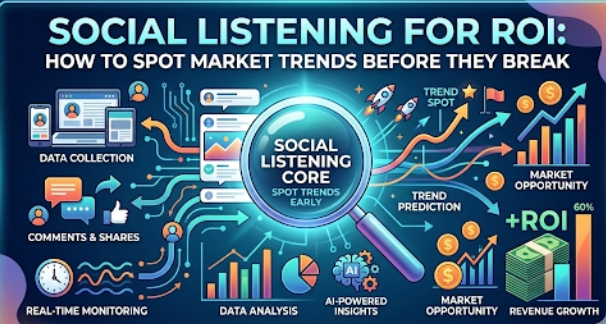
Social Listening for ROI: How to Spot Market Trends Before They Break
Posted on 08/03/2026 09:12:16
Audience: 236
Share with friends on:
In the competitive economy of the twenty-first century, the difference between a brand that leads a market trend and one that merely reacts to it is rarely a matter of luck. It is almost always a matter of information — specifically, who gathered the right signals, interpreted them correctly, and acted on them before the window of advantage closed. For most of the twentieth century, that information advantage belonged to whoever could afford the most sophisticated market research: expensive consumer surveys, focus groups, proprietary analyst reports, and retail scanner data that arrived weeks or months after the purchasing behavior it was meant to describe. The democratization of social media has fundamentally disrupted that equation. Billions of people now volunteer, in real time and in their own words, exactly what they want, what they resent, what they are excited about, and what they are about to buy — and the organizations that have mastered the discipline of social listening are converting that torrent of unstructured human expression into some of the most actionable market intelligence ever assembled.
Social listening, as a practice, is frequently confused with social monitoring, and the distinction matters enormously for anyone hoping to generate real return on investment from the discipline. Social monitoring is reactive — it tracks mentions of a brand, flags customer complaints, and measures engagement metrics on published content. It is a rearview mirror. Social listening is fundamentally forward-looking. It involves the systematic analysis of online conversations across social media platforms, forums, review sites, podcasts, news comment sections, and increasingly the dark social channels of private messaging groups, with the explicit goal of identifying patterns in public sentiment that anticipate shifts in consumer behavior, competitive positioning, or cultural mood before those shifts are visible in conventional market data. Where monitoring asks "what are people saying about us," listening asks the considerably more valuable question: "what are people saying that will eventually change the market we operate in?" The former is a customer service function. The latter is a strategic intelligence function, and the organizations treating it as such are building durable competitive advantages that their competitors are often not even aware they are losing.
The mechanics of effective social listening begin with the architecture of what practitioners call a listening taxonomy — the structured set of keywords, phrases, hashtags, topics, and competitor names that define the boundaries of what the system is designed to capture. A poorly constructed taxonomy produces data that is simultaneously overwhelming in volume and useless in specificity, drowning analysts in noise while the genuinely significant signals pass undetected. A well-constructed one is dynamic rather than static, expanding and contracting as the cultural conversation evolves, and sophisticated enough to capture not just explicit brand mentions but the adjacent conversations that indicate emerging needs the market has not yet articulated in product terms. A beverage company that only listens for mentions of its own brand and its direct competitors will miss the early-stage conversation about a new dietary philosophy that is quietly reshaping what millions of consumers want to drink — conversations happening in fitness communities, wellness subreddits, and nutrition-focused TikTok comment sections months before they crystallize into purchasing behavior that shows up in sales data.
The temporal dimension of social listening is what gives it its distinctive strategic value, and understanding how trend signals move through the information ecosystem is essential to exploiting that value. Cultural and market trends do not emerge spontaneously at scale — they originate in small, highly engaged communities and propagate outward through a predictable sequence of adoption stages before reaching mass-market awareness. Researchers and practitioners have mapped this diffusion process with considerable precision: a behavioral or aesthetic trend typically surfaces first in niche online communities — specialized subreddits, Discord servers, independent blogs, and the comment sections of micro-influencer content — where it exists as what the trend forecasting world calls a "weak signal." At this stage, the absolute volume of conversation is low enough that conventional monitoring tools, calibrated to flag high-volume spikes, will not register it at all. But the intensity of engagement within the niche community — the passion, the specificity, the language innovation, the rate at which the conversation is accelerating rather than merely persisting — contains predictive information about whether the trend will remain subcultural or cross into mainstream adoption. Organizations with social listening infrastructure sensitive enough to detect and correctly evaluate these weak signals are operating with an intelligence advantage of anywhere from three months to two years over competitors who only recognize a trend once it has reached the volume threshold of mass-market discourse, at which point the opportunity for early-mover advantage has long expired.
Translating raw listening data into genuine return on investment requires an analytical framework that connects sentiment signals to specific business decisions with sufficient rigor to justify the investment and to learn from both the successes and the failures. The most effective organizations using social listening for ROI have built what amount to internal trend validation protocols — staged processes in which a signal identified through listening is cross-referenced against search volume trends, e-commerce pattern data, supply chain inquiry rates, and if available, proprietary customer data before resources are committed to acting on it. This multi-source corroboration discipline is critical because social media conversations are susceptible to distortions that can mislead a listening program into false positives: bot-amplified discourse, coordinated promotional campaigns masquerading as organic conversation, and the tendency of highly vocal online minorities to appear representative of broader consumer populations when they are not. A spike in conversation volume about a product category may reflect genuine emerging demand, a journalist's viral article, or a coordinated marketing push by a competitor — and the business decisions appropriate to each of those explanations are entirely different. The organizations that generate the highest ROI from social listening are those that treat it not as an oracle but as one layer of a multi-dimensional intelligence system, powerful precisely because of what it captures that other data sources cannot, but always interpreted in dialogue with other evidence.
The competitive intelligence dimension of social listening deserves particular attention because it represents one of the discipline's most underutilized and highest-value applications. Most organizations, when they think about monitoring competitors, focus on tracking the content their rivals publish and the engagement those posts receive — a form of competitive awareness that reveals nothing more than what the competitor has chosen to make publicly visible about their strategy. Social listening inverts this dynamic entirely. By monitoring the conversations happening around a competitor's brand rather than the conversations the competitor is itself generating, a sophisticated listener can detect early warning signs of competitive moves, product launches, partnership discussions, and emerging customer dissatisfaction that the competitor has not chosen to advertise. An unusual cluster of conversations among logistics professionals about a competitor's new fulfillment center. A surge in questions on industry forums about a technical capability that the competitor is rumored to be building. A pattern of sentiment shift in a competitor's customer base that suggests a product quality issue not yet acknowledged publicly. Each of these signals, identified early through disciplined social listening, represents an opportunity to either accelerate a competitive response or exploit a vulnerability that would otherwise go unnoticed until it was too late to respond effectively.
The role of artificial intelligence in social listening has advanced the discipline from a labor-intensive manual process to something approaching real-time strategic intelligence at scale, but it has also introduced a new category of analytical risk that practitioners must understand clearly. Natural language processing models have dramatically improved the accuracy of sentiment analysis, the ability to detect sarcasm and irony that defeated earlier generation tools, and the capacity to cluster thematically related conversations that use different vocabulary — a particular challenge in multilingual listening programs where the same emerging trend may be expressed in a dozen different languages simultaneously. Generative AI tools are now being used to synthesize large bodies of listening data into narrative intelligence summaries that non-specialist executives can act upon, compressing what was once a multi-day analyst task into something closer to a continuous feed. But these same AI systems can amplify biases present in their training data, misinterpret cultural context in communities they were not trained to understand, and produce fluent-sounding analytical narratives that are confidently wrong in ways that are difficult to detect without deep subject matter expertise. The efficiency gains from AI-powered social listening are real and substantial; the interpretive responsibility remains firmly human.
Ultimately, the organizations that generate the most durable ROI from social listening are those that have embedded it not as a marketing department function but as an enterprise-wide intelligence capability with direct lines to product development, supply chain planning, investor relations, and executive decision-making. The companies that launched plant-based product lines ahead of the mainstream vegan boom, that repositioned supply chains ahead of tariff shifts that were telegraphed months in advance in trade policy forums, that discontinued products quietly accumulating negative sentiment before that sentiment crystallized into public brand damage — these outcomes were not accidents of intuition. They were the product of organizations that had learned to treat the internet's endless, unfiltered human conversation not as noise to be managed but as signal to be understood. In a market environment where the speed of cultural change consistently outpaces the refresh cycle of traditional research methods, the ability to hear what the market is whispering before it begins to shout is not a marginal advantage. It is, increasingly, the difference between leading an industry and scrambling to catch up with one.
Social listening, as a practice, is frequently confused with social monitoring, and the distinction matters enormously for anyone hoping to generate real return on investment from the discipline. Social monitoring is reactive — it tracks mentions of a brand, flags customer complaints, and measures engagement metrics on published content. It is a rearview mirror. Social listening is fundamentally forward-looking. It involves the systematic analysis of online conversations across social media platforms, forums, review sites, podcasts, news comment sections, and increasingly the dark social channels of private messaging groups, with the explicit goal of identifying patterns in public sentiment that anticipate shifts in consumer behavior, competitive positioning, or cultural mood before those shifts are visible in conventional market data. Where monitoring asks "what are people saying about us," listening asks the considerably more valuable question: "what are people saying that will eventually change the market we operate in?" The former is a customer service function. The latter is a strategic intelligence function, and the organizations treating it as such are building durable competitive advantages that their competitors are often not even aware they are losing.
The mechanics of effective social listening begin with the architecture of what practitioners call a listening taxonomy — the structured set of keywords, phrases, hashtags, topics, and competitor names that define the boundaries of what the system is designed to capture. A poorly constructed taxonomy produces data that is simultaneously overwhelming in volume and useless in specificity, drowning analysts in noise while the genuinely significant signals pass undetected. A well-constructed one is dynamic rather than static, expanding and contracting as the cultural conversation evolves, and sophisticated enough to capture not just explicit brand mentions but the adjacent conversations that indicate emerging needs the market has not yet articulated in product terms. A beverage company that only listens for mentions of its own brand and its direct competitors will miss the early-stage conversation about a new dietary philosophy that is quietly reshaping what millions of consumers want to drink — conversations happening in fitness communities, wellness subreddits, and nutrition-focused TikTok comment sections months before they crystallize into purchasing behavior that shows up in sales data.
The temporal dimension of social listening is what gives it its distinctive strategic value, and understanding how trend signals move through the information ecosystem is essential to exploiting that value. Cultural and market trends do not emerge spontaneously at scale — they originate in small, highly engaged communities and propagate outward through a predictable sequence of adoption stages before reaching mass-market awareness. Researchers and practitioners have mapped this diffusion process with considerable precision: a behavioral or aesthetic trend typically surfaces first in niche online communities — specialized subreddits, Discord servers, independent blogs, and the comment sections of micro-influencer content — where it exists as what the trend forecasting world calls a "weak signal." At this stage, the absolute volume of conversation is low enough that conventional monitoring tools, calibrated to flag high-volume spikes, will not register it at all. But the intensity of engagement within the niche community — the passion, the specificity, the language innovation, the rate at which the conversation is accelerating rather than merely persisting — contains predictive information about whether the trend will remain subcultural or cross into mainstream adoption. Organizations with social listening infrastructure sensitive enough to detect and correctly evaluate these weak signals are operating with an intelligence advantage of anywhere from three months to two years over competitors who only recognize a trend once it has reached the volume threshold of mass-market discourse, at which point the opportunity for early-mover advantage has long expired.
Translating raw listening data into genuine return on investment requires an analytical framework that connects sentiment signals to specific business decisions with sufficient rigor to justify the investment and to learn from both the successes and the failures. The most effective organizations using social listening for ROI have built what amount to internal trend validation protocols — staged processes in which a signal identified through listening is cross-referenced against search volume trends, e-commerce pattern data, supply chain inquiry rates, and if available, proprietary customer data before resources are committed to acting on it. This multi-source corroboration discipline is critical because social media conversations are susceptible to distortions that can mislead a listening program into false positives: bot-amplified discourse, coordinated promotional campaigns masquerading as organic conversation, and the tendency of highly vocal online minorities to appear representative of broader consumer populations when they are not. A spike in conversation volume about a product category may reflect genuine emerging demand, a journalist's viral article, or a coordinated marketing push by a competitor — and the business decisions appropriate to each of those explanations are entirely different. The organizations that generate the highest ROI from social listening are those that treat it not as an oracle but as one layer of a multi-dimensional intelligence system, powerful precisely because of what it captures that other data sources cannot, but always interpreted in dialogue with other evidence.
The competitive intelligence dimension of social listening deserves particular attention because it represents one of the discipline's most underutilized and highest-value applications. Most organizations, when they think about monitoring competitors, focus on tracking the content their rivals publish and the engagement those posts receive — a form of competitive awareness that reveals nothing more than what the competitor has chosen to make publicly visible about their strategy. Social listening inverts this dynamic entirely. By monitoring the conversations happening around a competitor's brand rather than the conversations the competitor is itself generating, a sophisticated listener can detect early warning signs of competitive moves, product launches, partnership discussions, and emerging customer dissatisfaction that the competitor has not chosen to advertise. An unusual cluster of conversations among logistics professionals about a competitor's new fulfillment center. A surge in questions on industry forums about a technical capability that the competitor is rumored to be building. A pattern of sentiment shift in a competitor's customer base that suggests a product quality issue not yet acknowledged publicly. Each of these signals, identified early through disciplined social listening, represents an opportunity to either accelerate a competitive response or exploit a vulnerability that would otherwise go unnoticed until it was too late to respond effectively.
The role of artificial intelligence in social listening has advanced the discipline from a labor-intensive manual process to something approaching real-time strategic intelligence at scale, but it has also introduced a new category of analytical risk that practitioners must understand clearly. Natural language processing models have dramatically improved the accuracy of sentiment analysis, the ability to detect sarcasm and irony that defeated earlier generation tools, and the capacity to cluster thematically related conversations that use different vocabulary — a particular challenge in multilingual listening programs where the same emerging trend may be expressed in a dozen different languages simultaneously. Generative AI tools are now being used to synthesize large bodies of listening data into narrative intelligence summaries that non-specialist executives can act upon, compressing what was once a multi-day analyst task into something closer to a continuous feed. But these same AI systems can amplify biases present in their training data, misinterpret cultural context in communities they were not trained to understand, and produce fluent-sounding analytical narratives that are confidently wrong in ways that are difficult to detect without deep subject matter expertise. The efficiency gains from AI-powered social listening are real and substantial; the interpretive responsibility remains firmly human.
Ultimately, the organizations that generate the most durable ROI from social listening are those that have embedded it not as a marketing department function but as an enterprise-wide intelligence capability with direct lines to product development, supply chain planning, investor relations, and executive decision-making. The companies that launched plant-based product lines ahead of the mainstream vegan boom, that repositioned supply chains ahead of tariff shifts that were telegraphed months in advance in trade policy forums, that discontinued products quietly accumulating negative sentiment before that sentiment crystallized into public brand damage — these outcomes were not accidents of intuition. They were the product of organizations that had learned to treat the internet's endless, unfiltered human conversation not as noise to be managed but as signal to be understood. In a market environment where the speed of cultural change consistently outpaces the refresh cycle of traditional research methods, the ability to hear what the market is whispering before it begins to shout is not a marginal advantage. It is, increasingly, the difference between leading an industry and scrambling to catch up with one.
Kindly join discussion on this topic on:
} Share with friends on:Related Posts
- Conversational Keywords: Writing for Natural Language Processing
- Trade Resilience: Data on Front-Loaded Shipments and New Bilateral Trade Deals
- Venture Capital in 2026: The Shift from "Growth at All Costs" to "Unit Economics"
- What Is the Force Majeure Clause Released in Bahrain Amidst the US-Israeli-Iranian Conflict
- E-Commerce Integration: Taking Your Local Trade to a Global Audience
- Authoritative Content: How to Become a Primary Source for AI Models
- Interoperability: Connecting Private Blockchains with Public Liquidity
- Smart Cities or Gated Communities? The Social Impact of Tech-Driven Urban Planning
- Agricultural Yields: Impact of Climate-Related Shocks on Global Food Security
- AI Wallets: Self-Managing Digital Assets with Zero-Human Intervention