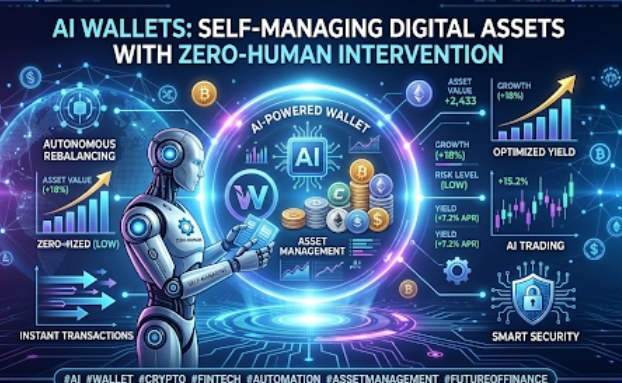
AI Wallets: Self-Managing Digital Assets with Zero-Human Intervention
Posted on 08/03/2026 08:15:39
Audience: 200
Share with friends on:
The history of personal finance has always been a story of delegation. Humans have long entrusted the management of their wealth to intermediaries — bankers, brokers, financial advisors — because the complexity of markets, tax codes, and investment instruments long ago outpaced what any individual could reasonably track alone. Digital technology compressed that delegation, giving retail investors dashboards, robo-advisors, and algorithmic trading tools that brought a measure of automation to portfolio management. But the emergence of artificial intelligence-powered wallets represents something qualitatively different from anything that came before. These are not tools that assist human decision-making — they are systems designed to make decisions, execute transactions, manage risk, and optimize holdings entirely on their own, with the human owner functioning less as a manager and more as a passive beneficiary of an autonomous financial agent.
To understand what AI wallets actually do, it helps to distinguish them from their predecessors. A traditional crypto wallet is essentially a secure key-storage mechanism — it holds credentials that prove ownership of digital assets but does nothing with those assets unless the owner instructs it to. A robo-advisor, one step further along, applies rule-based automation to rebalance a portfolio according to parameters the user sets at the outset. An AI wallet goes several steps beyond both. Using large language models, reinforcement learning, and real-time data feeds that span blockchain activity, market sentiment, macroeconomic indicators, and even social media signals, these systems continuously evaluate an asset portfolio, identify opportunities and threats, and execute trades, yield farming strategies, staking decisions, and liquidity provisions — all without waiting for a human to review or approve each action. Projects like Brian, Numerai's Erasure protocol, and a growing ecosystem of autonomous DeFi agents have already demonstrated versions of this capability, while major financial institutions are quietly racing to build proprietary equivalents for traditional asset classes.
The appeal of zero-human-intervention asset management is not difficult to articulate. Markets do not close at five o'clock, and the cryptocurrency ecosystem in particular operates in a state of perpetual, global activity that no human investor can monitor continuously. Arbitrage windows open and close in milliseconds. Yield rates on decentralized lending protocols shift hourly. Liquidation cascades can erase leveraged positions before a sleeping investor ever receives a notification. An AI wallet that never sleeps, never panics, never second-guesses itself in the grip of loss aversion, and can process thousands of data signals simultaneously is theoretically a far more disciplined and responsive asset manager than any human — not because it is smarter in any philosophical sense, but because it is faster, more consistent, and immune to the cognitive biases that reliably cost human investors money. Behavioral finance has spent decades cataloguing the ways emotion corrupts financial decision-making; an AI wallet, in theory, simply removes emotion from the equation entirely.
The technical architecture underpinning these systems reveals both their sophistication and their fragility. Modern AI wallets typically operate through a combination of on-chain smart contracts and off-chain intelligence layers. The smart contract handles execution — it is the mechanism that actually moves assets, interacts with decentralized exchanges, and enforces the rules of a given strategy. The AI layer, operating off-chain, functions as the strategic brain, analyzing conditions and sending signed instructions to the smart contract when its models determine that action is warranted. This separation of intelligence and execution creates a system that is transparent in its actions — everything recorded immutably on a public blockchain — but opaque in its reasoning, since the neural networks and reinforcement learning models driving decisions are not legible to outside observers in the way that a human trader explaining their thesis would be. This opacity is not a minor concern. When an AI wallet makes a catastrophic error — and they do, as the collapse of several algorithmic stablecoin systems and DeFi liquidation events have demonstrated — reconstructing why the system behaved as it did is an enormously difficult forensic exercise.
Security considerations in fully autonomous wallets occupy a category of risk that has no clean precedent in traditional finance. When a human financial advisor makes a negligent decision, there are legal frameworks, regulatory bodies, and liability structures designed to provide recourse. When an AI wallet drains its own holdings through a miscalibrated strategy, executes a transaction into a malicious smart contract, or is manipulated by a carefully crafted market signal designed to exploit its decision logic — a technique researchers call adversarial attacks on financial AI — the owner's options for remedy are limited. Blockchain transactions are, by design, irreversible. There is no fraud department to call, no chargeback mechanism, no regulator with jurisdiction over a decentralized protocol operating across a dozen blockchain networks simultaneously. The promise of trustless, permissionless finance is also, in this context, a warning: the absence of intermediaries means the absence of safety nets. Insurance products for AI-managed digital asset losses are nascent at best, and the legal question of who bears liability when an autonomous system causes financial harm — the developer, the deployer, the owner who granted it autonomy — remains almost entirely unsettled.
Regulatory frameworks around the world are only beginning to grapple with the implications of fully autonomous financial agents. Most existing securities law is premised on the assumption that a human being, or at minimum a human-controlled algorithm with documented and auditable logic, is responsible for investment decisions. An AI wallet that genuinely operates without human intervention in real time challenges that premise at its foundation. The European Union's AI Act and the United States Securities and Exchange Commission's evolving guidance on algorithmic trading both gesture toward requirements for human oversight and explainability in high-stakes automated systems, but neither framework was written with fully autonomous DeFi agents in mind. What constitutes a "security" when assets are being managed by a system with no legal personhood? Who must register as an investment adviser when the adviser is a transformer model running on a decentralized compute network? These questions are not hypothetical — they are live legal debates that will shape whether AI wallets scale into the mainstream financial system or remain confined to the regulatory gray zones of decentralized finance.
Perhaps the deepest tension in the AI wallet paradigm is philosophical rather than technical or regulatory. The entire promise rests on a willingness to surrender not just operational control but meaningful oversight — to trust a system whose reasoning is opaque, whose error modes are poorly understood, and whose performance in tail-risk scenarios has no long track record. Human investors have always outsourced execution to some degree, but they have rarely outsourced judgment entirely, and the few historical experiments in doing so — Long-Term Capital Management's model-driven near-collapse in 1998, the Flash Crash of 2010, the cascade failures of algorithmic stablecoins in 2022 — serve as sobering reminders that automated financial systems tend to perform brilliantly in the conditions they were designed for and catastrophically in the conditions they were not. An AI wallet trained on data from a bull market may not have learned anything useful about how to preserve capital in a regime it has never seen. The confidence of the system and the confidence of the owner in the system are not the same thing as competence.
None of this forecloses the transformative potential of AI-managed digital assets. The technology is genuinely powerful, the inefficiencies it targets are real, and the long-term trajectory of financial services has consistently moved toward greater automation with each successive technological generation. The wallets that will ultimately earn broad trust are likely those that embrace a graduated model of autonomy — operating independently within defined parameters, surfacing decisions above certain thresholds for human review, maintaining auditable logs of their reasoning processes, and carrying insurance or collateral structures that protect owners against catastrophic failure. Full autonomy may be the destination, but the path to it runs through accountability. The most transformative thing an AI wallet can do right now is not to eliminate the human from the equation entirely, but to earn, incrementally and transparently, the right to act alone.
To understand what AI wallets actually do, it helps to distinguish them from their predecessors. A traditional crypto wallet is essentially a secure key-storage mechanism — it holds credentials that prove ownership of digital assets but does nothing with those assets unless the owner instructs it to. A robo-advisor, one step further along, applies rule-based automation to rebalance a portfolio according to parameters the user sets at the outset. An AI wallet goes several steps beyond both. Using large language models, reinforcement learning, and real-time data feeds that span blockchain activity, market sentiment, macroeconomic indicators, and even social media signals, these systems continuously evaluate an asset portfolio, identify opportunities and threats, and execute trades, yield farming strategies, staking decisions, and liquidity provisions — all without waiting for a human to review or approve each action. Projects like Brian, Numerai's Erasure protocol, and a growing ecosystem of autonomous DeFi agents have already demonstrated versions of this capability, while major financial institutions are quietly racing to build proprietary equivalents for traditional asset classes.
The appeal of zero-human-intervention asset management is not difficult to articulate. Markets do not close at five o'clock, and the cryptocurrency ecosystem in particular operates in a state of perpetual, global activity that no human investor can monitor continuously. Arbitrage windows open and close in milliseconds. Yield rates on decentralized lending protocols shift hourly. Liquidation cascades can erase leveraged positions before a sleeping investor ever receives a notification. An AI wallet that never sleeps, never panics, never second-guesses itself in the grip of loss aversion, and can process thousands of data signals simultaneously is theoretically a far more disciplined and responsive asset manager than any human — not because it is smarter in any philosophical sense, but because it is faster, more consistent, and immune to the cognitive biases that reliably cost human investors money. Behavioral finance has spent decades cataloguing the ways emotion corrupts financial decision-making; an AI wallet, in theory, simply removes emotion from the equation entirely.
The technical architecture underpinning these systems reveals both their sophistication and their fragility. Modern AI wallets typically operate through a combination of on-chain smart contracts and off-chain intelligence layers. The smart contract handles execution — it is the mechanism that actually moves assets, interacts with decentralized exchanges, and enforces the rules of a given strategy. The AI layer, operating off-chain, functions as the strategic brain, analyzing conditions and sending signed instructions to the smart contract when its models determine that action is warranted. This separation of intelligence and execution creates a system that is transparent in its actions — everything recorded immutably on a public blockchain — but opaque in its reasoning, since the neural networks and reinforcement learning models driving decisions are not legible to outside observers in the way that a human trader explaining their thesis would be. This opacity is not a minor concern. When an AI wallet makes a catastrophic error — and they do, as the collapse of several algorithmic stablecoin systems and DeFi liquidation events have demonstrated — reconstructing why the system behaved as it did is an enormously difficult forensic exercise.
Security considerations in fully autonomous wallets occupy a category of risk that has no clean precedent in traditional finance. When a human financial advisor makes a negligent decision, there are legal frameworks, regulatory bodies, and liability structures designed to provide recourse. When an AI wallet drains its own holdings through a miscalibrated strategy, executes a transaction into a malicious smart contract, or is manipulated by a carefully crafted market signal designed to exploit its decision logic — a technique researchers call adversarial attacks on financial AI — the owner's options for remedy are limited. Blockchain transactions are, by design, irreversible. There is no fraud department to call, no chargeback mechanism, no regulator with jurisdiction over a decentralized protocol operating across a dozen blockchain networks simultaneously. The promise of trustless, permissionless finance is also, in this context, a warning: the absence of intermediaries means the absence of safety nets. Insurance products for AI-managed digital asset losses are nascent at best, and the legal question of who bears liability when an autonomous system causes financial harm — the developer, the deployer, the owner who granted it autonomy — remains almost entirely unsettled.
Regulatory frameworks around the world are only beginning to grapple with the implications of fully autonomous financial agents. Most existing securities law is premised on the assumption that a human being, or at minimum a human-controlled algorithm with documented and auditable logic, is responsible for investment decisions. An AI wallet that genuinely operates without human intervention in real time challenges that premise at its foundation. The European Union's AI Act and the United States Securities and Exchange Commission's evolving guidance on algorithmic trading both gesture toward requirements for human oversight and explainability in high-stakes automated systems, but neither framework was written with fully autonomous DeFi agents in mind. What constitutes a "security" when assets are being managed by a system with no legal personhood? Who must register as an investment adviser when the adviser is a transformer model running on a decentralized compute network? These questions are not hypothetical — they are live legal debates that will shape whether AI wallets scale into the mainstream financial system or remain confined to the regulatory gray zones of decentralized finance.
Perhaps the deepest tension in the AI wallet paradigm is philosophical rather than technical or regulatory. The entire promise rests on a willingness to surrender not just operational control but meaningful oversight — to trust a system whose reasoning is opaque, whose error modes are poorly understood, and whose performance in tail-risk scenarios has no long track record. Human investors have always outsourced execution to some degree, but they have rarely outsourced judgment entirely, and the few historical experiments in doing so — Long-Term Capital Management's model-driven near-collapse in 1998, the Flash Crash of 2010, the cascade failures of algorithmic stablecoins in 2022 — serve as sobering reminders that automated financial systems tend to perform brilliantly in the conditions they were designed for and catastrophically in the conditions they were not. An AI wallet trained on data from a bull market may not have learned anything useful about how to preserve capital in a regime it has never seen. The confidence of the system and the confidence of the owner in the system are not the same thing as competence.
None of this forecloses the transformative potential of AI-managed digital assets. The technology is genuinely powerful, the inefficiencies it targets are real, and the long-term trajectory of financial services has consistently moved toward greater automation with each successive technological generation. The wallets that will ultimately earn broad trust are likely those that embrace a graduated model of autonomy — operating independently within defined parameters, surfacing decisions above certain thresholds for human review, maintaining auditable logs of their reasoning processes, and carrying insurance or collateral structures that protect owners against catastrophic failure. Full autonomy may be the destination, but the path to it runs through accountability. The most transformative thing an AI wallet can do right now is not to eliminate the human from the equation entirely, but to earn, incrementally and transparently, the right to act alone.
Kindly join discussion on this topic on:
} Share with friends on:Related Posts
- Conversational Keywords: Writing for Natural Language Processing
- Trade Resilience: Data on Front-Loaded Shipments and New Bilateral Trade Deals
- Venture Capital in 2026: The Shift from "Growth at All Costs" to "Unit Economics"
- What Is the Force Majeure Clause Released in Bahrain Amidst the US-Israeli-Iranian Conflict
- E-Commerce Integration: Taking Your Local Trade to a Global Audience
- Authoritative Content: How to Become a Primary Source for AI Models
- Interoperability: Connecting Private Blockchains with Public Liquidity
- Smart Cities or Gated Communities? The Social Impact of Tech-Driven Urban Planning
- Social Listening for ROI: How to Spot Market Trends Before They Break
- Agricultural Yields: Impact of Climate-Related Shocks on Global Food Security