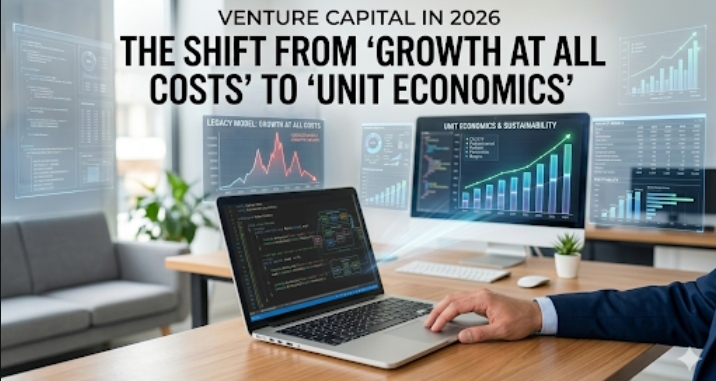
Venture Capital in 2026: The Shift from "Growth at All Costs" to "Unit Economics"
Posted on 09/03/2026 12:41:55
Audience: 236
Share with friends on:
The venture capital landscape of 2026 bears little resemblance to the frenzied, valuations-first culture that defined the decade before it. What was once a gold rush mentality — pour capital in, scale fast, sort out profitability later — has given way to a more disciplined, almost clinical approach to deploying money. The transformation did not happen overnight. It was the cumulative result of rising interest rates, a brutal correction in public markets, a graveyard of once-celebrated unicorns, and a generation of limited partners who finally ran out of patience for promises dressed up as progress. In 2026, the central question a venture investor asks is no longer "how fast can this company grow?" but rather "how much does it actually cost to grow?"
The concept of unit economics — long a staple of business school curricula but historically treated as an afterthought in Silicon Valley pitch meetings — has become the new lingua franca of the startup ecosystem. Customer acquisition cost, lifetime value, gross margin, payback period: these were once metrics you buried in the appendix of a deck. Today they sit front and center, and founders who cannot speak fluently about them tend to leave partner meetings empty-handed. The shift reflects a broader recalibration of what sophistication looks like in early-stage investing. For years, velocity of growth served as a proxy for quality. Now investors have come to understand that rapid expansion built on poor unit economics is not a business being built — it is a subsidy being paid to customers at the expense of LPs.
This philosophical pivot has reshaped the relationship between venture capitalists and the companies they back. In the era of "growth at all costs," VCs often pushed founders to spend aggressively, open new markets simultaneously, and prioritize top-line revenue above nearly everything else. The implicit logic was that scale created defensibility — that once a company was large enough, the economics would inevitably follow. That logic proved catastrophically wrong for dozens of high-profile companies that found themselves with enormous revenues, enormous losses, and no credible path to profitability. When the capital markets tightened and the IPO window narrowed, those companies had nowhere to turn. Founders who had been celebrated as visionaries were suddenly recast as cautionary tales. The lesson was not lost on investors who had backed them.
What emerged in place of that model is something closer to what traditional private equity always demanded: a coherent theory of the business that connects revenue to margin to cash flow in a way that actually closes. Funds that once prided themselves on backing "category creators" regardless of near-term economics have quietly recalibrated their investment criteria. Seed rounds that might have been raised in 2021 on little more than a slide deck and a compelling narrative now require evidence of early retention, some signal of organic demand, and at minimum a plausible story about where gross margins land at scale. This is not to say that ambition is no longer valued — it is — but ambition without a unit economic foundation now reads as naivety rather than boldness.
The ripple effects of this shift have been profound across the entire startup lifecycle. At the earliest stages, founders are raising smaller rounds with tighter milestones, choosing to grow more deliberately rather than burning toward an arbitrary ARR target set to justify the next valuation step-up. At the growth stage, the bar for a Series B or C has risen dramatically; a company scaling at 80% year-over-year with mediocre margins and high churn now struggles to raise where it once would have been celebrated. And at the pre-IPO stage, public market investors — burned by the cohort of 2020 and 2021 listings that crumbled within 18 months — are demanding not just profitability but demonstrated, durable profitability, not the adjusted, non-GAAP variety that once satisfied analysts on roadshows.
Artificial intelligence has added an interesting wrinkle to all of this. The explosion of AI-native startups has attracted enormous capital, and for a moment it seemed as though the old patterns might reassert themselves — valuations disconnecting from fundamentals, competition collapsing margins, investors willing to fund growth without scrutiny because the technology seemed too important to miss. But even within AI, 2026 has brought a measure of discipline that was absent in 2023 and 2024. Investors have grown acutely aware of the infrastructure costs embedded in AI-native products, and the question of whether AI companies can achieve the kind of gross margins that justify software-like valuations has become a live and uncomfortable debate. The best AI founders are now modeling compute costs as a core strategic variable, not a line item to optimize later.
Perhaps the most durable consequence of this era is what it has done to the culture of the startup ecosystem itself. Founders who entered the industry in the last four years have been shaped by a fundamentally different set of incentives than those who came up during the zero-interest-rate boom. Frugality is no longer a sign of insufficient ambition; in many circles, it has become a mark of sophistication. The founder who can get to meaningful revenue on a lean team, demonstrate strong retention, and show a clear line to cash flow efficiency commands a different kind of respect than the one who raised $50 million and built a headcount-heavy organization chasing growth. This cultural shift, more than any regulatory change or macroeconomic force, may be the lasting legacy of venture capital's painful but necessary correction — a return to the foundational idea that a great business must, eventually, make more money than it spends.
The concept of unit economics — long a staple of business school curricula but historically treated as an afterthought in Silicon Valley pitch meetings — has become the new lingua franca of the startup ecosystem. Customer acquisition cost, lifetime value, gross margin, payback period: these were once metrics you buried in the appendix of a deck. Today they sit front and center, and founders who cannot speak fluently about them tend to leave partner meetings empty-handed. The shift reflects a broader recalibration of what sophistication looks like in early-stage investing. For years, velocity of growth served as a proxy for quality. Now investors have come to understand that rapid expansion built on poor unit economics is not a business being built — it is a subsidy being paid to customers at the expense of LPs.
This philosophical pivot has reshaped the relationship between venture capitalists and the companies they back. In the era of "growth at all costs," VCs often pushed founders to spend aggressively, open new markets simultaneously, and prioritize top-line revenue above nearly everything else. The implicit logic was that scale created defensibility — that once a company was large enough, the economics would inevitably follow. That logic proved catastrophically wrong for dozens of high-profile companies that found themselves with enormous revenues, enormous losses, and no credible path to profitability. When the capital markets tightened and the IPO window narrowed, those companies had nowhere to turn. Founders who had been celebrated as visionaries were suddenly recast as cautionary tales. The lesson was not lost on investors who had backed them.
What emerged in place of that model is something closer to what traditional private equity always demanded: a coherent theory of the business that connects revenue to margin to cash flow in a way that actually closes. Funds that once prided themselves on backing "category creators" regardless of near-term economics have quietly recalibrated their investment criteria. Seed rounds that might have been raised in 2021 on little more than a slide deck and a compelling narrative now require evidence of early retention, some signal of organic demand, and at minimum a plausible story about where gross margins land at scale. This is not to say that ambition is no longer valued — it is — but ambition without a unit economic foundation now reads as naivety rather than boldness.
The ripple effects of this shift have been profound across the entire startup lifecycle. At the earliest stages, founders are raising smaller rounds with tighter milestones, choosing to grow more deliberately rather than burning toward an arbitrary ARR target set to justify the next valuation step-up. At the growth stage, the bar for a Series B or C has risen dramatically; a company scaling at 80% year-over-year with mediocre margins and high churn now struggles to raise where it once would have been celebrated. And at the pre-IPO stage, public market investors — burned by the cohort of 2020 and 2021 listings that crumbled within 18 months — are demanding not just profitability but demonstrated, durable profitability, not the adjusted, non-GAAP variety that once satisfied analysts on roadshows.
Artificial intelligence has added an interesting wrinkle to all of this. The explosion of AI-native startups has attracted enormous capital, and for a moment it seemed as though the old patterns might reassert themselves — valuations disconnecting from fundamentals, competition collapsing margins, investors willing to fund growth without scrutiny because the technology seemed too important to miss. But even within AI, 2026 has brought a measure of discipline that was absent in 2023 and 2024. Investors have grown acutely aware of the infrastructure costs embedded in AI-native products, and the question of whether AI companies can achieve the kind of gross margins that justify software-like valuations has become a live and uncomfortable debate. The best AI founders are now modeling compute costs as a core strategic variable, not a line item to optimize later.
Perhaps the most durable consequence of this era is what it has done to the culture of the startup ecosystem itself. Founders who entered the industry in the last four years have been shaped by a fundamentally different set of incentives than those who came up during the zero-interest-rate boom. Frugality is no longer a sign of insufficient ambition; in many circles, it has become a mark of sophistication. The founder who can get to meaningful revenue on a lean team, demonstrate strong retention, and show a clear line to cash flow efficiency commands a different kind of respect than the one who raised $50 million and built a headcount-heavy organization chasing growth. This cultural shift, more than any regulatory change or macroeconomic force, may be the lasting legacy of venture capital's painful but necessary correction — a return to the foundational idea that a great business must, eventually, make more money than it spends.
Kindly join discussion on this topic on:
} Share with friends on:Related Posts
- Conversational Keywords: Writing for Natural Language Processing
- Trade Resilience: Data on Front-Loaded Shipments and New Bilateral Trade Deals
- What Is the Force Majeure Clause Released in Bahrain Amidst the US-Israeli-Iranian Conflict
- E-Commerce Integration: Taking Your Local Trade to a Global Audience
- Authoritative Content: How to Become a Primary Source for AI Models
- Interoperability: Connecting Private Blockchains with Public Liquidity
- Smart Cities or Gated Communities? The Social Impact of Tech-Driven Urban Planning
- Social Listening for ROI: How to Spot Market Trends Before They Break
- Agricultural Yields: Impact of Climate-Related Shocks on Global Food Security
- AI Wallets: Self-Managing Digital Assets with Zero-Human Intervention