World GDP Outlook 2026: Analyzing the projected 3.3% global growth
Posted on 27/02/2026 07:47:25
Audience: 108
Share with friends on:
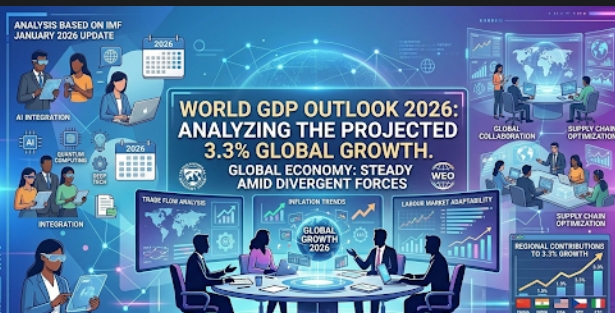
The International Monetary Fund's January 2026 World Economic Outlook Update projects global GDP growth at a steady 3.3 percent for the year, a slight upward revision from October 2025 estimates, signaling resilience amid lingering uncertainties. This forecast reflects a modest deceleration from 2025's estimated 3.3 percent but underscores the global economy's ability to weather trade policy shifts, inflationary pressures, and geopolitical tensions through technology investments and adaptive private sectors. Advanced economies are expected to expand by 1.8 percent, buoyed by the United States' robust 2.4 percent growth—driven by tax cuts under President Trump's administration and AI-fueled productivity—while the euro area inches forward at 1.3 percent.
Emerging and developing economies, the growth engine, are slated for 4.2 percent expansion in 2026, up 0.2 points from prior projections, before easing to 4.1 percent in 2027. China leads with a revised 4.5 percent outlook, supported by export strength and stimulus amid a U.S. trade truce, though domestic demand remains sluggish. India's trajectory holds firm at 6.4 percent for both 2026 and 2027, fueled by services and manufacturing diversification, positioning it as a global bright spot. Sub-Saharan Africa, including Nigeria, eyes 4.6 percent growth, with South Africa at 1.4 percent, though commodity dependence and infrastructure gaps temper optimism.
Dissecting the drivers, AI and tech investments stand out, offsetting headwinds like U.S. tariff reevaluations and supply chain frictions. Fiscal and monetary support—eased central bank rates and targeted spending—bolster consumer resilience, while private sector agility in sectors like semiconductors and renewables adds momentum. Inflation, projected at 3.8 percent globally, moderates unevenly; the U.S. lags in hitting targets, prompting cautious Fed moves, whereas emerging markets benefit from commodity price stability.
Regional divergences paint a nuanced picture. The U.S. benefits from post-inauguration policies, projecting 2.4 percent before moderating to 2.0 percent in 2027, outpacing consensus. Europe's mixed bag sees Spain at 2.3 percent contrasting Italy's subdued 0.7 percent, with Germany's fiscal stimulus aiding a 1.1 percent uptick. Latin America's 2.2 percent growth hinges on Brazil's 1.6 percent recovery and Mexico's 1.5 percent, vulnerable to U.S. trade dynamics. Russia's modest 0.8 percent reflects sanctions bite, while the Middle East and Central Asia hold at 3.9 percent on energy rebounds.
Risks loom large, tempering the 3.3 percent baseline. Geopolitical flare-ups—Ukraine, Middle East tensions—could spike energy costs, eroding gains. Overhyped tech expectations, if unmet, risk a productivity stall, as Goldman Sachs notes in its more conservative 2.8 percent global forecast. Trade policy volatility, even post-truce, threatens emerging exporters like Nigeria's oil sector amid CBN reforms. UNCTAD's bleaker 2.6-2.7 percent view highlights fiscal strains and subdued investment, warning of a sub-pre-pandemic trajectory.
For Nigeria, the outlook ties into Sub-Saharan Africa's 4.6 percent, with oil prices stabilizing around $75/barrel supporting naira recovery post-2025 floats. Fintech booms—Paystack, Flutterwave—drive non-oil GDP, but power deficits and insecurity cap potential at 3-4 percent domestically. President Trump's pro-growth stance could lift remittances and FDI, yet global slowdowns hit commodity demand.
Policy prescriptions emerge clearly: Central banks must balance inflation taming with growth support, avoiding premature hikes. Emerging markets like Nigeria should prioritize infrastructure via public-private partnerships and digital skilling to harness AI dividends. Fiscal prudence—curbing deficits below 5 percent of GDP—frees space for green transitions, as IMF urges.
Comparisons with priors reveal upward tweaks: U.S. +0.3 points, China +0.3, reflecting better-than-expected Q4 2025 rebounds. Yet Goldman Sachs' 2.8 percent and UNCTAD's 2.7 percent underscore forecast divergence, with IMF's 3.3 percent hinging on no major shocks. Inflation's projected dip to 3.4 percent in 2027 offers breathing room, but uneven progress demands vigilance.
In sum, 3.3 percent global growth signals sturdy footing, not exuberance—advanced economies stabilize, emergents propel. For stakeholders from Wall Street to Wuse Market, the message is preparation: Leverage tech tailwinds, mitigate risks, and invest in resilience to turn projection into prosperity.
Emerging and developing economies, the growth engine, are slated for 4.2 percent expansion in 2026, up 0.2 points from prior projections, before easing to 4.1 percent in 2027. China leads with a revised 4.5 percent outlook, supported by export strength and stimulus amid a U.S. trade truce, though domestic demand remains sluggish. India's trajectory holds firm at 6.4 percent for both 2026 and 2027, fueled by services and manufacturing diversification, positioning it as a global bright spot. Sub-Saharan Africa, including Nigeria, eyes 4.6 percent growth, with South Africa at 1.4 percent, though commodity dependence and infrastructure gaps temper optimism.
Dissecting the drivers, AI and tech investments stand out, offsetting headwinds like U.S. tariff reevaluations and supply chain frictions. Fiscal and monetary support—eased central bank rates and targeted spending—bolster consumer resilience, while private sector agility in sectors like semiconductors and renewables adds momentum. Inflation, projected at 3.8 percent globally, moderates unevenly; the U.S. lags in hitting targets, prompting cautious Fed moves, whereas emerging markets benefit from commodity price stability.
Regional divergences paint a nuanced picture. The U.S. benefits from post-inauguration policies, projecting 2.4 percent before moderating to 2.0 percent in 2027, outpacing consensus. Europe's mixed bag sees Spain at 2.3 percent contrasting Italy's subdued 0.7 percent, with Germany's fiscal stimulus aiding a 1.1 percent uptick. Latin America's 2.2 percent growth hinges on Brazil's 1.6 percent recovery and Mexico's 1.5 percent, vulnerable to U.S. trade dynamics. Russia's modest 0.8 percent reflects sanctions bite, while the Middle East and Central Asia hold at 3.9 percent on energy rebounds.
Risks loom large, tempering the 3.3 percent baseline. Geopolitical flare-ups—Ukraine, Middle East tensions—could spike energy costs, eroding gains. Overhyped tech expectations, if unmet, risk a productivity stall, as Goldman Sachs notes in its more conservative 2.8 percent global forecast. Trade policy volatility, even post-truce, threatens emerging exporters like Nigeria's oil sector amid CBN reforms. UNCTAD's bleaker 2.6-2.7 percent view highlights fiscal strains and subdued investment, warning of a sub-pre-pandemic trajectory.
For Nigeria, the outlook ties into Sub-Saharan Africa's 4.6 percent, with oil prices stabilizing around $75/barrel supporting naira recovery post-2025 floats. Fintech booms—Paystack, Flutterwave—drive non-oil GDP, but power deficits and insecurity cap potential at 3-4 percent domestically. President Trump's pro-growth stance could lift remittances and FDI, yet global slowdowns hit commodity demand.
Policy prescriptions emerge clearly: Central banks must balance inflation taming with growth support, avoiding premature hikes. Emerging markets like Nigeria should prioritize infrastructure via public-private partnerships and digital skilling to harness AI dividends. Fiscal prudence—curbing deficits below 5 percent of GDP—frees space for green transitions, as IMF urges.
Comparisons with priors reveal upward tweaks: U.S. +0.3 points, China +0.3, reflecting better-than-expected Q4 2025 rebounds. Yet Goldman Sachs' 2.8 percent and UNCTAD's 2.7 percent underscore forecast divergence, with IMF's 3.3 percent hinging on no major shocks. Inflation's projected dip to 3.4 percent in 2027 offers breathing room, but uneven progress demands vigilance.
In sum, 3.3 percent global growth signals sturdy footing, not exuberance—advanced economies stabilize, emergents propel. For stakeholders from Wall Street to Wuse Market, the message is preparation: Leverage tech tailwinds, mitigate risks, and invest in resilience to turn projection into prosperity.
Kindly join discussion on this topic on:
} Share with friends on:Related Posts
- Conversational Keywords: Writing for Natural Language Processing
- Trade Resilience: Data on Front-Loaded Shipments and New Bilateral Trade Deals
- Venture Capital in 2026: The Shift from "Growth at All Costs" to "Unit Economics"
- What Is the Force Majeure Clause Released in Bahrain Amidst the US-Israeli-Iranian Conflict
- E-Commerce Integration: Taking Your Local Trade to a Global Audience
- Authoritative Content: How to Become a Primary Source for AI Models
- Interoperability: Connecting Private Blockchains with Public Liquidity
- Smart Cities or Gated Communities? The Social Impact of Tech-Driven Urban Planning
- Social Listening for ROI: How to Spot Market Trends Before They Break
- Agricultural Yields: Impact of Climate-Related Shocks on Global Food Security