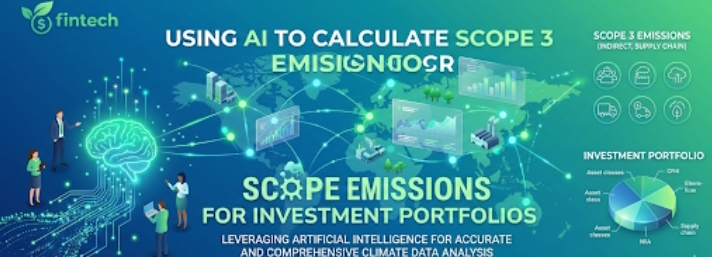
Green Fintech: Using AI to Calculate Scope 3 Emissions for Investment Portfolios
Posted on 06/03/2026 12:05:08
Audience: 99
Share with friends on:
The financial industry is undergoing a quiet but profound transformation. As climate risk becomes inseparable from investment risk, a new wave of green fintech companies is emerging at the intersection of artificial intelligence and environmental accountability. Their mission is ambitious: to give investors a clear, accurate, and real-time picture of the carbon footprint embedded in their portfolios — particularly the notoriously elusive Scope 3 emissions that have long evaded meaningful measurement.
To understand why this matters, it helps to understand what Scope 3 emissions actually are. Under the Greenhouse Gas Protocol framework, companies report emissions in three categories. Scope 1 covers direct emissions from owned or controlled sources. Scope 2 covers indirect emissions from purchased energy. Scope 3 is everything else — the upstream and downstream emissions that occur across a company's entire value chain, from the raw materials it sources to the way customers ultimately use and dispose of its products. For most companies, Scope 3 accounts for more than 70% of their total carbon footprint, and yet it is the category that receives the least reliable reporting. The data is fragmented, inconsistent, often self-reported, and riddled with estimation gaps. For investors trying to assess the true climate exposure of a portfolio, this has historically been close to impossible.
This is precisely where artificial intelligence is beginning to change the game. Modern AI systems — particularly large language models and machine learning pipelines trained on financial, environmental, and supply chain data — can now process vast quantities of unstructured information at a speed and scale no human analyst could match. These systems can ingest corporate sustainability reports, regulatory filings, satellite imagery, trade flow databases, procurement records, and industry benchmarks to construct a far more granular picture of a company's value chain emissions than traditional self-reported figures ever could. By training models on patterns across thousands of companies in similar sectors, AI can also generate statistically robust estimates for firms that disclose little or nothing, using peer-based inference techniques that are increasingly accepted by standard-setting bodies.
For investment portfolios, this capability is transformational. Asset managers overseeing large, diversified funds may hold positions in hundreds of companies across dozens of sectors and geographies. Manually tracking Scope 3 exposure across such a portfolio would require armies of analysts and months of work for data that would already be outdated by the time it was compiled. AI-powered platforms can now do this continuously, recalibrating emissions estimates as new information becomes available — whether that is a supplier changing its energy mix, a logistics network shifting to electric vehicles, or a portfolio company acquiring a carbon-intensive business unit. The result is a living, dynamic carbon accounting system rather than a static annual snapshot.
Several fintech companies have already built compelling products in this space. Firms like Watershed, Persefoni, and South Pole have developed platforms that combine AI-driven data aggregation with sophisticated emissions modelling, allowing institutional investors to drill down into the emissions profile of individual holdings and understand their portfolio's aggregate exposure to transition risk. Regulatory pressure has accelerated adoption significantly. The European Union's Sustainable Finance Disclosure Regulation and the SEC's proposed climate disclosure rules in the United States have made it increasingly urgent for asset managers to quantify and report climate risk in ways that are credible, auditable, and comparable across portfolios.
There are, of course, important limitations and challenges that the industry must be honest about. AI models are only as good as the data they are trained on, and the fundamental problem of poor corporate disclosure does not disappear simply because a machine is doing the estimation. There is also a real risk of false precision — of AI-generated numbers that look authoritative but carry significant margins of error that are not adequately communicated to end users. Greenwashing through sophisticated technology is a genuine danger, and regulators are beginning to scrutinize the methodologies behind AI-driven ESG metrics with increasing scepticism. The question of whose emissions accounting framework to use, and how to handle double-counting across supply chains, remains genuinely contested among academics and standard-setters.
Despite these tensions, the trajectory is clear. The convergence of regulatory mandates, investor demand for climate transparency, and rapidly maturing AI capabilities is creating both the incentive and the infrastructure for a new standard of portfolio-level carbon accounting. Green fintech is not merely building better spreadsheets — it is rearchitecting the information layer through which capital flows, ensuring that the true environmental cost of investment decisions can finally be seen, measured, and ultimately priced. In a world where the financial system's alignment with net-zero goals will determine much of what the energy transition looks like in practice, that is not a marginal development. It is a foundational one.
To understand why this matters, it helps to understand what Scope 3 emissions actually are. Under the Greenhouse Gas Protocol framework, companies report emissions in three categories. Scope 1 covers direct emissions from owned or controlled sources. Scope 2 covers indirect emissions from purchased energy. Scope 3 is everything else — the upstream and downstream emissions that occur across a company's entire value chain, from the raw materials it sources to the way customers ultimately use and dispose of its products. For most companies, Scope 3 accounts for more than 70% of their total carbon footprint, and yet it is the category that receives the least reliable reporting. The data is fragmented, inconsistent, often self-reported, and riddled with estimation gaps. For investors trying to assess the true climate exposure of a portfolio, this has historically been close to impossible.
This is precisely where artificial intelligence is beginning to change the game. Modern AI systems — particularly large language models and machine learning pipelines trained on financial, environmental, and supply chain data — can now process vast quantities of unstructured information at a speed and scale no human analyst could match. These systems can ingest corporate sustainability reports, regulatory filings, satellite imagery, trade flow databases, procurement records, and industry benchmarks to construct a far more granular picture of a company's value chain emissions than traditional self-reported figures ever could. By training models on patterns across thousands of companies in similar sectors, AI can also generate statistically robust estimates for firms that disclose little or nothing, using peer-based inference techniques that are increasingly accepted by standard-setting bodies.
For investment portfolios, this capability is transformational. Asset managers overseeing large, diversified funds may hold positions in hundreds of companies across dozens of sectors and geographies. Manually tracking Scope 3 exposure across such a portfolio would require armies of analysts and months of work for data that would already be outdated by the time it was compiled. AI-powered platforms can now do this continuously, recalibrating emissions estimates as new information becomes available — whether that is a supplier changing its energy mix, a logistics network shifting to electric vehicles, or a portfolio company acquiring a carbon-intensive business unit. The result is a living, dynamic carbon accounting system rather than a static annual snapshot.
Several fintech companies have already built compelling products in this space. Firms like Watershed, Persefoni, and South Pole have developed platforms that combine AI-driven data aggregation with sophisticated emissions modelling, allowing institutional investors to drill down into the emissions profile of individual holdings and understand their portfolio's aggregate exposure to transition risk. Regulatory pressure has accelerated adoption significantly. The European Union's Sustainable Finance Disclosure Regulation and the SEC's proposed climate disclosure rules in the United States have made it increasingly urgent for asset managers to quantify and report climate risk in ways that are credible, auditable, and comparable across portfolios.
There are, of course, important limitations and challenges that the industry must be honest about. AI models are only as good as the data they are trained on, and the fundamental problem of poor corporate disclosure does not disappear simply because a machine is doing the estimation. There is also a real risk of false precision — of AI-generated numbers that look authoritative but carry significant margins of error that are not adequately communicated to end users. Greenwashing through sophisticated technology is a genuine danger, and regulators are beginning to scrutinize the methodologies behind AI-driven ESG metrics with increasing scepticism. The question of whose emissions accounting framework to use, and how to handle double-counting across supply chains, remains genuinely contested among academics and standard-setters.
Despite these tensions, the trajectory is clear. The convergence of regulatory mandates, investor demand for climate transparency, and rapidly maturing AI capabilities is creating both the incentive and the infrastructure for a new standard of portfolio-level carbon accounting. Green fintech is not merely building better spreadsheets — it is rearchitecting the information layer through which capital flows, ensuring that the true environmental cost of investment decisions can finally be seen, measured, and ultimately priced. In a world where the financial system's alignment with net-zero goals will determine much of what the energy transition looks like in practice, that is not a marginal development. It is a foundational one.
Kindly join discussion on this topic on:
} Share with friends on:Related Posts
- Conversational Keywords: Writing for Natural Language Processing
- Trade Resilience: Data on Front-Loaded Shipments and New Bilateral Trade Deals
- Venture Capital in 2026: The Shift from "Growth at All Costs" to "Unit Economics"
- What Is the Force Majeure Clause Released in Bahrain Amidst the US-Israeli-Iranian Conflict
- E-Commerce Integration: Taking Your Local Trade to a Global Audience
- Authoritative Content: How to Become a Primary Source for AI Models
- Interoperability: Connecting Private Blockchains with Public Liquidity
- Smart Cities or Gated Communities? The Social Impact of Tech-Driven Urban Planning
- Social Listening for ROI: How to Spot Market Trends Before They Break
- Agricultural Yields: Impact of Climate-Related Shocks on Global Food Security