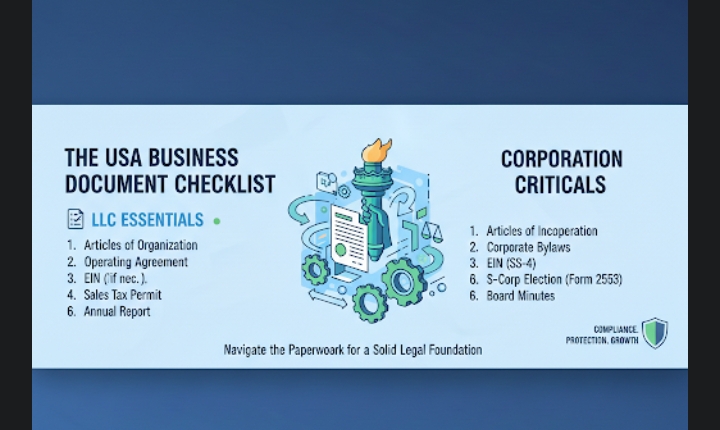
Checklist of Specific Documents Required for an LLC or a Corporation USA
Posted on 21/02/2026 06:42:39
Audience: 102
Share with friends on:
When embarking on the journey of formalizing a business in the United States, the primary document you will encounter is the Articles of Organization for an LLC or the Articles of Incorporation for a corporation. This foundational filing acts as the birth certificate of your company, legally establishing its existence within a specific state. While the name varies—Delaware and Texas refer to it as a Certificate of Formation—the purpose remains the same: to notify the state of your entity's name, its registered agent, and its governing structure.
Selecting a registered agent is a mandatory step that requires a specific document or a designated section within your formation papers. This agent must have a physical street address in the state of registration to accept legal "service of process" and official government correspondence. In states like California and Florida, the registered agent must also sign a statement of acceptance, ensuring they are aware of their legal responsibilities to your business.
Once the state acknowledges your filing, you will receive a Certificate of Status or a Filing Receipt. This document is often required by banks and lenders as proof that the business is currently in good standing. In New York, for instance, this receipt is vital for the next step of publication, which is a unique and mandatory requirement for LLCs in that state to maintain their legal standing.
The New York publication requirement involves filing an Affidavit of Publication. To obtain this, an LLC must publish a notice of its formation in two local newspapers for six consecutive weeks. Once the newspapers provide the affidavits, the business must file a Certificate of Publication with the Department of State. This added layer of paperwork is unique to only a few jurisdictions but is critical for compliance in the Empire State.
For internal governance, the most important document for an LLC is the Operating Agreement. While most states do not require you to file this with the Secretary of State, California law mandates that every LLC have one, even if it is just a single-member entity. This internal contract outlines how the company is managed, how profits are shared, and what happens if a member decides to leave the business.
In the corporate world, the equivalent of an Operating Agreement is a set of Bylaws. Corporate Bylaws are comprehensive documents that dictate the frequency of shareholder meetings, the number of directors on the board, and the specific duties of officers like the CEO and Secretary. Having these bylaws drafted and signed is essential for maintaining the "corporate veil" and protecting owners from personal liability.
Moving to the federal level, every new entity needs an SS-4 application to obtain an Employer Identification Number (EIN) from the IRS. This nine-digit number is the business version of a Social Security Number and is a prerequisite for almost every financial transaction. Without an EIN, you cannot hire employees, pay federal taxes, or open a business bank account at major institutions.
In Texas, registration involves a specific Certificate of Formation (Form 205), which requires the disclosure of whether the LLC is "member-managed" or "manager-managed." This distinction is legally binding and dictates who has the authority to sign contracts on behalf of the company. If the structure changes later, a formal Amendment to the Certificate of Formation must be filed and paid for.
Delaware, a popular choice for corporations due to its flexible court system, requires a Certificate of Incorporation. If you are forming a "Series LLC" in Delaware—a structure where one parent LLC holds multiple sub-units—you must file a specific Certificate of Formation that includes a notice of the limitation of liability for each individual series. This specialized document requires careful legal drafting to ensure each series is properly protected.
Beyond formation, businesses often need a "Doing Business As" (DBA) certificate, also known as a Fictitious Name Registration. If you are a corporation named "Smith Holdings Inc." but you want to operate a restaurant called "Royal Restaurant," you must file this document with the state or county. In Florida, this registration must be advertised in a local newspaper at least once before the application is filed.
Another critical state-specific document is the Initial Report or Statement of Information. In California, this must be filed within 90 days of formation. It provides the state with an updated list of the company’s managers or officers and their contact information. Failing to file this initial document can result in immediate penalties and can even lead to the suspension of your business powers.
For businesses moving into a new state where they weren't originally formed, a Certificate of Authority for Foreign Qualification is required. This document tells the new state that a "foreign" entity (meaning formed in another U.S. state) is authorized to conduct business there. To get this, you usually need to provide a Certificate of Good Standing from your home state, dated within the last 30 to 90 days.
Financial institutions will often ask for a Banking Resolution. This is a formal document, usually drafted during the first meeting of the members or directors, that specifies who is authorized to open bank accounts and sign checks. It prevents unauthorized individuals from accessing the company's funds and provides the bank with the legal assurance they need to facilitate transactions.
If your corporation intends to be taxed as an "S-Corp" to avoid double taxation, you must file Form 2553 with the IRS. This is a time-sensitive document that must be submitted no later than two months and 15 days after the beginning of the tax year the election is to take effect. For many small business owners, this is the single most important tax document in their arsenal.
In the realm of professional services—like law, medicine, or architecture—states often require a Certificate of Registration for a Professional LLC (PLLC) or Professional Corporation (PC). This involves obtaining a document from the state’s professional licensing board first, proving that the owners are licensed in their respective fields, before the Secretary of State will allow the business to be registered.
For corporations, issuing stock requires a Stock Purchase Agreement and the issuance of Stock Certificates. Even in a small family-owned corporation, these documents are necessary to track ownership and basis in the company. In some states, a "Notice of Transaction" or similar securities filing may be required if you are raising money from outside investors, even if those investors are friends and family.
Sales tax is another area that requires its own set of paperwork, specifically a Sales Tax Permit or Seller's Permit. In states like Texas and Florida, this is a separate registration with the Department of Revenue. This document allows the business to collect sales tax from customers and, in many cases, buy inventory tax-free for the purpose of resale.
To maintain compliance, every entity must keep a Record of Minutes from its organizational and annual meetings. While these are not filed with the government, they are essential legal documents that must be kept in the company's records. In the event of a lawsuit or an IRS audit, these minutes prove that the business is being run as a separate legal entity and not just as an extension of the owner’s personal life.
If your business involves physical products, you may need to file for a Trademark with the USPTO. While not a "registration" document in the sense of forming the company, the Trademark Registration Certificate is the ultimate proof of ownership for your brand names, such as "ABC Airlines." This federal document prevents others from using your brand name in similar industries across the country.
When changes happen, such as a change in the business address or a change in the registered agent, you must file a Statement of Change or an Amended Certificate of Formation. In Florida, this is done through the "Sunbiz" portal. Keeping these documents current is vital because the state uses this information to send tax notices and legal warnings; if they go to an old address, you could lose your business standing.
Insurance is also documented through an Accord Certificate of Insurance. While this is an industry document rather than a government one, it is a staple in the business checklist. Many clients will not sign a contract with an LLC or corporation until they have a copy of this document showing general liability and workers' compensation coverage.
In recent years, a new federal requirement has emerged: the Beneficial Ownership Information (BOI) Report. Filed with the Financial Crimes Enforcement Network (FinCEN), this document identifies the individuals who ultimately own or control the company. Most LLCs and corporations formed in the USA must file this report to comply with anti-money laundering laws.
In states like Delaware, the Annual Franchise Tax Report is the recurring document that keeps the business alive. Even if the company has no income, this report must be filed and the tax paid every year by March 1st for corporations and June 1st for LLCs. This document is a summary of the company's authorized shares or a flat-fee report for LLCs.
Finally, if a business decides to close, it must file Articles of Dissolution or a Certificate of Cancellation. This document formally ends the entity's existence and stops the clock on state taxes and reporting requirements. Without this final piece of paperwork, the state will continue to expect annual reports and taxes, potentially leading to personal debt for the owners.
The complexity of these documents underscores the importance of a well-organized corporate record book. Whether it's the state-level Articles or the federal EIN confirmation letter, each piece of paper plays a specific role in protecting the business owner's interests. By methodically checking off these requirements, an entrepreneur ensures their business is built on a solid, legally compliant foundation.
Selecting a registered agent is a mandatory step that requires a specific document or a designated section within your formation papers. This agent must have a physical street address in the state of registration to accept legal "service of process" and official government correspondence. In states like California and Florida, the registered agent must also sign a statement of acceptance, ensuring they are aware of their legal responsibilities to your business.
Once the state acknowledges your filing, you will receive a Certificate of Status or a Filing Receipt. This document is often required by banks and lenders as proof that the business is currently in good standing. In New York, for instance, this receipt is vital for the next step of publication, which is a unique and mandatory requirement for LLCs in that state to maintain their legal standing.
The New York publication requirement involves filing an Affidavit of Publication. To obtain this, an LLC must publish a notice of its formation in two local newspapers for six consecutive weeks. Once the newspapers provide the affidavits, the business must file a Certificate of Publication with the Department of State. This added layer of paperwork is unique to only a few jurisdictions but is critical for compliance in the Empire State.
For internal governance, the most important document for an LLC is the Operating Agreement. While most states do not require you to file this with the Secretary of State, California law mandates that every LLC have one, even if it is just a single-member entity. This internal contract outlines how the company is managed, how profits are shared, and what happens if a member decides to leave the business.
In the corporate world, the equivalent of an Operating Agreement is a set of Bylaws. Corporate Bylaws are comprehensive documents that dictate the frequency of shareholder meetings, the number of directors on the board, and the specific duties of officers like the CEO and Secretary. Having these bylaws drafted and signed is essential for maintaining the "corporate veil" and protecting owners from personal liability.
Moving to the federal level, every new entity needs an SS-4 application to obtain an Employer Identification Number (EIN) from the IRS. This nine-digit number is the business version of a Social Security Number and is a prerequisite for almost every financial transaction. Without an EIN, you cannot hire employees, pay federal taxes, or open a business bank account at major institutions.
In Texas, registration involves a specific Certificate of Formation (Form 205), which requires the disclosure of whether the LLC is "member-managed" or "manager-managed." This distinction is legally binding and dictates who has the authority to sign contracts on behalf of the company. If the structure changes later, a formal Amendment to the Certificate of Formation must be filed and paid for.
Delaware, a popular choice for corporations due to its flexible court system, requires a Certificate of Incorporation. If you are forming a "Series LLC" in Delaware—a structure where one parent LLC holds multiple sub-units—you must file a specific Certificate of Formation that includes a notice of the limitation of liability for each individual series. This specialized document requires careful legal drafting to ensure each series is properly protected.
Beyond formation, businesses often need a "Doing Business As" (DBA) certificate, also known as a Fictitious Name Registration. If you are a corporation named "Smith Holdings Inc." but you want to operate a restaurant called "Royal Restaurant," you must file this document with the state or county. In Florida, this registration must be advertised in a local newspaper at least once before the application is filed.
Another critical state-specific document is the Initial Report or Statement of Information. In California, this must be filed within 90 days of formation. It provides the state with an updated list of the company’s managers or officers and their contact information. Failing to file this initial document can result in immediate penalties and can even lead to the suspension of your business powers.
For businesses moving into a new state where they weren't originally formed, a Certificate of Authority for Foreign Qualification is required. This document tells the new state that a "foreign" entity (meaning formed in another U.S. state) is authorized to conduct business there. To get this, you usually need to provide a Certificate of Good Standing from your home state, dated within the last 30 to 90 days.
Financial institutions will often ask for a Banking Resolution. This is a formal document, usually drafted during the first meeting of the members or directors, that specifies who is authorized to open bank accounts and sign checks. It prevents unauthorized individuals from accessing the company's funds and provides the bank with the legal assurance they need to facilitate transactions.
If your corporation intends to be taxed as an "S-Corp" to avoid double taxation, you must file Form 2553 with the IRS. This is a time-sensitive document that must be submitted no later than two months and 15 days after the beginning of the tax year the election is to take effect. For many small business owners, this is the single most important tax document in their arsenal.
In the realm of professional services—like law, medicine, or architecture—states often require a Certificate of Registration for a Professional LLC (PLLC) or Professional Corporation (PC). This involves obtaining a document from the state’s professional licensing board first, proving that the owners are licensed in their respective fields, before the Secretary of State will allow the business to be registered.
For corporations, issuing stock requires a Stock Purchase Agreement and the issuance of Stock Certificates. Even in a small family-owned corporation, these documents are necessary to track ownership and basis in the company. In some states, a "Notice of Transaction" or similar securities filing may be required if you are raising money from outside investors, even if those investors are friends and family.
Sales tax is another area that requires its own set of paperwork, specifically a Sales Tax Permit or Seller's Permit. In states like Texas and Florida, this is a separate registration with the Department of Revenue. This document allows the business to collect sales tax from customers and, in many cases, buy inventory tax-free for the purpose of resale.
To maintain compliance, every entity must keep a Record of Minutes from its organizational and annual meetings. While these are not filed with the government, they are essential legal documents that must be kept in the company's records. In the event of a lawsuit or an IRS audit, these minutes prove that the business is being run as a separate legal entity and not just as an extension of the owner’s personal life.
If your business involves physical products, you may need to file for a Trademark with the USPTO. While not a "registration" document in the sense of forming the company, the Trademark Registration Certificate is the ultimate proof of ownership for your brand names, such as "ABC Airlines." This federal document prevents others from using your brand name in similar industries across the country.
When changes happen, such as a change in the business address or a change in the registered agent, you must file a Statement of Change or an Amended Certificate of Formation. In Florida, this is done through the "Sunbiz" portal. Keeping these documents current is vital because the state uses this information to send tax notices and legal warnings; if they go to an old address, you could lose your business standing.
Insurance is also documented through an Accord Certificate of Insurance. While this is an industry document rather than a government one, it is a staple in the business checklist. Many clients will not sign a contract with an LLC or corporation until they have a copy of this document showing general liability and workers' compensation coverage.
In recent years, a new federal requirement has emerged: the Beneficial Ownership Information (BOI) Report. Filed with the Financial Crimes Enforcement Network (FinCEN), this document identifies the individuals who ultimately own or control the company. Most LLCs and corporations formed in the USA must file this report to comply with anti-money laundering laws.
In states like Delaware, the Annual Franchise Tax Report is the recurring document that keeps the business alive. Even if the company has no income, this report must be filed and the tax paid every year by March 1st for corporations and June 1st for LLCs. This document is a summary of the company's authorized shares or a flat-fee report for LLCs.
Finally, if a business decides to close, it must file Articles of Dissolution or a Certificate of Cancellation. This document formally ends the entity's existence and stops the clock on state taxes and reporting requirements. Without this final piece of paperwork, the state will continue to expect annual reports and taxes, potentially leading to personal debt for the owners.
The complexity of these documents underscores the importance of a well-organized corporate record book. Whether it's the state-level Articles or the federal EIN confirmation letter, each piece of paper plays a specific role in protecting the business owner's interests. By methodically checking off these requirements, an entrepreneur ensures their business is built on a solid, legally compliant foundation.
Kindly join discussion on this topic on:
} Share with friends on:Related Posts
- Conversational Keywords: Writing for Natural Language Processing
- Trade Resilience: Data on Front-Loaded Shipments and New Bilateral Trade Deals
- Venture Capital in 2026: The Shift from "Growth at All Costs" to "Unit Economics"
- What Is the Force Majeure Clause Released in Bahrain Amidst the US-Israeli-Iranian Conflict
- E-Commerce Integration: Taking Your Local Trade to a Global Audience
- Authoritative Content: How to Become a Primary Source for AI Models
- Interoperability: Connecting Private Blockchains with Public Liquidity
- Smart Cities or Gated Communities? The Social Impact of Tech-Driven Urban Planning
- Social Listening for ROI: How to Spot Market Trends Before They Break
- Agricultural Yields: Impact of Climate-Related Shocks on Global Food Security