Omnichannel vs. Multichannel: What Real Business Integration Looks Like
Posted on 26/02/2026 15:44:37
Audience: 72
Share with friends on:
In today's fast-paced retail landscape, businesses grapple with how to meet customers where they are—across websites, apps, physical stores, social media, and email—without creating a disjointed experience. Multichannel and omnichannel strategies both aim to expand reach through these touchpoints, but they differ fundamentally in execution and impact.
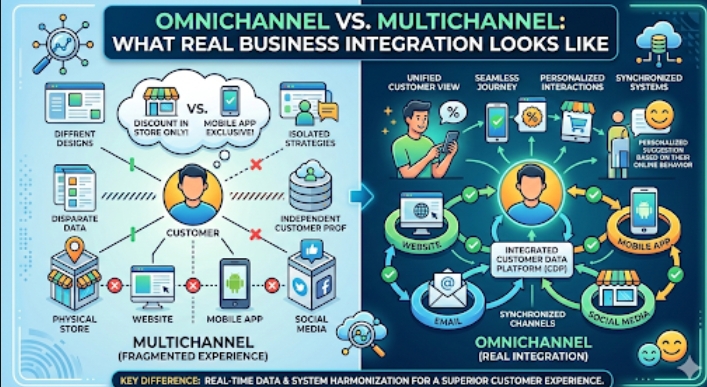
Multichannel approaches treat each channel as an independent silo: a customer might browse products on your Instagram feed, add items to a cart on your website, and then visit a store to buy, but the systems don't communicate. Inventory updates lag, promotions vary by platform, and loyalty points earned online might not apply in-store, leading to frustration and lost sales. This siloed model scales presence but often sacrifices cohesion, as evidenced by a 2023 Forrester report showing multichannel retailers losing up to 30% of potential revenue due to inconsistent customer journeys.
Omnichannel, by contrast, represents true integration, where channels seamlessly interconnect to deliver a unified brand experience. Imagine a shopper starting on your mobile app, receiving personalized recommendations based on past in-store purchases, then picking up the item curbside at a nearby location with real-time inventory synced across all systems. Here, customer data flows freely via a central CRM platform, enabling consistent messaging, pricing, and fulfillment options regardless of entry point.
Starbucks exemplifies this: their app lets users order ahead, pay digitally, and redeem rewards in-store or drive-thru, with loyalty data updating instantly to boost repeat visits by 20-30%, per their own metrics. This isn't just tech stacking; it's a holistic ecosystem where backend systems like ERP and POS unify operations, allowing for advanced features such as buy-online-pickup-in-store (BOPIS) or ship-from-store, which drove 10-15% sales lifts for early adopters like Walmart during the pandemic.
The real business integration of omnichannel shines in metrics that matter: higher customer lifetime value, reduced cart abandonment, and superior retention. While multichannel might boost top-of-funnel awareness—think a brand popping up everywhere—omnichannel converts that into loyalty by personalizing at scale.
A McKinsey study found omnichannel customers spend 4% more in-store and 10% more online than multichannel ones, thanks to seamless handoffs. Transitioning requires investment in APIs, cloud infrastructure, and cultural shifts toward data-sharing, but the payoff is resilience; during supply chain disruptions, integrated firms pivot faster, like using store stock for online orders. Ultimately, multichannel builds breadth, but omnichannel forges depth—turning transactions into relationships that propel sustainable growth in a channel-agnostic world.
Multichannel approaches treat each channel as an independent silo: a customer might browse products on your Instagram feed, add items to a cart on your website, and then visit a store to buy, but the systems don't communicate. Inventory updates lag, promotions vary by platform, and loyalty points earned online might not apply in-store, leading to frustration and lost sales. This siloed model scales presence but often sacrifices cohesion, as evidenced by a 2023 Forrester report showing multichannel retailers losing up to 30% of potential revenue due to inconsistent customer journeys.
Omnichannel, by contrast, represents true integration, where channels seamlessly interconnect to deliver a unified brand experience. Imagine a shopper starting on your mobile app, receiving personalized recommendations based on past in-store purchases, then picking up the item curbside at a nearby location with real-time inventory synced across all systems. Here, customer data flows freely via a central CRM platform, enabling consistent messaging, pricing, and fulfillment options regardless of entry point.
Starbucks exemplifies this: their app lets users order ahead, pay digitally, and redeem rewards in-store or drive-thru, with loyalty data updating instantly to boost repeat visits by 20-30%, per their own metrics. This isn't just tech stacking; it's a holistic ecosystem where backend systems like ERP and POS unify operations, allowing for advanced features such as buy-online-pickup-in-store (BOPIS) or ship-from-store, which drove 10-15% sales lifts for early adopters like Walmart during the pandemic.
The real business integration of omnichannel shines in metrics that matter: higher customer lifetime value, reduced cart abandonment, and superior retention. While multichannel might boost top-of-funnel awareness—think a brand popping up everywhere—omnichannel converts that into loyalty by personalizing at scale.
A McKinsey study found omnichannel customers spend 4% more in-store and 10% more online than multichannel ones, thanks to seamless handoffs. Transitioning requires investment in APIs, cloud infrastructure, and cultural shifts toward data-sharing, but the payoff is resilience; during supply chain disruptions, integrated firms pivot faster, like using store stock for online orders. Ultimately, multichannel builds breadth, but omnichannel forges depth—turning transactions into relationships that propel sustainable growth in a channel-agnostic world.
Kindly join discussion on this topic on:
} Share with friends on:Related Posts
- Conversational Keywords: Writing for Natural Language Processing
- Trade Resilience: Data on Front-Loaded Shipments and New Bilateral Trade Deals
- Venture Capital in 2026: The Shift from "Growth at All Costs" to "Unit Economics"
- What Is the Force Majeure Clause Released in Bahrain Amidst the US-Israeli-Iranian Conflict
- E-Commerce Integration: Taking Your Local Trade to a Global Audience
- Authoritative Content: How to Become a Primary Source for AI Models
- Interoperability: Connecting Private Blockchains with Public Liquidity
- Smart Cities or Gated Communities? The Social Impact of Tech-Driven Urban Planning
- Social Listening for ROI: How to Spot Market Trends Before They Break
- Agricultural Yields: Impact of Climate-Related Shocks on Global Food Security