E-Government Evolution: Case Studies from Estonia to Rwanda on Digitizing the Civil Service
Posted on 26/02/2026 21:51:49
Audience: 82
Share with friends on:
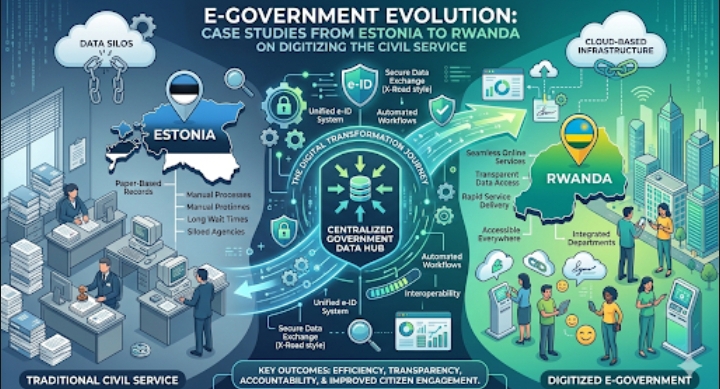
E-Government has transformed public administration worldwide, with Estonia and Rwanda standing out as compelling case studies in digitizing the civil service, from post-Soviet reinvention to ambitious African leapfrogging. Estonia's journey began in the early 1990s after independence from the USSR, when a small nation of 1.3 million prioritized digital infrastructure to bypass traditional bureaucracy; by introducing mandatory ID cards with digital signatures in 2002, it enabled secure online access to services like e-voting—first used in 2005—and tax filing, which 94% of citizens now complete digitally in under three minutes. This evolution accelerated with X-Road, an interoperable data exchange platform launched in 2001, ensuring the "once-only" principle where citizens submit information just once, automating processes across agencies and saving an estimated 2% of GDP annually in taxpayer costs by streamlining civil service operations. By December 2024, Estonia achieved 100% digital public services, including even divorce filings, positioning it as a global benchmark where civil servants shifted from paper-pushers to data stewards, though challenges like digital trust and empathy in automated systems persist.
Rwanda, emerging from the 1994 genocide with rudimentary infrastructure, adopted e-government as a core pillar of its Vision 2020 strategy, launching Irembo in 2015 as a single portal for over 100 services—from business registration to birth certificates—reducing processing times from weeks to hours and cutting corruption through transparent tracking. The National Public Service Commission's e-governance initiatives, including e-administration and e-participation platforms, have digitized recruitment, performance management, and citizen feedback for its 400,000-strong civil service, boosting efficiency in a landlocked economy where mobile penetration exceeds 80%. Smart Rwanda Master Plan initiatives like the National Data Centre and blockchain pilots for land registry further integrate AI-driven analytics, bridging urban-rural divides despite uneven broadband access, and enabling real-time service delivery that aligns civil servants with national development goals.
Comparing these models reveals shared principles—citizen-centric design, public-private partnerships, and iterative scaling—but divergent contexts: Estonia's tech-savvy populace and EU integration fueled rapid adoption, while Rwanda's mobile-first approach and authoritarian efficiency overcame low literacy via USSD codes and agents. Both nations demonstrate that digitizing the civil service not only slashes red tape—Estonia eliminated 50% of paperwork, Rwanda 90% in key sectors—but fosters inclusive governance, with Estonia's e-residency attracting global talent and Rwanda's platforms empowering women entrepreneurs. Yet, successes hinge on cybersecurity (Estonia's post-2007 reforms) and inclusivity investments (Rwanda's digital literacy campaigns), offering blueprints for developing worlds where e-government evolves from efficiency tool to trust-building ecosystem.
Rwanda, emerging from the 1994 genocide with rudimentary infrastructure, adopted e-government as a core pillar of its Vision 2020 strategy, launching Irembo in 2015 as a single portal for over 100 services—from business registration to birth certificates—reducing processing times from weeks to hours and cutting corruption through transparent tracking. The National Public Service Commission's e-governance initiatives, including e-administration and e-participation platforms, have digitized recruitment, performance management, and citizen feedback for its 400,000-strong civil service, boosting efficiency in a landlocked economy where mobile penetration exceeds 80%. Smart Rwanda Master Plan initiatives like the National Data Centre and blockchain pilots for land registry further integrate AI-driven analytics, bridging urban-rural divides despite uneven broadband access, and enabling real-time service delivery that aligns civil servants with national development goals.
Comparing these models reveals shared principles—citizen-centric design, public-private partnerships, and iterative scaling—but divergent contexts: Estonia's tech-savvy populace and EU integration fueled rapid adoption, while Rwanda's mobile-first approach and authoritarian efficiency overcame low literacy via USSD codes and agents. Both nations demonstrate that digitizing the civil service not only slashes red tape—Estonia eliminated 50% of paperwork, Rwanda 90% in key sectors—but fosters inclusive governance, with Estonia's e-residency attracting global talent and Rwanda's platforms empowering women entrepreneurs. Yet, successes hinge on cybersecurity (Estonia's post-2007 reforms) and inclusivity investments (Rwanda's digital literacy campaigns), offering blueprints for developing worlds where e-government evolves from efficiency tool to trust-building ecosystem.
Kindly join discussion on this topic on:
} Share with friends on:Related Posts
- Conversational Keywords: Writing for Natural Language Processing
- Trade Resilience: Data on Front-Loaded Shipments and New Bilateral Trade Deals
- Venture Capital in 2026: The Shift from "Growth at All Costs" to "Unit Economics"
- What Is the Force Majeure Clause Released in Bahrain Amidst the US-Israeli-Iranian Conflict
- E-Commerce Integration: Taking Your Local Trade to a Global Audience
- Authoritative Content: How to Become a Primary Source for AI Models
- Interoperability: Connecting Private Blockchains with Public Liquidity
- Smart Cities or Gated Communities? The Social Impact of Tech-Driven Urban Planning
- Social Listening for ROI: How to Spot Market Trends Before They Break
- Agricultural Yields: Impact of Climate-Related Shocks on Global Food Security