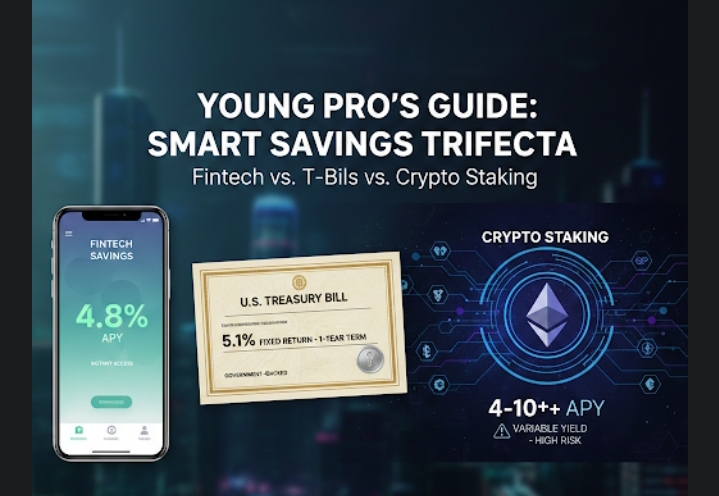
Young Pro's Guide: Fintech vs. T-Bill vs. Crypto Staking
Posted on 20/02/2026 15:28:53
Audience: 81
Share with friends on:
In the rapidly evolving financial landscape of 2026, young professionals are increasingly moving beyond traditional savings accounts to navigate a triad of distinct wealth-building tools: high-yield fintech savings apps, treasury bills (T-bills), and crypto staking. Each of these options serves a specific role in a balanced portfolio, and the key to financial agility lies in understanding how to leverage their unique risk-return profiles.
High-yield fintech apps, such as Raisin or Flagstone, currently offer accessible entry points with annual percentage yields (APYs) often hovering between 4% and 5%. These platforms are ideal for "lazy" liquid cash—money you might need within days for an emergency or a lifestyle purchase. Because they are typically backed by deposit insurance (like the FSCS or FDIC), they provide a psychological and financial safety net, acting as the bedrock of a conservative cash management strategy where convenience and immediate liquidity are prioritized over aggressive growth.
Transitioning toward the more structured "risk-free" end of the spectrum, treasury bills have regained significant popularity as government-backed instruments that offer fixed, predictable returns. For an investor in 2026, T-bills are often used to "lock in" high interest rates—frequently exceeding 5%—for durations of 91, 182, or 364 days.
Unlike fintech savings apps, which have variable rates that can fluctuate at the whim of the central bank, T-bills provide a guaranteed discount rate, meaning you know your exact profit the moment you buy. They are particularly attractive for young professionals saving for specific medium-term goals, such as a home down payment or a wedding in a year’s time. While they are slightly less liquid than a savings app—requiring you to sell on a secondary market if you need cash before maturity—their tax advantages and government-backed security make them an indispensable tool for protecting capital against inflation without the volatility of the stock or crypto markets.
At the high-octane edge of this strategy is crypto staking, a method that allows you to earn passive income by "locking" your digital assets to support blockchain networks like Ethereum or Solana.
In 2026, the maturity of the crypto ecosystem has introduced yield-bearing stablecoins and regulated staking platforms that offer rewards ranging from 4% to 10% or more. However, this potential for higher yield comes with a complex layer of risks: price volatility of the underlying asset, "slashing" penalties if a network validator fails, and lock-up periods that can prevent you from selling during a market crash. For a young professional, staking should rarely be the primary bucket for savings; instead, it serves as a high-growth "kicker" for the portion of the portfolio that can withstand loss.
A modern, balanced approach might see 50% of liquid cash in a high-yield fintech app for flexibility, 40% in T-bills for guaranteed stability, and 10% in staking to capture the upside of the digital economy, ensuring that while the heart of the portfolio is safe, the edges are actively working to outpace traditional benchmarks.
High-yield fintech apps, such as Raisin or Flagstone, currently offer accessible entry points with annual percentage yields (APYs) often hovering between 4% and 5%. These platforms are ideal for "lazy" liquid cash—money you might need within days for an emergency or a lifestyle purchase. Because they are typically backed by deposit insurance (like the FSCS or FDIC), they provide a psychological and financial safety net, acting as the bedrock of a conservative cash management strategy where convenience and immediate liquidity are prioritized over aggressive growth.
Transitioning toward the more structured "risk-free" end of the spectrum, treasury bills have regained significant popularity as government-backed instruments that offer fixed, predictable returns. For an investor in 2026, T-bills are often used to "lock in" high interest rates—frequently exceeding 5%—for durations of 91, 182, or 364 days.
Unlike fintech savings apps, which have variable rates that can fluctuate at the whim of the central bank, T-bills provide a guaranteed discount rate, meaning you know your exact profit the moment you buy. They are particularly attractive for young professionals saving for specific medium-term goals, such as a home down payment or a wedding in a year’s time. While they are slightly less liquid than a savings app—requiring you to sell on a secondary market if you need cash before maturity—their tax advantages and government-backed security make them an indispensable tool for protecting capital against inflation without the volatility of the stock or crypto markets.
At the high-octane edge of this strategy is crypto staking, a method that allows you to earn passive income by "locking" your digital assets to support blockchain networks like Ethereum or Solana.
In 2026, the maturity of the crypto ecosystem has introduced yield-bearing stablecoins and regulated staking platforms that offer rewards ranging from 4% to 10% or more. However, this potential for higher yield comes with a complex layer of risks: price volatility of the underlying asset, "slashing" penalties if a network validator fails, and lock-up periods that can prevent you from selling during a market crash. For a young professional, staking should rarely be the primary bucket for savings; instead, it serves as a high-growth "kicker" for the portion of the portfolio that can withstand loss.
A modern, balanced approach might see 50% of liquid cash in a high-yield fintech app for flexibility, 40% in T-bills for guaranteed stability, and 10% in staking to capture the upside of the digital economy, ensuring that while the heart of the portfolio is safe, the edges are actively working to outpace traditional benchmarks.
Kindly join discussion on this topic on:
} Share with friends on:Related Posts
- Conversational Keywords: Writing for Natural Language Processing
- Trade Resilience: Data on Front-Loaded Shipments and New Bilateral Trade Deals
- Venture Capital in 2026: The Shift from "Growth at All Costs" to "Unit Economics"
- What Is the Force Majeure Clause Released in Bahrain Amidst the US-Israeli-Iranian Conflict
- E-Commerce Integration: Taking Your Local Trade to a Global Audience
- Authoritative Content: How to Become a Primary Source for AI Models
- Interoperability: Connecting Private Blockchains with Public Liquidity
- Smart Cities or Gated Communities? The Social Impact of Tech-Driven Urban Planning
- Social Listening for ROI: How to Spot Market Trends Before They Break
- Agricultural Yields: Impact of Climate-Related Shocks on Global Food Security