Will AI Replace the Nigerian Middle Manager?
Posted on 20/02/2026 17:03:21
Audience: 106
Share with friends on:
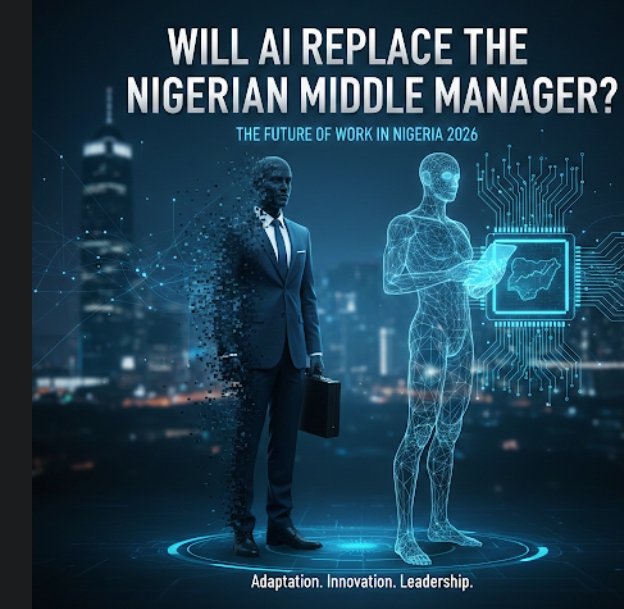
The conversation surrounding the displacement of the Nigerian middle manager by artificial intelligence has reached a fever pitch in 2026, as local corporate structures grapple with high inflation and the rapid adoption of digital workers. For decades, the middle manager in Nigeria has served as the "connective tissue" of the organization, responsible for manual coordination, reporting, and supervising routine administrative tasks. However, as AI agents become increasingly capable of handling documentation, data analysis, and basic project oversight, the traditional "supervisor" model is under direct threat.
Reports from the Nigerian corporate sector suggest that up to half of middle management roles focused purely on coordination could be eliminated by the end of the year as organizations look to flatten their hierarchies and reduce operational costs.
Despite the looming automation of routine oversight, the role is not so much vanishing as it is undergoing a radical transformation into that of a high-value orchestrator. In the unique Nigerian business environment, where "people-centered" leadership and complex interpersonal networking are vital for navigating institutional bottlenecks, the human element remains indispensable. AI can generate a performance dashboard, but it cannot navigate the cultural nuances of a Lagos boardroom, provide empathy to a team facing economic burnout, or mediate the high-stakes conflicts that often arise in cross-functional operations.
Consequently, the Nigerian middle managers who survive this transition are those evolving into strategic leaders who manage the intersection of human talent and machine intelligence, using AI to automate their drudgery so they can focus on coaching and innovation.
Ultimately, the future of work in Nigeria will be defined not by a total replacement of the middle class, but by a widening divide between those who resist automation and those who embrace AI fluency. Financial institutions and fintechs across the country are already prioritizing leaders who can demonstrate "AI-literacy," with some offering wage premiums for those who can effectively integrate these tools into their workflows.
For the Nigerian manager, the mandate for 2026 is clear: adapt to a reality where routine tasks are handled by algorithms, while doubling down on the "soft" human skills—creativity, emotional intelligence, and ethical judgment—that a machine simply cannot replicate. The "average" worker may indeed be at risk, but the modern, tech-enabled manager is becoming more critical to the organization than ever before.
Reports from the Nigerian corporate sector suggest that up to half of middle management roles focused purely on coordination could be eliminated by the end of the year as organizations look to flatten their hierarchies and reduce operational costs.
Despite the looming automation of routine oversight, the role is not so much vanishing as it is undergoing a radical transformation into that of a high-value orchestrator. In the unique Nigerian business environment, where "people-centered" leadership and complex interpersonal networking are vital for navigating institutional bottlenecks, the human element remains indispensable. AI can generate a performance dashboard, but it cannot navigate the cultural nuances of a Lagos boardroom, provide empathy to a team facing economic burnout, or mediate the high-stakes conflicts that often arise in cross-functional operations.
Consequently, the Nigerian middle managers who survive this transition are those evolving into strategic leaders who manage the intersection of human talent and machine intelligence, using AI to automate their drudgery so they can focus on coaching and innovation.
Ultimately, the future of work in Nigeria will be defined not by a total replacement of the middle class, but by a widening divide between those who resist automation and those who embrace AI fluency. Financial institutions and fintechs across the country are already prioritizing leaders who can demonstrate "AI-literacy," with some offering wage premiums for those who can effectively integrate these tools into their workflows.
For the Nigerian manager, the mandate for 2026 is clear: adapt to a reality where routine tasks are handled by algorithms, while doubling down on the "soft" human skills—creativity, emotional intelligence, and ethical judgment—that a machine simply cannot replicate. The "average" worker may indeed be at risk, but the modern, tech-enabled manager is becoming more critical to the organization than ever before.
Kindly join discussion on this topic on:
} Share with friends on:Related Posts
- Conversational Keywords: Writing for Natural Language Processing
- Trade Resilience: Data on Front-Loaded Shipments and New Bilateral Trade Deals
- Venture Capital in 2026: The Shift from "Growth at All Costs" to "Unit Economics"
- What Is the Force Majeure Clause Released in Bahrain Amidst the US-Israeli-Iranian Conflict
- E-Commerce Integration: Taking Your Local Trade to a Global Audience
- Authoritative Content: How to Become a Primary Source for AI Models
- Interoperability: Connecting Private Blockchains with Public Liquidity
- Smart Cities or Gated Communities? The Social Impact of Tech-Driven Urban Planning
- Social Listening for ROI: How to Spot Market Trends Before They Break
- Agricultural Yields: Impact of Climate-Related Shocks on Global Food Security