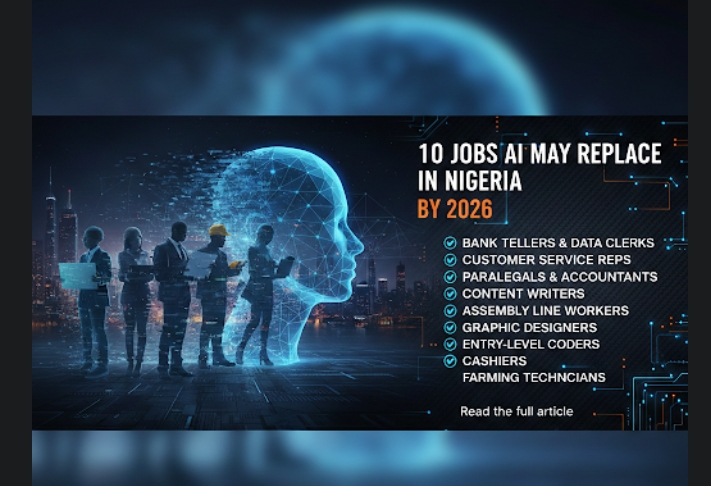
10 Jobs AI May Replace in Nigeria, 2026
Posted on 21/02/2026 12:54:14
Audience: 104
Share with friends on:
As the digital landscape in Nigeria undergoes a rapid transformation in 2026, the integration of advanced artificial intelligence is no longer a futuristic concept but a present reality reshaping the national labor market. While AI acts as a powerful catalyst for efficiency, it simultaneously poses a significant challenge to roles defined by routine, data processing, and predictable manual tasks. The Nigerian economy, traditionally reliant on large-scale human intervention for administrative and logistical operations, is witnessing a pivot toward automation that threatens to displace several long-standing career paths.
One of the most immediate shifts is occurring within the financial sector, specifically impacting Bank Tellers and Data Entry Clerks. With Nigerian banks increasingly deploying AI-driven kiosks and sophisticated mobile banking interfaces, the need for human personnel to process basic deposits, withdrawals, or ledger updates has plummeted. Similarly, the role of Customer Service Representatives is being revolutionized by localized AI chatbots capable of understanding Nigerian Pidgin and regional nuances. These systems provide instant, 24/7 support for telecommunications and utility companies, making the traditional, large-scale call center model increasingly redundant.
The transportation and logistics industry is also on the brink of a major overhaul. As smart infrastructure begins to take root in urban centers like Lagos and Abuja, Delivery Drivers and Dispatch Riders are seeing the early stages of displacement by autonomous delivery bots and optimized drone corridors. This shift is mirrored in the legal and accounting professions, where Paralegals and Junior Accountants are finding their traditional roles—such as document review, contract drafting, and tax auditing—performed more accurately and faster by specialized AI algorithms. These tools can sift through mountains of Nigerian case law or complex corporate filings in seconds, a task that previously required dozens of man-hours.
In the realm of media and commerce, Content Writers and Copywriters are facing intense competition from generative AI models that can produce marketing materials, news reports, and social media posts with minimal human oversight. This trend extends to the manufacturing sector, where Assembly Line Workers are being replaced by collaborative robots (cobots) that offer higher precision and lower long-term costs for Nigerian factories. Even the creative and technical fields are not immune; Basic Graphic Designers who specialize in simple layouts and Entry-level Coders focused on routine debugging are seeing their tasks automated by AI platforms that generate visual assets and functional code snippets from simple text prompts.
Finally, the retail and agricultural sectors are experiencing a quiet revolution. Cashiers and Inventory Managers in large supermarket chains are being phased out in favor of automated checkout systems and AI-powered supply chain trackers that predict stock needs without human intervention.
In agriculture, the rise of Precision Farming Technicians—once a role for manual laborers—is being superseded by AI-driven drones and sensors that monitor crop health and soil quality autonomously. As Nigeria navigates this transition, the emphasis is rapidly shifting from manual execution to high-level AI management, leaving those in repetitive roles to seek urgent upskilling in a machine-augmented economy.
One of the most immediate shifts is occurring within the financial sector, specifically impacting Bank Tellers and Data Entry Clerks. With Nigerian banks increasingly deploying AI-driven kiosks and sophisticated mobile banking interfaces, the need for human personnel to process basic deposits, withdrawals, or ledger updates has plummeted. Similarly, the role of Customer Service Representatives is being revolutionized by localized AI chatbots capable of understanding Nigerian Pidgin and regional nuances. These systems provide instant, 24/7 support for telecommunications and utility companies, making the traditional, large-scale call center model increasingly redundant.
The transportation and logistics industry is also on the brink of a major overhaul. As smart infrastructure begins to take root in urban centers like Lagos and Abuja, Delivery Drivers and Dispatch Riders are seeing the early stages of displacement by autonomous delivery bots and optimized drone corridors. This shift is mirrored in the legal and accounting professions, where Paralegals and Junior Accountants are finding their traditional roles—such as document review, contract drafting, and tax auditing—performed more accurately and faster by specialized AI algorithms. These tools can sift through mountains of Nigerian case law or complex corporate filings in seconds, a task that previously required dozens of man-hours.
In the realm of media and commerce, Content Writers and Copywriters are facing intense competition from generative AI models that can produce marketing materials, news reports, and social media posts with minimal human oversight. This trend extends to the manufacturing sector, where Assembly Line Workers are being replaced by collaborative robots (cobots) that offer higher precision and lower long-term costs for Nigerian factories. Even the creative and technical fields are not immune; Basic Graphic Designers who specialize in simple layouts and Entry-level Coders focused on routine debugging are seeing their tasks automated by AI platforms that generate visual assets and functional code snippets from simple text prompts.
Finally, the retail and agricultural sectors are experiencing a quiet revolution. Cashiers and Inventory Managers in large supermarket chains are being phased out in favor of automated checkout systems and AI-powered supply chain trackers that predict stock needs without human intervention.
In agriculture, the rise of Precision Farming Technicians—once a role for manual laborers—is being superseded by AI-driven drones and sensors that monitor crop health and soil quality autonomously. As Nigeria navigates this transition, the emphasis is rapidly shifting from manual execution to high-level AI management, leaving those in repetitive roles to seek urgent upskilling in a machine-augmented economy.
Kindly join discussion on this topic on:
} Share with friends on:Related Posts
- Conversational Keywords: Writing for Natural Language Processing
- Trade Resilience: Data on Front-Loaded Shipments and New Bilateral Trade Deals
- Venture Capital in 2026: The Shift from "Growth at All Costs" to "Unit Economics"
- What Is the Force Majeure Clause Released in Bahrain Amidst the US-Israeli-Iranian Conflict
- E-Commerce Integration: Taking Your Local Trade to a Global Audience
- Authoritative Content: How to Become a Primary Source for AI Models
- Interoperability: Connecting Private Blockchains with Public Liquidity
- Smart Cities or Gated Communities? The Social Impact of Tech-Driven Urban Planning
- Social Listening for ROI: How to Spot Market Trends Before They Break
- Agricultural Yields: Impact of Climate-Related Shocks on Global Food Security