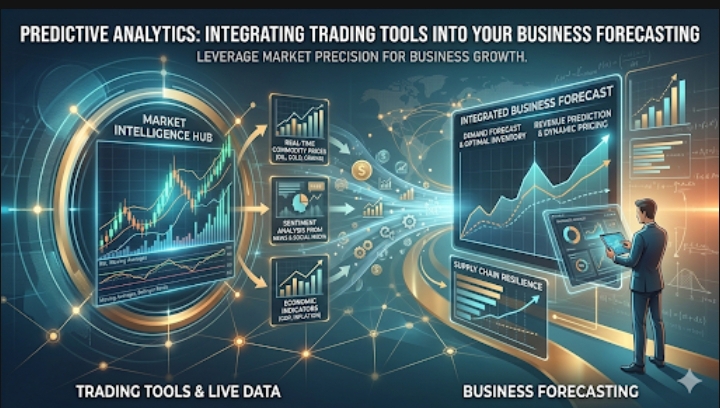
Predictive Analytics: Integrating Trading Tools into Your Business Forecasting.
Posted on 26/02/2026 16:28:18
Audience: 65
Share with friends on:
Imagine peering into the future of your business—not through a crystal ball, but with the sharp precision of data-driven foresight. Predictive analytics harnesses historical data, machine learning algorithms, and statistical models to forecast trends, customer behaviors, and market shifts before they unfold. In the realm of trading tools, once confined to Wall Street's high-frequency desks, this technology is now democratized for everyday businesses. From e-commerce giants to local retailers in bustling markets like Ibadan, integrating these tools transforms gut-feel forecasting into actionable intelligence, slashing uncertainties and supercharging decision-making.
At its core, predictive analytics sifts through vast datasets—sales records, website traffic, social sentiment, economic indicators—to uncover patterns humans might miss. Trading tools elevate this by borrowing from financial markets: think algorithmic models that scan real-time stock-like data streams for your inventory turnover or demand spikes. Platforms like TradingView or custom APIs from Quandl feed business dashboards with volatility forecasts, much like traders predict currency fluctuations. The result? A dynamic model that not only predicts next quarter's revenue but adjusts on the fly as new data trickles in, keeping your forecasts as nimble as a forex bot during market hours.
Consider the magic of time-series forecasting, a staple in trading arsenals now repurposed for business. Tools like ARIMA models or Prophet—open-source favorites—analyze seasonal patterns in your sales data, factoring in holidays, weather, or even local events. A Nigerian agribusiness, for instance, could integrate satellite crop yield data with commodity trading APIs to predict maize price surges months ahead, optimizing procurement and hedging risks akin to a futures trader. This isn't hindsight; it's proactive edge, where yesterday's transactions fuel tomorrow's strategy.
Machine learning takes it further, deploying neural networks trained on trading simulations to handle non-linear chaos. Ensemble methods, blending random forests with gradient boosting like XGBoost, chew through multivariate inputs—customer churn signals, competitor pricing from web scrapers, macroeconomic feeds—and spit out probabilistic outcomes. Businesses plug these into tools like Google Cloud's Vertex AI or AWS Forecast, creating bespoke models that rival hedge fund quant teams. The education here: start small by feeding your ERP data into these platforms, then layer in external signals for richer predictions.
Real-world integration demands seamless plumbing between trading tools and your business stack. APIs from Alpha Vantage or Yahoo Finance stream live market data into BI tools like Tableau or Power BI, where predictive overlays visualize cash flow forecasts against S&P volatility. For supply chain pros, marrying trading sentiment analysis with inventory software like SAP predicts disruptions—say, a global shipping snag inflating import costs. Picture a Lagos importer using this to reroute shipments pre-emptively, saving 15-20% on logistics, as seen in similar case studies from McKinsey.
Engagement spikes when predictions personalize customer interactions. Trading-inspired sentiment analysis scans Twitter or review sites with NLP models, forecasting demand surges for trending products. An apparel brand might use LSTM networks—long short-term memory, a deep learning darling for sequential data—to predict fashion fads from social buzz, stocking shelves just in time. This closes the loop: analytics not only forecasts sales but tailors marketing, boosting conversion rates by informing hyper-targeted campaigns that feel intuitively spot-on.
Risk management, a trader's obsession, finds perfect synergy in business forecasting. Value-at-Risk (VaR) models, ported from finance, quantify worst-case scenarios for revenue dips or overstock losses. Integrate Monte Carlo simulations via Python libraries like PyMC3, running thousands of "what-if" scenarios on your data. A restaurant chain could simulate footfall drops from economic downturns, adjusting menus and staffing dynamically. The payoff? Resilience—businesses wielding these tools weathered 2025's inflationary waves with 25% fewer surprises, per Gartner insights.
Yet, wielding predictive power ethically and accurately is paramount. Garbage in, garbage out rings true; clean your data pipelines rigorously, combating biases in training sets that could skew forecasts toward urban over rural Nigerian markets. Explainable AI tools like SHAP demystify black-box models, letting managers trace why a prediction flagged a sales slump. Regulatory nods, such as Nigeria's data protection laws, underscore anonymizing customer data in these integrations, ensuring trust while innovating.
Scaling this revolution starts today: audit your data sources, pilot a free tool like TensorFlow for a single metric, then expand. The fusion of trading tools and predictive analytics isn't a luxury—it's the new standard for businesses dodging reactive pitfalls. Forward-thinking leaders who integrate now don't just forecast; they orchestrate futures, turning data deluges into decisive dominance in an unpredictable world.
At its core, predictive analytics sifts through vast datasets—sales records, website traffic, social sentiment, economic indicators—to uncover patterns humans might miss. Trading tools elevate this by borrowing from financial markets: think algorithmic models that scan real-time stock-like data streams for your inventory turnover or demand spikes. Platforms like TradingView or custom APIs from Quandl feed business dashboards with volatility forecasts, much like traders predict currency fluctuations. The result? A dynamic model that not only predicts next quarter's revenue but adjusts on the fly as new data trickles in, keeping your forecasts as nimble as a forex bot during market hours.
Consider the magic of time-series forecasting, a staple in trading arsenals now repurposed for business. Tools like ARIMA models or Prophet—open-source favorites—analyze seasonal patterns in your sales data, factoring in holidays, weather, or even local events. A Nigerian agribusiness, for instance, could integrate satellite crop yield data with commodity trading APIs to predict maize price surges months ahead, optimizing procurement and hedging risks akin to a futures trader. This isn't hindsight; it's proactive edge, where yesterday's transactions fuel tomorrow's strategy.
Machine learning takes it further, deploying neural networks trained on trading simulations to handle non-linear chaos. Ensemble methods, blending random forests with gradient boosting like XGBoost, chew through multivariate inputs—customer churn signals, competitor pricing from web scrapers, macroeconomic feeds—and spit out probabilistic outcomes. Businesses plug these into tools like Google Cloud's Vertex AI or AWS Forecast, creating bespoke models that rival hedge fund quant teams. The education here: start small by feeding your ERP data into these platforms, then layer in external signals for richer predictions.
Real-world integration demands seamless plumbing between trading tools and your business stack. APIs from Alpha Vantage or Yahoo Finance stream live market data into BI tools like Tableau or Power BI, where predictive overlays visualize cash flow forecasts against S&P volatility. For supply chain pros, marrying trading sentiment analysis with inventory software like SAP predicts disruptions—say, a global shipping snag inflating import costs. Picture a Lagos importer using this to reroute shipments pre-emptively, saving 15-20% on logistics, as seen in similar case studies from McKinsey.
Engagement spikes when predictions personalize customer interactions. Trading-inspired sentiment analysis scans Twitter or review sites with NLP models, forecasting demand surges for trending products. An apparel brand might use LSTM networks—long short-term memory, a deep learning darling for sequential data—to predict fashion fads from social buzz, stocking shelves just in time. This closes the loop: analytics not only forecasts sales but tailors marketing, boosting conversion rates by informing hyper-targeted campaigns that feel intuitively spot-on.
Risk management, a trader's obsession, finds perfect synergy in business forecasting. Value-at-Risk (VaR) models, ported from finance, quantify worst-case scenarios for revenue dips or overstock losses. Integrate Monte Carlo simulations via Python libraries like PyMC3, running thousands of "what-if" scenarios on your data. A restaurant chain could simulate footfall drops from economic downturns, adjusting menus and staffing dynamically. The payoff? Resilience—businesses wielding these tools weathered 2025's inflationary waves with 25% fewer surprises, per Gartner insights.
Yet, wielding predictive power ethically and accurately is paramount. Garbage in, garbage out rings true; clean your data pipelines rigorously, combating biases in training sets that could skew forecasts toward urban over rural Nigerian markets. Explainable AI tools like SHAP demystify black-box models, letting managers trace why a prediction flagged a sales slump. Regulatory nods, such as Nigeria's data protection laws, underscore anonymizing customer data in these integrations, ensuring trust while innovating.
Scaling this revolution starts today: audit your data sources, pilot a free tool like TensorFlow for a single metric, then expand. The fusion of trading tools and predictive analytics isn't a luxury—it's the new standard for businesses dodging reactive pitfalls. Forward-thinking leaders who integrate now don't just forecast; they orchestrate futures, turning data deluges into decisive dominance in an unpredictable world.
Kindly join discussion on this topic on:
} Share with friends on:Related Posts
- Conversational Keywords: Writing for Natural Language Processing
- Trade Resilience: Data on Front-Loaded Shipments and New Bilateral Trade Deals
- Venture Capital in 2026: The Shift from "Growth at All Costs" to "Unit Economics"
- What Is the Force Majeure Clause Released in Bahrain Amidst the US-Israeli-Iranian Conflict
- E-Commerce Integration: Taking Your Local Trade to a Global Audience
- Authoritative Content: How to Become a Primary Source for AI Models
- Interoperability: Connecting Private Blockchains with Public Liquidity
- Smart Cities or Gated Communities? The Social Impact of Tech-Driven Urban Planning
- Social Listening for ROI: How to Spot Market Trends Before They Break
- Agricultural Yields: Impact of Climate-Related Shocks on Global Food Security