The Most Profitable Cash Crops to Grow in 2026/2027
Posted on 20/02/2026 11:51:59
Audience: 195
Share with friends on:
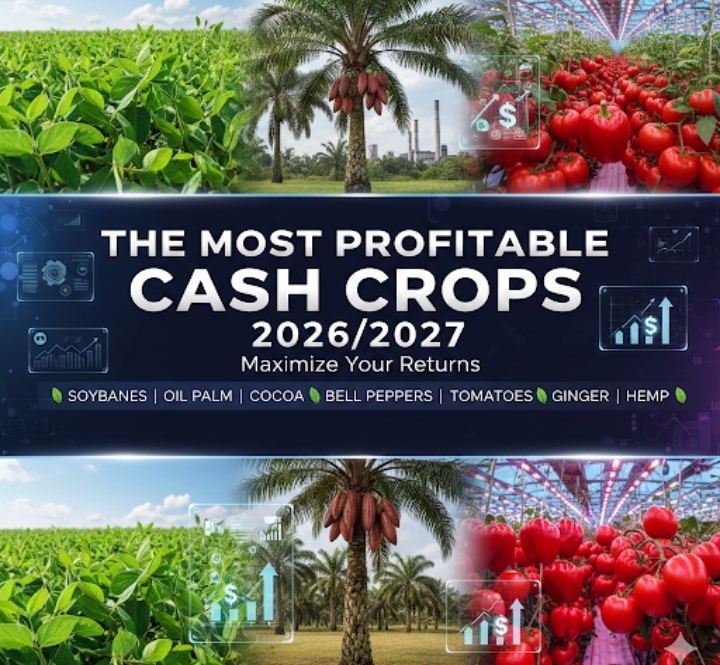
As the global agricultural landscape shifts toward sustainable and high-efficiency models in 2026 and 2027, certain cash crops are emerging as frontrunners for farmers seeking maximized returns. The transition is largely driven by a growing demand for plant-based proteins, renewable energy sources, and specialty health products. In this environment, soyabeans remain a powerhouse of profitability, fueled by their dual utility in the livestock feed industry and the expanding market for meat alternatives. Because soyabeans require relatively low water and nitrogen compared to other staples, they offer a favorable margin, especially as precision farming technologies help reduce the overhead costs associated with large-scale production.
For those looking toward long-term wealth, tree crops like oil palm and cocoa are reaching new heights of value. In regions like West Africa and Southeast Asia, the industrial demand for palm oil and its myriad by-products—ranging from cosmetics to biofuels—ensures a consistent market. While these crops require significant initial investment and several years to mature, their ability to provide a steady income stream for two to three decades makes them foundational assets for commercial estates. Cocoa, in particular, is seeing a price resurgence as global supply chains tighten and consumer preference for ethically sourced, high-quality chocolate continues to grow.
Horticultural crops, specifically bell peppers and tomatoes, represent the most lucrative options for farmers who prioritize quick turnover and high cash flow. These "fast-money" crops are indispensable in domestic markets and, when grown using greenhouse or irrigation systems, can bypass the volatility of seasonal price fluctuations. In 2026, bell peppers have become a standout performer due to their premium pricing in urban centers and their suitability for export. By utilizing improved hybrid seeds and intensive spacing, small-scale growers can achieve yields that far exceed the profit-per-hectare of traditional grains.
The export-driven spice and root market is another area where significant gains are expected in 2027. Ginger, for instance, has transitioned from a niche flavoring to a high-demand global commodity, valued for its medicinal properties and long shelf life. Farmers who focus on organic certification for ginger can command even higher premiums in European and North American markets. Similarly, garlic and turmeric are gaining ground as "superfood" cash crops that require relatively low maintenance but offer substantial returns when processed into powders or oils, allowing farmers to capture more value along the supply chain.
Staple grains like maize and rice continue to be reliable anchors for agricultural portfolios, particularly in developing economies where food security remains a priority. The profitability of maize in 2026 is bolstered by its essential role in the production of animal feed and industrial ethanol. To maximize earnings from these staples, forward-thinking farmers are moving toward mechanization and the use of drought-resistant hybrids. These advancements allow for multiple harvest cycles within a single year, effectively doubling the annual profit potential of a single plot of land compared to traditional single-crop cycles.
Finally, "niche" crops such as chickpeas, lentils, and even industrial hemp are becoming strategic choices for diversification. As soil health becomes a critical metric for farm viability, these nitrogen-fixing legumes are being integrated into crop rotations to reduce fertilizer costs for subsequent seasons. Industrial hemp, specifically, is seeing increased adoption due to its versatility in the textile and construction industries. By balancing high-risk, high-reward horticultural crops with stable legumes and long-term tree plantations, farmers in the 2026/2027 season can build a resilient and highly profitable agribusiness.
For those looking toward long-term wealth, tree crops like oil palm and cocoa are reaching new heights of value. In regions like West Africa and Southeast Asia, the industrial demand for palm oil and its myriad by-products—ranging from cosmetics to biofuels—ensures a consistent market. While these crops require significant initial investment and several years to mature, their ability to provide a steady income stream for two to three decades makes them foundational assets for commercial estates. Cocoa, in particular, is seeing a price resurgence as global supply chains tighten and consumer preference for ethically sourced, high-quality chocolate continues to grow.
Horticultural crops, specifically bell peppers and tomatoes, represent the most lucrative options for farmers who prioritize quick turnover and high cash flow. These "fast-money" crops are indispensable in domestic markets and, when grown using greenhouse or irrigation systems, can bypass the volatility of seasonal price fluctuations. In 2026, bell peppers have become a standout performer due to their premium pricing in urban centers and their suitability for export. By utilizing improved hybrid seeds and intensive spacing, small-scale growers can achieve yields that far exceed the profit-per-hectare of traditional grains.
The export-driven spice and root market is another area where significant gains are expected in 2027. Ginger, for instance, has transitioned from a niche flavoring to a high-demand global commodity, valued for its medicinal properties and long shelf life. Farmers who focus on organic certification for ginger can command even higher premiums in European and North American markets. Similarly, garlic and turmeric are gaining ground as "superfood" cash crops that require relatively low maintenance but offer substantial returns when processed into powders or oils, allowing farmers to capture more value along the supply chain.
Staple grains like maize and rice continue to be reliable anchors for agricultural portfolios, particularly in developing economies where food security remains a priority. The profitability of maize in 2026 is bolstered by its essential role in the production of animal feed and industrial ethanol. To maximize earnings from these staples, forward-thinking farmers are moving toward mechanization and the use of drought-resistant hybrids. These advancements allow for multiple harvest cycles within a single year, effectively doubling the annual profit potential of a single plot of land compared to traditional single-crop cycles.
Finally, "niche" crops such as chickpeas, lentils, and even industrial hemp are becoming strategic choices for diversification. As soil health becomes a critical metric for farm viability, these nitrogen-fixing legumes are being integrated into crop rotations to reduce fertilizer costs for subsequent seasons. Industrial hemp, specifically, is seeing increased adoption due to its versatility in the textile and construction industries. By balancing high-risk, high-reward horticultural crops with stable legumes and long-term tree plantations, farmers in the 2026/2027 season can build a resilient and highly profitable agribusiness.
Kindly join discussion on this topic on:
} Share with friends on:Related Posts
- Conversational Keywords: Writing for Natural Language Processing
- Trade Resilience: Data on Front-Loaded Shipments and New Bilateral Trade Deals
- Venture Capital in 2026: The Shift from "Growth at All Costs" to "Unit Economics"
- What Is the Force Majeure Clause Released in Bahrain Amidst the US-Israeli-Iranian Conflict
- E-Commerce Integration: Taking Your Local Trade to a Global Audience
- Authoritative Content: How to Become a Primary Source for AI Models
- Interoperability: Connecting Private Blockchains with Public Liquidity
- Smart Cities or Gated Communities? The Social Impact of Tech-Driven Urban Planning
- Social Listening for ROI: How to Spot Market Trends Before They Break
- Agricultural Yields: Impact of Climate-Related Shocks on Global Food Security