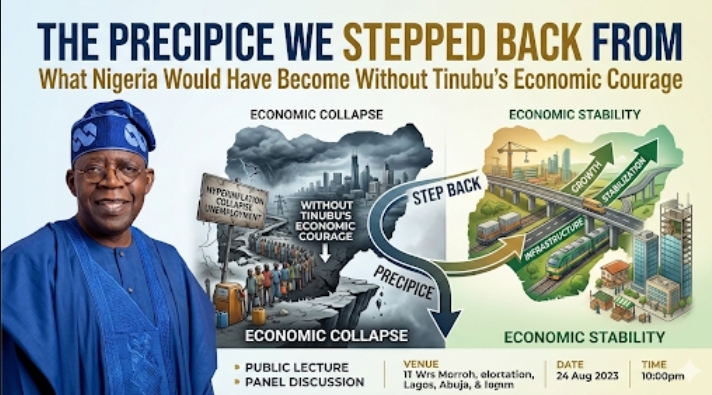
The Precipice We Stepped Back From: What Nigeria Would Have Become Without Tinubu's Economic Courage
Posted on 05/03/2026 10:36:45
Audience: 104
Share with friends on:
To understand the weight of what President Bola Ahmed Tinubu did on May 29, 2023, one must first be willing to imagine the alternative — a Nigeria that continued limping down a path of subsidised paralysis, artificial exchange rates, and an economy rigged to serve a privileged few at the expense of the many. The hardship Nigerians feel today is real, undeniable, and worthy of honest conversation. But the more important and perhaps more uncomfortable conversation is the one about what would have been — what depths of economic ruin, institutional decay, and generational poverty Nigeria would have descended into had a leader, any leader, lacked the nerve to make the decisions that Tinubu made in the opening hours of his administration. History will not judge Nigeria by the pain of transition. It will judge her by whether she had the wisdom to change course before the course changed her.
For decades, Nigeria ran one of the most expensive and most corrupt fuel subsidy regimes in the world. At its peak, the Federal Government was spending upwards of ₦4 trillion annually — later ballooning to over ₦6 trillion — to keep petrol prices artificially low at the pump. On paper, it looked like a social good. In reality, it was a sophisticated wealth transfer mechanism that moved public money into the pockets of oil marketers, NNPC insiders, and a cabal of subsidy rent-seekers who had perfected the art of importing fuel that never arrived and claiming billions for a phantom public service. The Nigerian poor, the very people the subsidy was meant to protect, bought petrol from black market hawkers at inflated prices anyway, while the elite filled their generators and fleet vehicles at government-subsidised stations. Every naira that left the federation account for subsidy was a naira that never built a hospital, never trained a teacher, never fixed a road, and never powered a productive enterprise. Had Tinubu not removed the subsidy, Nigeria would have entered 2025 spending, by conservative projections, somewhere between ₦8 trillion and ₦15 trillion per year on a programme that was actively impoverishing the nation it claimed to protect.
The foreign exchange crisis that preceded Tinubu's reforms was quietly strangling every sector of Nigeria's productive economy. Under a managed multiple exchange rate regime, the official rate bore no relationship to economic reality. While the Central Bank sold dollars at artificially suppressed rates to a tiny group of favoured importers and politically connected businessmen, manufacturers, farmers who needed imported inputs, hospitals that required foreign medical supplies, and students paying school fees abroad were all forced to scramble for forex on a parallel market that the government simultaneously criminalised and secretly depended upon. The result was a catastrophic disincentive to invest. Why would any serious foreign investor bring capital into an economy where they could not repatriate profits at a fair rate? Why would any Nigerian entrepreneur build a factory that relied on imported machinery when the cost of accessing foreign exchange was unpredictable, politicised, and often simply impossible? The unification of the exchange rate, painful as it was in the short term, removed the most debilitating structural distortion in Nigeria's modern economic history. Without that reform, Nigeria was on a trajectory to becoming fully uninvestable — a country that printed naira with one hand and watched its real economic capacity shrink with the other.
Consider the full portrait of a Nigeria that never made these reforms. By the end of 2025, with subsidy payments restored and foreign exchange distortions intact, the Federation Account would have been functionally empty. States would have been unable to pay salaries. The National Grid, already fragile beyond description, would have lost whatever modest investment was beginning to flow into the power sector. Nigeria's debt service obligations — already consuming well over 90 kobo of every naira of government revenue — would have crossed into the territory of total fiscal insolvency. The International Monetary Fund and the World Bank would not merely be cautioning Nigeria; they would be issuing formal sovereign risk warnings. Nigeria's Eurobonds would have faced severe downgrades. The naira, rather than finding a troubled but real market-determined floor, would have been collapsing in the shadows of an underground economy that the government no longer had the reserves to even pretend to manage. The economy, in short, would not merely have been in recession. It would have been in a structured descent toward the kind of macroeconomic crisis that takes not years but decades to recover from.
The human cost of inaction deserves to be spoken plainly. An unreformed Nigeria, still paying subsidies and maintaining phantom exchange rates, would have been a Nigeria incapable of funding its primary health care system at any meaningful scale. Infant and maternal mortality, already among the highest in the world, would have continued their grim trajectory. Public schools, already teaching under trees and through collapsing roofs, would have seen their teachers go unpaid for months at a stretch. Youth unemployment, sitting officially around 33 percent but realistically far higher when one accounts for disguised and informal unemployment, would have pushed deeper into social crisis territory. The insurgency in the Northeast, the banditry across the Northwest, the militancy and kidnapping that have bled the Middle Belt and parts of the South — these are not simply failures of security policy. They are, in large measure, the violence of economic exclusion. A nation that cannot employ its young men and women, that offers no credible pathway from poverty to participation, creates the conditions in which desperate people make desperate choices. Removing the distortions that were choking Nigeria's economy was, among other things, an act of long-term security policy.
There is a particular cruelty in the timing of Nigeria's reforms coinciding with one of the most turbulent periods for emerging markets in living memory. The global interest rate environment that followed the post-COVID inflation surge pushed dollar borrowing costs to levels not seen in a generation, hammering every developing economy that carried dollar-denominated debt. Commodity price volatility, disrupted supply chains, and the residual effects of the Russia-Ukraine conflict on energy and food markets created headwinds that no economic reform programme, however well-designed, could simply wish away. Nigerians who feel that the reforms have not yet delivered the promised relief are not wrong to feel that way. But the question is never whether pain exists. The question is whether the pain is the pain of healing or the pain of continuing to be sick. The Nigeria that did not reform would have faced this same brutal global environment — with the added burden of a subsidy bill crowding out every other public expenditure, a foreign exchange regime that scared away the investment needed to diversify the economy, and a fiscal position so weak that there would have been nothing left to shield the most vulnerable from the storm.
It is worth dwelling for a moment on what has quietly changed, even in the midst of difficulty. Nigeria's foreign reserves have stabilised. The parallel market premium — that shadow toll that once punished every honest business that could not get to the front of the CBN's forex queue — has largely collapsed as the official and street rates have converged. Foreign portfolio investors have begun returning to Nigerian markets. The International Finance Corporation and the African Development Bank, among other multilateral institutions, have deepened their engagement with Nigeria in ways they would not have considered under the old regime. States are receiving larger absolute transfers from the Federation Account, even as they rightly continue to argue about how those funds are managed. The Nigerian National Petroleum Company Limited is, for the first time in its troubled history, beginning to be held to something approaching commercial accountability. None of this is enough. But all of it is the difference between a country building from rubble and a country still adding to its pile of rubble.
The backlash against Tinubu's reforms has been passionate and, in many respects, understandable. Labour unions organised strikes. Market women wept at prices they had never seen before. Ordinary families who once budgeted their transport costs with some predictability suddenly found that budgets they had kept for years were useless. Politicians who benefited handsomely from the subsidy and forex rackets reinvented themselves overnight as champions of the poor and flooded the airwaves with outrage. The opposition was not always wrong in its compassion, even when it was deeply disingenuous in its prescription. Asking Nigerians who are already living at the margin to absorb the shock of structural adjustment without adequate palliative measures is a genuine governance failure, and the administration must own that. But opposing the reforms themselves — demanding a return to subsidies, to multiple exchange rates, to the architecture of managed scarcity — would not have been a defence of the poor. It would have been the slow strangulation of the poor in a more comfortable-feeling embrace.
What Nigeria needs now is not a retreat from reform but the political will to complete it. The removal of the petrol subsidy and the forex unification were the clearing of infected tissue. The work of building healthy tissue — investing the freed-up resources into functional public infrastructure, into education and health systems that actually deliver, into an agricultural sector that can genuinely feed the nation, into manufacturing incentives that create the jobs a young and growing population desperately needs — is the harder and longer task. It is the task for which the painful cuts were supposed to be preparation, not conclusion. The credibility of Tinubu's entire economic project rests not on whether Nigerians are comfortable today but on whether the pain of today is visibly and verifiably buying something real for tomorrow. That accountability must be demanded, loudly and persistently, by every Nigerian who understood what reforms were for and is now watching to make sure they are used for exactly that purpose.
Nigeria has walked away from the edge of a cliff it had been approaching for thirty years. The walk was bruising and it is not over. The ground ahead is uneven, the weather is harsh, and the guides are not always trustworthy. But the alternative was to stay on the cliff — to kick the can one more time, to tell one more generation that the hard choices could wait, to let the subsidy machine and the forex racket and the institutionalised rent-seeking run until the whole edifice collapsed under its own contradictions. That collapse, had it come — and it was coming — would not have spared anyone. Not the middle class that is suffering now. Not the poor that the populists claim to speak for. Not the businesses that are grinding through import costs and power failures. Nigeria without Tinubu's boldness would not have been a more comfortable Nigeria. It would have been a Nigeria that had run out of time, run out of reserves, and run out of the basic institutional coherence needed to begin again. That is the country we did not become. That, in the end, may be the most important story of this difficult season.
For decades, Nigeria ran one of the most expensive and most corrupt fuel subsidy regimes in the world. At its peak, the Federal Government was spending upwards of ₦4 trillion annually — later ballooning to over ₦6 trillion — to keep petrol prices artificially low at the pump. On paper, it looked like a social good. In reality, it was a sophisticated wealth transfer mechanism that moved public money into the pockets of oil marketers, NNPC insiders, and a cabal of subsidy rent-seekers who had perfected the art of importing fuel that never arrived and claiming billions for a phantom public service. The Nigerian poor, the very people the subsidy was meant to protect, bought petrol from black market hawkers at inflated prices anyway, while the elite filled their generators and fleet vehicles at government-subsidised stations. Every naira that left the federation account for subsidy was a naira that never built a hospital, never trained a teacher, never fixed a road, and never powered a productive enterprise. Had Tinubu not removed the subsidy, Nigeria would have entered 2025 spending, by conservative projections, somewhere between ₦8 trillion and ₦15 trillion per year on a programme that was actively impoverishing the nation it claimed to protect.
The foreign exchange crisis that preceded Tinubu's reforms was quietly strangling every sector of Nigeria's productive economy. Under a managed multiple exchange rate regime, the official rate bore no relationship to economic reality. While the Central Bank sold dollars at artificially suppressed rates to a tiny group of favoured importers and politically connected businessmen, manufacturers, farmers who needed imported inputs, hospitals that required foreign medical supplies, and students paying school fees abroad were all forced to scramble for forex on a parallel market that the government simultaneously criminalised and secretly depended upon. The result was a catastrophic disincentive to invest. Why would any serious foreign investor bring capital into an economy where they could not repatriate profits at a fair rate? Why would any Nigerian entrepreneur build a factory that relied on imported machinery when the cost of accessing foreign exchange was unpredictable, politicised, and often simply impossible? The unification of the exchange rate, painful as it was in the short term, removed the most debilitating structural distortion in Nigeria's modern economic history. Without that reform, Nigeria was on a trajectory to becoming fully uninvestable — a country that printed naira with one hand and watched its real economic capacity shrink with the other.
Consider the full portrait of a Nigeria that never made these reforms. By the end of 2025, with subsidy payments restored and foreign exchange distortions intact, the Federation Account would have been functionally empty. States would have been unable to pay salaries. The National Grid, already fragile beyond description, would have lost whatever modest investment was beginning to flow into the power sector. Nigeria's debt service obligations — already consuming well over 90 kobo of every naira of government revenue — would have crossed into the territory of total fiscal insolvency. The International Monetary Fund and the World Bank would not merely be cautioning Nigeria; they would be issuing formal sovereign risk warnings. Nigeria's Eurobonds would have faced severe downgrades. The naira, rather than finding a troubled but real market-determined floor, would have been collapsing in the shadows of an underground economy that the government no longer had the reserves to even pretend to manage. The economy, in short, would not merely have been in recession. It would have been in a structured descent toward the kind of macroeconomic crisis that takes not years but decades to recover from.
The human cost of inaction deserves to be spoken plainly. An unreformed Nigeria, still paying subsidies and maintaining phantom exchange rates, would have been a Nigeria incapable of funding its primary health care system at any meaningful scale. Infant and maternal mortality, already among the highest in the world, would have continued their grim trajectory. Public schools, already teaching under trees and through collapsing roofs, would have seen their teachers go unpaid for months at a stretch. Youth unemployment, sitting officially around 33 percent but realistically far higher when one accounts for disguised and informal unemployment, would have pushed deeper into social crisis territory. The insurgency in the Northeast, the banditry across the Northwest, the militancy and kidnapping that have bled the Middle Belt and parts of the South — these are not simply failures of security policy. They are, in large measure, the violence of economic exclusion. A nation that cannot employ its young men and women, that offers no credible pathway from poverty to participation, creates the conditions in which desperate people make desperate choices. Removing the distortions that were choking Nigeria's economy was, among other things, an act of long-term security policy.
There is a particular cruelty in the timing of Nigeria's reforms coinciding with one of the most turbulent periods for emerging markets in living memory. The global interest rate environment that followed the post-COVID inflation surge pushed dollar borrowing costs to levels not seen in a generation, hammering every developing economy that carried dollar-denominated debt. Commodity price volatility, disrupted supply chains, and the residual effects of the Russia-Ukraine conflict on energy and food markets created headwinds that no economic reform programme, however well-designed, could simply wish away. Nigerians who feel that the reforms have not yet delivered the promised relief are not wrong to feel that way. But the question is never whether pain exists. The question is whether the pain is the pain of healing or the pain of continuing to be sick. The Nigeria that did not reform would have faced this same brutal global environment — with the added burden of a subsidy bill crowding out every other public expenditure, a foreign exchange regime that scared away the investment needed to diversify the economy, and a fiscal position so weak that there would have been nothing left to shield the most vulnerable from the storm.
It is worth dwelling for a moment on what has quietly changed, even in the midst of difficulty. Nigeria's foreign reserves have stabilised. The parallel market premium — that shadow toll that once punished every honest business that could not get to the front of the CBN's forex queue — has largely collapsed as the official and street rates have converged. Foreign portfolio investors have begun returning to Nigerian markets. The International Finance Corporation and the African Development Bank, among other multilateral institutions, have deepened their engagement with Nigeria in ways they would not have considered under the old regime. States are receiving larger absolute transfers from the Federation Account, even as they rightly continue to argue about how those funds are managed. The Nigerian National Petroleum Company Limited is, for the first time in its troubled history, beginning to be held to something approaching commercial accountability. None of this is enough. But all of it is the difference between a country building from rubble and a country still adding to its pile of rubble.
The backlash against Tinubu's reforms has been passionate and, in many respects, understandable. Labour unions organised strikes. Market women wept at prices they had never seen before. Ordinary families who once budgeted their transport costs with some predictability suddenly found that budgets they had kept for years were useless. Politicians who benefited handsomely from the subsidy and forex rackets reinvented themselves overnight as champions of the poor and flooded the airwaves with outrage. The opposition was not always wrong in its compassion, even when it was deeply disingenuous in its prescription. Asking Nigerians who are already living at the margin to absorb the shock of structural adjustment without adequate palliative measures is a genuine governance failure, and the administration must own that. But opposing the reforms themselves — demanding a return to subsidies, to multiple exchange rates, to the architecture of managed scarcity — would not have been a defence of the poor. It would have been the slow strangulation of the poor in a more comfortable-feeling embrace.
What Nigeria needs now is not a retreat from reform but the political will to complete it. The removal of the petrol subsidy and the forex unification were the clearing of infected tissue. The work of building healthy tissue — investing the freed-up resources into functional public infrastructure, into education and health systems that actually deliver, into an agricultural sector that can genuinely feed the nation, into manufacturing incentives that create the jobs a young and growing population desperately needs — is the harder and longer task. It is the task for which the painful cuts were supposed to be preparation, not conclusion. The credibility of Tinubu's entire economic project rests not on whether Nigerians are comfortable today but on whether the pain of today is visibly and verifiably buying something real for tomorrow. That accountability must be demanded, loudly and persistently, by every Nigerian who understood what reforms were for and is now watching to make sure they are used for exactly that purpose.
Nigeria has walked away from the edge of a cliff it had been approaching for thirty years. The walk was bruising and it is not over. The ground ahead is uneven, the weather is harsh, and the guides are not always trustworthy. But the alternative was to stay on the cliff — to kick the can one more time, to tell one more generation that the hard choices could wait, to let the subsidy machine and the forex racket and the institutionalised rent-seeking run until the whole edifice collapsed under its own contradictions. That collapse, had it come — and it was coming — would not have spared anyone. Not the middle class that is suffering now. Not the poor that the populists claim to speak for. Not the businesses that are grinding through import costs and power failures. Nigeria without Tinubu's boldness would not have been a more comfortable Nigeria. It would have been a Nigeria that had run out of time, run out of reserves, and run out of the basic institutional coherence needed to begin again. That is the country we did not become. That, in the end, may be the most important story of this difficult season.
Kindly join discussion on this topic on:
} Share with friends on:Related Posts
- Conversational Keywords: Writing for Natural Language Processing
- Trade Resilience: Data on Front-Loaded Shipments and New Bilateral Trade Deals
- Venture Capital in 2026: The Shift from "Growth at All Costs" to "Unit Economics"
- What Is the Force Majeure Clause Released in Bahrain Amidst the US-Israeli-Iranian Conflict
- E-Commerce Integration: Taking Your Local Trade to a Global Audience
- Authoritative Content: How to Become a Primary Source for AI Models
- Interoperability: Connecting Private Blockchains with Public Liquidity
- Smart Cities or Gated Communities? The Social Impact of Tech-Driven Urban Planning
- Social Listening for ROI: How to Spot Market Trends Before They Break
- Agricultural Yields: Impact of Climate-Related Shocks on Global Food Security