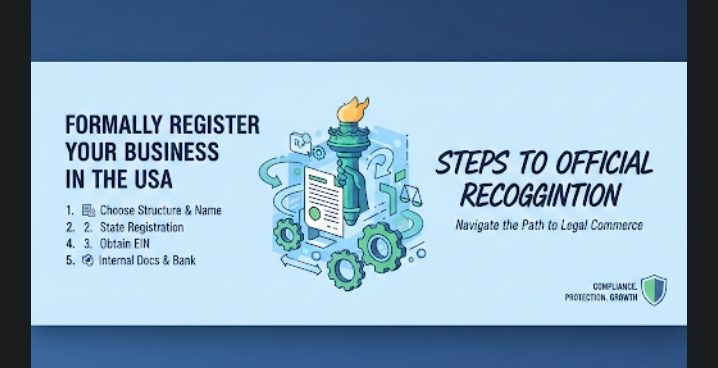
Steps Required to Formally Register a Business in USA
Posted on 21/02/2026 05:59:04
Audience: 79
Share with friends on:
Establishing a formal business entity in the United States begins with the foundational task of selecting a legal structure, which dictates everything from tax obligations to personal liability. Entrepreneurs typically choose between a sole proprietorship, partnership, limited liability company (LLC), or corporation. While a sole proprietorship is the simplest to form, an LLC or a corporation is often preferred for formal registration because these structures create a distinct legal entity that shields the owner’s personal assets from business debts. This choice is critical as it influences the specific documents you will need to file with government authorities in the subsequent steps.
Once a structure is decided, the next phase involves selecting and protecting a business name. This process requires a thorough search of state databases to ensure the name is unique and not already in use by another entity in the jurisdiction. If you plan to operate under a name other than your own legal name—such as "Royal Restaurant" or "ABC Airlines"—you may need to register a "Doing Business As" (DBA) name. Furthermore, it is often wise to check the United States Patent and Trademark Office (USPTO) database to ensure the chosen name does not infringe on existing federal trademarks, which provides a layer of protection that extends beyond state lines.
The heart of the registration process occurs at the state level, usually through the Secretary of State’s office. For an LLC, this involves filing Articles of Organization, while a corporation must file Articles of Incorporation. These documents typically outline the business name, its purpose, the names of the founders, and the details of a registered agent. A registered agent is a designated person or service with a physical address in the state who is authorized to receive legal and official documents on behalf of the company. It is important to note that if your business operates in multiple states, you must undergo a process called "foreign qualification" in each additional state to remain legally compliant.
Following state registration, businesses must interface with the federal government to obtain an Employer Identification Number (EIN) from the Internal Revenue Service (IRS). Often referred to as a social security number for a business, the EIN is a nine-digit identifier necessary for opening a business bank account, hiring employees, and filing federal tax returns. While U.S. citizens can typically apply for this online using a Social Security Number, non-citizens or those without an SSN may need to apply via mail or fax using an Individual Taxpayer Identification Number (ITIN). This step is non-negotiable for any entity that functions as a corporation or partnership, or any LLC that intends to have a payroll.
Beyond federal and state requirements, business owners must navigate local compliance by obtaining the necessary licenses and permits required by their city or county. Depending on the industry—such as food service, retail, or professional consulting—these permits might include general business operating licenses, health department permits, or professional certifications. Failing to secure these local approvals can result in heavy fines or the forced closure of the business, even if the state-level registration is perfectly in order. Each municipality has its own set of zoning laws and permit structures, so checking with the local clerk’s office is a vital final step in the legal setup.
Finally, the formalization process concludes with the establishment of internal governance and financial infrastructure. For an LLC, this means drafting an Operating Agreement, while corporations create Bylaws to define how the company will be managed and how disputes will be resolved. With the EIN and state formation documents in hand, the entrepreneur can then open a dedicated business bank account to keep personal and professional finances separate, which is essential for maintaining the "corporate veil" of liability protection. Once these administrative and financial foundations are laid, the business is officially recognized as a legal entity ready to engage in commerce within the United States.
Once a structure is decided, the next phase involves selecting and protecting a business name. This process requires a thorough search of state databases to ensure the name is unique and not already in use by another entity in the jurisdiction. If you plan to operate under a name other than your own legal name—such as "Royal Restaurant" or "ABC Airlines"—you may need to register a "Doing Business As" (DBA) name. Furthermore, it is often wise to check the United States Patent and Trademark Office (USPTO) database to ensure the chosen name does not infringe on existing federal trademarks, which provides a layer of protection that extends beyond state lines.
The heart of the registration process occurs at the state level, usually through the Secretary of State’s office. For an LLC, this involves filing Articles of Organization, while a corporation must file Articles of Incorporation. These documents typically outline the business name, its purpose, the names of the founders, and the details of a registered agent. A registered agent is a designated person or service with a physical address in the state who is authorized to receive legal and official documents on behalf of the company. It is important to note that if your business operates in multiple states, you must undergo a process called "foreign qualification" in each additional state to remain legally compliant.
Following state registration, businesses must interface with the federal government to obtain an Employer Identification Number (EIN) from the Internal Revenue Service (IRS). Often referred to as a social security number for a business, the EIN is a nine-digit identifier necessary for opening a business bank account, hiring employees, and filing federal tax returns. While U.S. citizens can typically apply for this online using a Social Security Number, non-citizens or those without an SSN may need to apply via mail or fax using an Individual Taxpayer Identification Number (ITIN). This step is non-negotiable for any entity that functions as a corporation or partnership, or any LLC that intends to have a payroll.
Beyond federal and state requirements, business owners must navigate local compliance by obtaining the necessary licenses and permits required by their city or county. Depending on the industry—such as food service, retail, or professional consulting—these permits might include general business operating licenses, health department permits, or professional certifications. Failing to secure these local approvals can result in heavy fines or the forced closure of the business, even if the state-level registration is perfectly in order. Each municipality has its own set of zoning laws and permit structures, so checking with the local clerk’s office is a vital final step in the legal setup.
Finally, the formalization process concludes with the establishment of internal governance and financial infrastructure. For an LLC, this means drafting an Operating Agreement, while corporations create Bylaws to define how the company will be managed and how disputes will be resolved. With the EIN and state formation documents in hand, the entrepreneur can then open a dedicated business bank account to keep personal and professional finances separate, which is essential for maintaining the "corporate veil" of liability protection. Once these administrative and financial foundations are laid, the business is officially recognized as a legal entity ready to engage in commerce within the United States.
Kindly join discussion on this topic on:
} Share with friends on:Related Posts
- Conversational Keywords: Writing for Natural Language Processing
- Trade Resilience: Data on Front-Loaded Shipments and New Bilateral Trade Deals
- Venture Capital in 2026: The Shift from "Growth at All Costs" to "Unit Economics"
- What Is the Force Majeure Clause Released in Bahrain Amidst the US-Israeli-Iranian Conflict
- E-Commerce Integration: Taking Your Local Trade to a Global Audience
- Authoritative Content: How to Become a Primary Source for AI Models
- Interoperability: Connecting Private Blockchains with Public Liquidity
- Smart Cities or Gated Communities? The Social Impact of Tech-Driven Urban Planning
- Social Listening for ROI: How to Spot Market Trends Before They Break
- Agricultural Yields: Impact of Climate-Related Shocks on Global Food Security