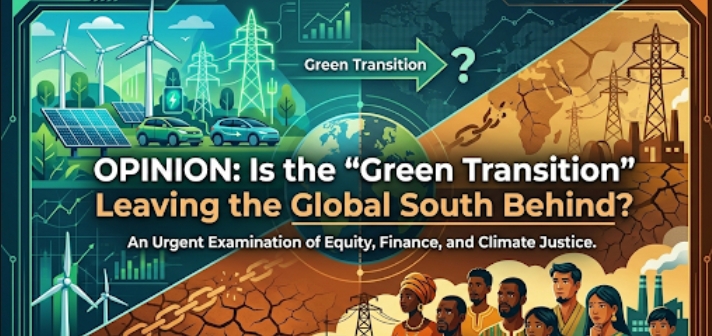
Opinion: Is the "Green Transition" Leaving the Global South Behind?
Posted on 06/03/2026 05:33:44
Audience: 117
Share with friends on:
The world's wealthiest nations have declared climate change the defining crisis of our time, pledging net-zero targets, electric vehicle mandates, and the rapid phaseout of fossil fuels. Yet as the green transition accelerates, an uncomfortable question hangs in the air: who is this transition actually being built for? The uncomfortable answer, increasingly, is that it is being built by and for the Global North, while the countries least responsible for historical emissions are being asked to bear a disproportionate share of the cost.
Consider the foundational injustice at the heart of this moment. Sub-Saharan Africa, home to over a billion people, is responsible for less than 4% of global cumulative carbon emissions. And yet countries across the continent are being pressured by international lenders and Western governments to forgo coal and gas development, even as hundreds of millions of their citizens still lack reliable access to electricity. When Nigeria or Mozambique discovers natural gas reserves that could power hospitals, schools, and small businesses, the response from wealthy nations is to restrict financing for such projects. The implicit message is chilling: the Global North industrialized its way to prosperity on fossil fuels for over two centuries, but the Global South must leapfrog that path entirely, on someone else's timeline, with tools that remain expensive and infrastructure that does not yet exist.
The financing gap makes this even more stark. Developed nations promised $100 billion per year in climate finance to poorer countries back in 2009, a target they failed to meet for over a decade. Meanwhile, the transition itself demands trillions, not billions. The International Energy Agency estimates that emerging and developing economies outside China need to triple their clean energy investments by 2030 to stay on track with global climate goals. Where is that money supposed to come from? International Monetary Fund loans come with austerity conditions. Green bonds favor countries with strong credit ratings. And bilateral climate finance from wealthy nations often arrives as loans rather than grants, deepening the debt burden of countries already strangled by borrowing costs that dwarf those of their richer counterparts.
There is also the matter of who controls the green economy's supply chains. The minerals that power the clean energy revolution, including cobalt, lithium, and manganese, are concentrated in countries like the Democratic Republic of Congo, Zambia, and Zimbabwe. For a fleeting moment, this looked like an opportunity: resource-rich African and Latin American nations finally holding cards in a global economic game. But the pattern of extraction that defined colonialism is reasserting itself. Raw materials are mined under often exploitative conditions, shipped abroad to be refined and manufactured into batteries and turbines in China, the United States, or Europe, and then sold back to the world as finished goods. The value-added manufacturing, the jobs, the technology transfer, remain elsewhere. The Global South gets the mines and the dust; the Global North gets the electric vehicles and the green growth narrative.
None of this means the green transition is wrong. Climate change is an existential threat, and the science is unambiguous. But a transition designed without genuine equity at its core is not only morally bankrupt; it is also strategically self-defeating. If developing nations conclude, reasonably, that the green agenda is another form of Western conditionality dressed in the language of environmentalism, the political will to cooperate on global climate targets will collapse. Solidarity cannot be demanded from those who have been denied solidarity themselves. The path forward requires real, unconditional financial transfers, technology sharing, and the space for developing nations to chart their own energy futures, even if those paths look messier and slower than Western planners would prefer. The planet cannot be saved by a green transition that only works for the already fortunate.
Consider the foundational injustice at the heart of this moment. Sub-Saharan Africa, home to over a billion people, is responsible for less than 4% of global cumulative carbon emissions. And yet countries across the continent are being pressured by international lenders and Western governments to forgo coal and gas development, even as hundreds of millions of their citizens still lack reliable access to electricity. When Nigeria or Mozambique discovers natural gas reserves that could power hospitals, schools, and small businesses, the response from wealthy nations is to restrict financing for such projects. The implicit message is chilling: the Global North industrialized its way to prosperity on fossil fuels for over two centuries, but the Global South must leapfrog that path entirely, on someone else's timeline, with tools that remain expensive and infrastructure that does not yet exist.
The financing gap makes this even more stark. Developed nations promised $100 billion per year in climate finance to poorer countries back in 2009, a target they failed to meet for over a decade. Meanwhile, the transition itself demands trillions, not billions. The International Energy Agency estimates that emerging and developing economies outside China need to triple their clean energy investments by 2030 to stay on track with global climate goals. Where is that money supposed to come from? International Monetary Fund loans come with austerity conditions. Green bonds favor countries with strong credit ratings. And bilateral climate finance from wealthy nations often arrives as loans rather than grants, deepening the debt burden of countries already strangled by borrowing costs that dwarf those of their richer counterparts.
There is also the matter of who controls the green economy's supply chains. The minerals that power the clean energy revolution, including cobalt, lithium, and manganese, are concentrated in countries like the Democratic Republic of Congo, Zambia, and Zimbabwe. For a fleeting moment, this looked like an opportunity: resource-rich African and Latin American nations finally holding cards in a global economic game. But the pattern of extraction that defined colonialism is reasserting itself. Raw materials are mined under often exploitative conditions, shipped abroad to be refined and manufactured into batteries and turbines in China, the United States, or Europe, and then sold back to the world as finished goods. The value-added manufacturing, the jobs, the technology transfer, remain elsewhere. The Global South gets the mines and the dust; the Global North gets the electric vehicles and the green growth narrative.
None of this means the green transition is wrong. Climate change is an existential threat, and the science is unambiguous. But a transition designed without genuine equity at its core is not only morally bankrupt; it is also strategically self-defeating. If developing nations conclude, reasonably, that the green agenda is another form of Western conditionality dressed in the language of environmentalism, the political will to cooperate on global climate targets will collapse. Solidarity cannot be demanded from those who have been denied solidarity themselves. The path forward requires real, unconditional financial transfers, technology sharing, and the space for developing nations to chart their own energy futures, even if those paths look messier and slower than Western planners would prefer. The planet cannot be saved by a green transition that only works for the already fortunate.
Kindly join discussion on this topic on:
} Share with friends on:Related Posts
- Conversational Keywords: Writing for Natural Language Processing
- Trade Resilience: Data on Front-Loaded Shipments and New Bilateral Trade Deals
- Venture Capital in 2026: The Shift from "Growth at All Costs" to "Unit Economics"
- What Is the Force Majeure Clause Released in Bahrain Amidst the US-Israeli-Iranian Conflict
- E-Commerce Integration: Taking Your Local Trade to a Global Audience
- Authoritative Content: How to Become a Primary Source for AI Models
- Interoperability: Connecting Private Blockchains with Public Liquidity
- Smart Cities or Gated Communities? The Social Impact of Tech-Driven Urban Planning
- Social Listening for ROI: How to Spot Market Trends Before They Break
- Agricultural Yields: Impact of Climate-Related Shocks on Global Food Security