Understanding Decentralized Finance (DeFi) vs. Traditional Banking
Posted on 14/02/2026 19:47:41
Audience: 114
Share with friends on:
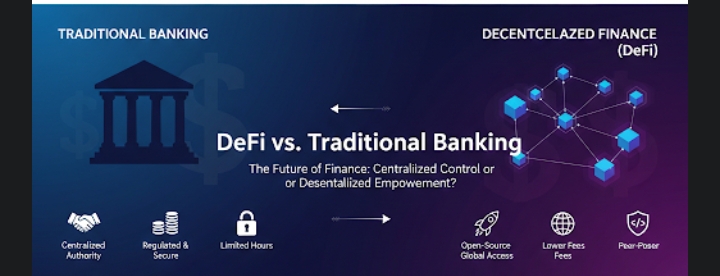
Traditional banking has served as the bedrock of global commerce for centuries, relying on a centralized architecture where institutions like commercial and central banks act as the primary gatekeepers of trust. In this model, financial activities are mediated by third parties that manage ledgers, verify identities, and facilitate movement of funds across borders. While this provides a sense of stability through government-backed insurance and regulatory oversight, it often introduces significant friction, including high transaction fees, limited banking hours, and long settlement periods. Furthermore, traditional banking remains exclusive, requiring credit checks and extensive documentation that often leave the "unbanked" population without a way to participate in the global economy.
Decentralized Finance, or DeFi, represents a fundamental shift away from these institutional intermediaries toward an open-source, permissionless ecosystem built on blockchain technology. Instead of relying on a bank’s private server to process a loan, DeFi uses smart contracts—self-executing code that automatically triggers transactions when predefined conditions are met. This decentralization ensures that the system is always accessible, operating 24 hours a day, 365 days a year, without the need for a physical branch or a central authority to approve a transfer. By removing the "middleman," DeFi can offer lower costs and near-instant cross-border settlement, democratizing access to complex financial tools like yield farming and automated liquidity provision.
Transparency is perhaps the most stark point of divergence between the two systems, as traditional banking operates on opaque, private ledgers that only authorized auditors can view. In contrast, DeFi transactions are recorded on public blockchains, making every movement of capital visible and verifiable by anyone with an internet connection. This radical transparency fosters a new kind of "trustless" accountability where users do not need to trust a bank's internal management; they simply trust the auditability of the underlying code. However, this openness comes with the responsibility of self-custody, meaning users are entirely responsible for securing their own digital wallets, a departure from the safety nets of fraud protection and password recovery offered by traditional institutions.
As we move through 2026, the lines between these two worlds are increasingly blurring through the rise of hybrid financial models. Traditional banks are beginning to integrate blockchain rails to improve the speed of their internal clearing processes, while prominent DeFi protocols are seeking regulatory charters to provide the same level of legal protection as conventional banks. This convergence suggests that the future of finance may not be a total replacement of one by the other, but rather a synergistic evolution. By combining the speed and inclusivity of decentralized protocols with the proven stability and consumer protections of traditional banking, the financial industry is moving toward a more resilient, globalized system that empowers the individual while maintaining systemic integrity.
Decentralized Finance, or DeFi, represents a fundamental shift away from these institutional intermediaries toward an open-source, permissionless ecosystem built on blockchain technology. Instead of relying on a bank’s private server to process a loan, DeFi uses smart contracts—self-executing code that automatically triggers transactions when predefined conditions are met. This decentralization ensures that the system is always accessible, operating 24 hours a day, 365 days a year, without the need for a physical branch or a central authority to approve a transfer. By removing the "middleman," DeFi can offer lower costs and near-instant cross-border settlement, democratizing access to complex financial tools like yield farming and automated liquidity provision.
Transparency is perhaps the most stark point of divergence between the two systems, as traditional banking operates on opaque, private ledgers that only authorized auditors can view. In contrast, DeFi transactions are recorded on public blockchains, making every movement of capital visible and verifiable by anyone with an internet connection. This radical transparency fosters a new kind of "trustless" accountability where users do not need to trust a bank's internal management; they simply trust the auditability of the underlying code. However, this openness comes with the responsibility of self-custody, meaning users are entirely responsible for securing their own digital wallets, a departure from the safety nets of fraud protection and password recovery offered by traditional institutions.
As we move through 2026, the lines between these two worlds are increasingly blurring through the rise of hybrid financial models. Traditional banks are beginning to integrate blockchain rails to improve the speed of their internal clearing processes, while prominent DeFi protocols are seeking regulatory charters to provide the same level of legal protection as conventional banks. This convergence suggests that the future of finance may not be a total replacement of one by the other, but rather a synergistic evolution. By combining the speed and inclusivity of decentralized protocols with the proven stability and consumer protections of traditional banking, the financial industry is moving toward a more resilient, globalized system that empowers the individual while maintaining systemic integrity.
Kindly join discussion on this topic on:
} Share with friends on:Related Posts
- Conversational Keywords: Writing for Natural Language Processing
- Trade Resilience: Data on Front-Loaded Shipments and New Bilateral Trade Deals
- Venture Capital in 2026: The Shift from "Growth at All Costs" to "Unit Economics"
- What Is the Force Majeure Clause Released in Bahrain Amidst the US-Israeli-Iranian Conflict
- E-Commerce Integration: Taking Your Local Trade to a Global Audience
- Authoritative Content: How to Become a Primary Source for AI Models
- Interoperability: Connecting Private Blockchains with Public Liquidity
- Smart Cities or Gated Communities? The Social Impact of Tech-Driven Urban Planning
- Social Listening for ROI: How to Spot Market Trends Before They Break
- Agricultural Yields: Impact of Climate-Related Shocks on Global Food Security