Steps to Get License for Operating Schools in Nigeria
Posted on 21/02/2026 03:14:38
Audience: 149
Share with friends on:
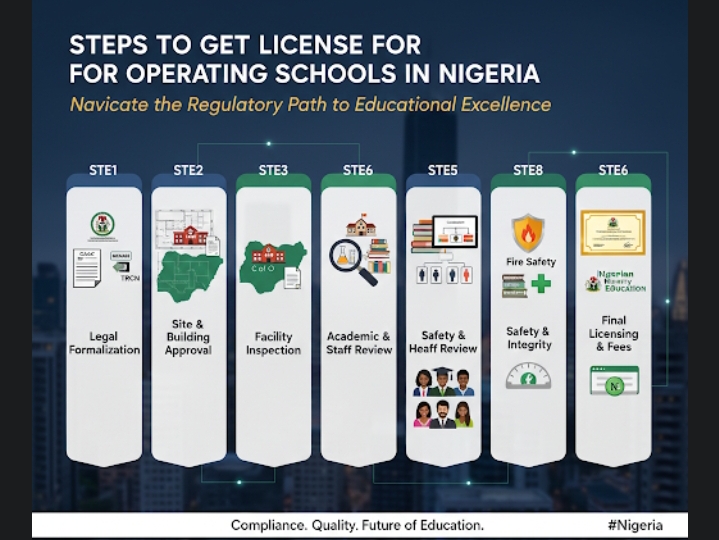
Establishing a private educational institution in Nigeria is a rigorous process governed by both federal corporate laws and state-specific educational standards. The journey begins with the legal formalization of the entity through the Corporate Affairs Commission (CAC). As of recent regulatory updates, schools can no longer operate as mere business names; they must be incorporated as limited liability companies. This step involves a name availability search, the submission of the Memorandum and Articles of Association—which must clearly state the school’s educational objectives—and the provision of valid identification for directors.
Furthermore, at least one director must hold a proficiency certificate from the Teachers Registration Council of Nigeria (TRCN) to satisfy the government that the leadership possesses the necessary academic and professional standing.
Once the corporate framework is in place, the proprietor must secure a suitable physical location that adheres to strict urban planning and educational zoning laws. The plot size and building specifications vary by state; for instance, many ministries require a minimum land area for playgrounds and expansion. Before construction or renovation begins, an application must be filed with the State Ministry of Education for site approval. This early engagement ensures that the proposed building plan—including classroom dimensions, ventilation, and emergency exits—meets the "National Minimum Standards." It is critical at this stage to have a legally executed land agreement or a Certificate of Occupancy (C of O) to prove ownership or long-term leasehold.
The next critical phase involves the first of several mandatory inspections by the Quality Assurance Bureau of the Ministry of Education. During this site visit, officials evaluate the "bricks and mortar" aspect of the school. They look for specific facilities such as an administrative block, a well-stocked library, a sickbay, and gender-segregated sanitation facilities with a high ratio of toilets to students.
For secondary schools, the presence of specialized laboratories for Physics, Chemistry, and Biology is non-negotiable. If the physical structure is deemed adequate, the ministry issues a "Provisional Approval," which allows the school to begin skeletal operations while the proprietor works toward full registration.
Following the physical assessment, the focus shifts to the academic and administrative integrity of the institution. A second inspection is usually conducted to review the curriculum, which must be aligned with the Nigerian National Policy on Education. Inspectors will examine statutory records such as the admission register, logbook, scheme of work, and the teachers' movement book. The staff must not only be qualified but also registered with the TRCN. The Ministry requires a complete staff list with original academic credentials and evidence of a stable financial plan, often necessitating a bank statement showing a significant minimum balance to ensure the school can sustain its operations for at least the first academic year.
Compliance with safety and health regulations forms the penultimate step in the licensing sequence. Proprietors must obtain a Fire Safety Certificate from the State Fire Service and a Health and Sanitation Permit from the Ministry of Health or local government health department. These permits verify that the school environment is safe from hazards and that there are adequate measures for waste management and clean water supply. In high-density areas like Lagos, an "Integrity Test Report" from the Material Testing Laboratory may also be required for existing buildings to certify that the structure can safely house hundreds of active children.
The final stage is the payment of the prescribed registration and licensing fees, which vary based on the school's capacity and the state of operation. Once all inspections are cleared and fees are confirmed via the government’s payment portal, the Ministry of Education issues the formal Letter of Approval or the Certificate of Registration. This document is the legal "license to operate" and must be renewed periodically through follow-up inspections. Operating without this final approval can lead to heavy fines or the permanent closure of the institution, making it essential for any serious educational entrepreneur to follow these steps meticulously.
Furthermore, at least one director must hold a proficiency certificate from the Teachers Registration Council of Nigeria (TRCN) to satisfy the government that the leadership possesses the necessary academic and professional standing.
Once the corporate framework is in place, the proprietor must secure a suitable physical location that adheres to strict urban planning and educational zoning laws. The plot size and building specifications vary by state; for instance, many ministries require a minimum land area for playgrounds and expansion. Before construction or renovation begins, an application must be filed with the State Ministry of Education for site approval. This early engagement ensures that the proposed building plan—including classroom dimensions, ventilation, and emergency exits—meets the "National Minimum Standards." It is critical at this stage to have a legally executed land agreement or a Certificate of Occupancy (C of O) to prove ownership or long-term leasehold.
The next critical phase involves the first of several mandatory inspections by the Quality Assurance Bureau of the Ministry of Education. During this site visit, officials evaluate the "bricks and mortar" aspect of the school. They look for specific facilities such as an administrative block, a well-stocked library, a sickbay, and gender-segregated sanitation facilities with a high ratio of toilets to students.
For secondary schools, the presence of specialized laboratories for Physics, Chemistry, and Biology is non-negotiable. If the physical structure is deemed adequate, the ministry issues a "Provisional Approval," which allows the school to begin skeletal operations while the proprietor works toward full registration.
Following the physical assessment, the focus shifts to the academic and administrative integrity of the institution. A second inspection is usually conducted to review the curriculum, which must be aligned with the Nigerian National Policy on Education. Inspectors will examine statutory records such as the admission register, logbook, scheme of work, and the teachers' movement book. The staff must not only be qualified but also registered with the TRCN. The Ministry requires a complete staff list with original academic credentials and evidence of a stable financial plan, often necessitating a bank statement showing a significant minimum balance to ensure the school can sustain its operations for at least the first academic year.
Compliance with safety and health regulations forms the penultimate step in the licensing sequence. Proprietors must obtain a Fire Safety Certificate from the State Fire Service and a Health and Sanitation Permit from the Ministry of Health or local government health department. These permits verify that the school environment is safe from hazards and that there are adequate measures for waste management and clean water supply. In high-density areas like Lagos, an "Integrity Test Report" from the Material Testing Laboratory may also be required for existing buildings to certify that the structure can safely house hundreds of active children.
The final stage is the payment of the prescribed registration and licensing fees, which vary based on the school's capacity and the state of operation. Once all inspections are cleared and fees are confirmed via the government’s payment portal, the Ministry of Education issues the formal Letter of Approval or the Certificate of Registration. This document is the legal "license to operate" and must be renewed periodically through follow-up inspections. Operating without this final approval can lead to heavy fines or the permanent closure of the institution, making it essential for any serious educational entrepreneur to follow these steps meticulously.
Kindly join discussion on this topic on:
} Share with friends on:Related Posts
- Conversational Keywords: Writing for Natural Language Processing
- Trade Resilience: Data on Front-Loaded Shipments and New Bilateral Trade Deals
- Venture Capital in 2026: The Shift from "Growth at All Costs" to "Unit Economics"
- What Is the Force Majeure Clause Released in Bahrain Amidst the US-Israeli-Iranian Conflict
- E-Commerce Integration: Taking Your Local Trade to a Global Audience
- Authoritative Content: How to Become a Primary Source for AI Models
- Interoperability: Connecting Private Blockchains with Public Liquidity
- Smart Cities or Gated Communities? The Social Impact of Tech-Driven Urban Planning
- Social Listening for ROI: How to Spot Market Trends Before They Break
- Agricultural Yields: Impact of Climate-Related Shocks on Global Food Security