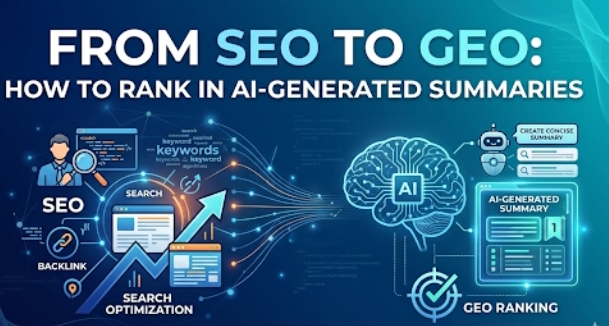
From SEO to GEO: How to Rank in AI-Generated Summaries
Posted on 04/03/2026 07:11:06
Audience: 117
Share with friends on:
The era of traditional SEO, where ranking high in blue-link search results reigned supreme, is giving way to GEO—Generational Engine Optimization—the art of positioning content to dominate AI-generated summaries that now cap search engine results pages. These summaries, powered by models like Google's Gemini or Perplexity's engines, aggregate and distill information from multiple sources into concise, authoritative answers, often reducing clicks to organic links by 18-64% for informational queries. To rank in them, shift from keyword-stuffed density to semantic relevance: craft content that mirrors natural query intent with structured data like schema markup for FAQs, lists, and tables, which AI crawlers prioritize for easy extraction. Explicitly, target long-tail, conversational phrases—"how to fix a leaky faucet step by step"—over broad terms, as AI favors precise, multi-faceted responses that pull from diverse, high-E-E-A-T (Experience, Expertise, Authoritativeness, Trustworthiness) sources.
Content structure becomes your first explicit lever in GEO. Use hierarchical headings (H1-H3) that pose direct questions or promises, followed by crisp paragraphs or numbered lists summarizing key takeaways—AI loves scannable formats like "5 proven steps" or "pros vs cons tables" because they map neatly to summary generation. Incorporate definition boxes, bolded key phrases, and TL;DR sections at article ends; for instance, Google's AI Overviews frequently cite pages with explicit "Key Takeaways" blocks, embedding them verbatim with source links. Avoid walls of text—aim for 300-800 words per section, laced with original data, case studies, or expert quotes that generic AI hallucinations can't replicate, ensuring your voice cuts through synthesized noise. Explicit tip: Test with tools like Ahrefs' content grader to score for "AI snippet potential" by checking snippet-friendly elements.
Authority signals amplify your GEO footprint exponentially. Build backlinks not just for PageRank but for co-citation—earn mentions alongside top domains like Wikipedia, Reddit threads, or niche forums, as AI engines cross-reference these for credibility. Publish first-party research or unique datasets; a study showing "40% CTR drop from AI summaries" positions you as the oracle AI queries. Leverage author bylines with verifiable credentials—link to LinkedIn or publications—and interlink clusters of your thematic content to signal topical depth. Explicitly, for YMYL (Your Money Your Life) topics like finance or health, flaunt medical reviews or CPA stamps, as AI filters ruthlessly for trust, often sidelining thin affiliate spam.
Technical GEO demands mobile-first indexing with Core Web Vitals in the green—Core Web Vitals score above 90%—since sluggish loads get deprioritized in real-time rendering. Implement JSON-LD schema for HowTo, FAQPage, and Article types, explicitly validating via Google's Rich Results Test to make your data machine-readable. Compress images to WebP under 100KB, enable lazy loading, and use semantic HTML5 tags like "" and "
Content structure becomes your first explicit lever in GEO. Use hierarchical headings (H1-H3) that pose direct questions or promises, followed by crisp paragraphs or numbered lists summarizing key takeaways—AI loves scannable formats like "5 proven steps" or "pros vs cons tables" because they map neatly to summary generation. Incorporate definition boxes, bolded key phrases, and TL;DR sections at article ends; for instance, Google's AI Overviews frequently cite pages with explicit "Key Takeaways" blocks, embedding them verbatim with source links. Avoid walls of text—aim for 300-800 words per section, laced with original data, case studies, or expert quotes that generic AI hallucinations can't replicate, ensuring your voice cuts through synthesized noise. Explicit tip: Test with tools like Ahrefs' content grader to score for "AI snippet potential" by checking snippet-friendly elements.
Authority signals amplify your GEO footprint exponentially. Build backlinks not just for PageRank but for co-citation—earn mentions alongside top domains like Wikipedia, Reddit threads, or niche forums, as AI engines cross-reference these for credibility. Publish first-party research or unique datasets; a study showing "40% CTR drop from AI summaries" positions you as the oracle AI queries. Leverage author bylines with verifiable credentials—link to LinkedIn or publications—and interlink clusters of your thematic content to signal topical depth. Explicitly, for YMYL (Your Money Your Life) topics like finance or health, flaunt medical reviews or CPA stamps, as AI filters ruthlessly for trust, often sidelining thin affiliate spam.
Technical GEO demands mobile-first indexing with Core Web Vitals in the green—Core Web Vitals score above 90%—since sluggish loads get deprioritized in real-time rendering. Implement JSON-LD schema for HowTo, FAQPage, and Article types, explicitly validating via Google's Rich Results Test to make your data machine-readable. Compress images to WebP under 100KB, enable lazy loading, and use semantic HTML5 tags like "
Kindly join discussion on this topic on:
} Share with friends on:Related Posts
- Conversational Keywords: Writing for Natural Language Processing
- Trade Resilience: Data on Front-Loaded Shipments and New Bilateral Trade Deals
- Venture Capital in 2026: The Shift from "Growth at All Costs" to "Unit Economics"
- What Is the Force Majeure Clause Released in Bahrain Amidst the US-Israeli-Iranian Conflict
- E-Commerce Integration: Taking Your Local Trade to a Global Audience
- Authoritative Content: How to Become a Primary Source for AI Models
- Interoperability: Connecting Private Blockchains with Public Liquidity
- Smart Cities or Gated Communities? The Social Impact of Tech-Driven Urban Planning
- Social Listening for ROI: How to Spot Market Trends Before They Break
- Agricultural Yields: Impact of Climate-Related Shocks on Global Food Security