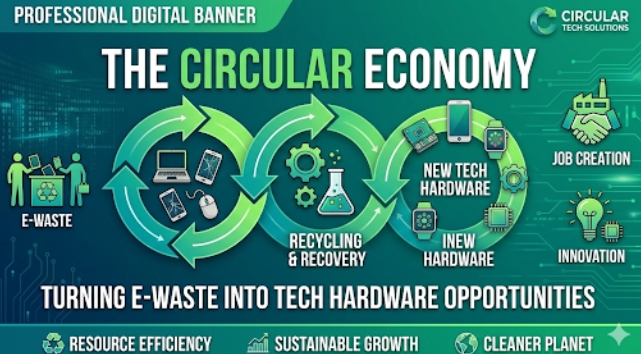
The Circular Economy: Turning E-Waste into Tech Hardware Opportunities
Posted on 27/02/2026 06:24:37
Audience: 162
Share with friends on:
The circular economy represents a paradigm shift from the linear "take-make-dispose" model that's choking our planet with e-waste, reimagining it as a fountain of opportunity for tech hardware innovation. In Nigeria and globally, electronic waste surges at over 62 million tons annually, with only 17% recycled, according to UN data. Yet, this toxic tide—discarded phones, laptops, and servers—harbors precious metals like gold, silver, and rare earths worth billions. By looping materials back into production, businesses and entrepreneurs can slash costs, curb environmental harm, and spark a new hardware renaissance, turning scrap into sleek devices.
At its core, the circular economy emphasizes reduce, reuse, repair, and recycle, applied masterfully to e-waste. Tech giants like Apple and Dell already refurbish devices, extending lifecycles and recovering components. For Nigerian startups, this means scavenging Lagos' bustling Computer Village or Ibadan's markets for salvaged parts to assemble affordable laptops or smartphones. A single ton of e-waste yields 300 times more gold than ore mining, making urban mining viable. Initiatives like the E-Waste Association of Nigeria (EWAN) facilitate collection, dismantling, and material recovery, creating jobs while diverting waste from landfills.
Urban mining unlocks hardware goldmines. Dismantling old circuit boards extracts copper wiring for new motherboards, while lithium-ion batteries from dead phones get refurbished for power banks or EVs. In Europe, firms like Umicore process e-waste into high-purity metals for semiconductors; Nigeria could emulate this with modular facilities. Imagine local fabricators reprinting casings via 3D printers using recycled plastics, or smelters purifying aluminum from scrap for server racks. This closed-loop approach cuts virgin material needs by up to 90%, stabilizing supply chains amid global shortages.
Repair and refurbishment form the economy's beating heart, challenging planned obsolescence. Right-to-repair laws in places like the EU empower consumers and tinkerers, fostering a service-based model. Nigerian repair hubs thrive already, fixing iPhones with salvaged screens, but scaling to certified refurb chains—like Fairphone's modular designs—could birth "as-new" hardware lines. Businesses profit by selling extended warranties or upgrade kits, retaining customer loyalty while keeping e-waste at bay. Data from the Global E-waste Monitor shows refurbished electronics could meet 20% of demand, slashing production emissions.
Policy and incentives turbocharge this transition. Governments offer tax breaks for recyclers, like Nigeria's extended producer responsibility (EPR) under the National Environmental Standards (NESREA). Partnerships with multinationals—think HP's recycling programs—bring tech transfer. Blockchain tracks material provenance, ensuring ethical sourcing and premium pricing for "circular-certified" hardware. In Kenya, Soda's e-waste recycling funds community tech labs; similar models in Oyo State could train youth in PCB design, birthing a skilled workforce for hardware startups.
Challenges persist, but innovation overcomes them. Informal e-waste pickers in Nigeria risk health from hazardous toxins, so formal hubs with safety gear and training are essential. Contamination demands advanced sorting tech like AI-powered spectrometers to separate alloys. Investment lags, yet impact funds and green bonds—from AfDB's $25 billion climate portfolio—beckon. Collaborative platforms like the Circular Economy Foundation connect suppliers, turning fragmented efforts into ecosystems.
Success stories illuminate the path. Fairphone assembles ethical phones from 50% recycled plastics, proving market viability. In Nigeria, Chanja Datti recycles e-waste into furniture and tech parts, employing hundreds. Globally, Patagonia's repair centers inspire tech parallels, boosting brand value. Scaling these yields economic multipliers: one EU study pegs circular electronics at €43 billion in savings by 2030.
For businesses, embracing circularity means redesigning products for disassembly—swappable batteries, upgradeable RAM—reducing e-waste at source. Consumers play a role too, via trade-in programs or apps like Back Market for certified refurbs. This synergy builds resilient supply chains, immune to mining disruptions or chip wars.
Ultimately, the circular economy transforms e-waste from burden to boon, fueling tech hardware's future. Nigerian entrepreneurs, with abundant feedstock and youthful ingenuity, stand poised to lead. By investing in collection networks, refining tech, and forging policies, we close the loop—profitable, sustainable, and innovative—heralding an era where yesterday's trash powers tomorrow's breakthroughs.
At its core, the circular economy emphasizes reduce, reuse, repair, and recycle, applied masterfully to e-waste. Tech giants like Apple and Dell already refurbish devices, extending lifecycles and recovering components. For Nigerian startups, this means scavenging Lagos' bustling Computer Village or Ibadan's markets for salvaged parts to assemble affordable laptops or smartphones. A single ton of e-waste yields 300 times more gold than ore mining, making urban mining viable. Initiatives like the E-Waste Association of Nigeria (EWAN) facilitate collection, dismantling, and material recovery, creating jobs while diverting waste from landfills.
Urban mining unlocks hardware goldmines. Dismantling old circuit boards extracts copper wiring for new motherboards, while lithium-ion batteries from dead phones get refurbished for power banks or EVs. In Europe, firms like Umicore process e-waste into high-purity metals for semiconductors; Nigeria could emulate this with modular facilities. Imagine local fabricators reprinting casings via 3D printers using recycled plastics, or smelters purifying aluminum from scrap for server racks. This closed-loop approach cuts virgin material needs by up to 90%, stabilizing supply chains amid global shortages.
Repair and refurbishment form the economy's beating heart, challenging planned obsolescence. Right-to-repair laws in places like the EU empower consumers and tinkerers, fostering a service-based model. Nigerian repair hubs thrive already, fixing iPhones with salvaged screens, but scaling to certified refurb chains—like Fairphone's modular designs—could birth "as-new" hardware lines. Businesses profit by selling extended warranties or upgrade kits, retaining customer loyalty while keeping e-waste at bay. Data from the Global E-waste Monitor shows refurbished electronics could meet 20% of demand, slashing production emissions.
Policy and incentives turbocharge this transition. Governments offer tax breaks for recyclers, like Nigeria's extended producer responsibility (EPR) under the National Environmental Standards (NESREA). Partnerships with multinationals—think HP's recycling programs—bring tech transfer. Blockchain tracks material provenance, ensuring ethical sourcing and premium pricing for "circular-certified" hardware. In Kenya, Soda's e-waste recycling funds community tech labs; similar models in Oyo State could train youth in PCB design, birthing a skilled workforce for hardware startups.
Challenges persist, but innovation overcomes them. Informal e-waste pickers in Nigeria risk health from hazardous toxins, so formal hubs with safety gear and training are essential. Contamination demands advanced sorting tech like AI-powered spectrometers to separate alloys. Investment lags, yet impact funds and green bonds—from AfDB's $25 billion climate portfolio—beckon. Collaborative platforms like the Circular Economy Foundation connect suppliers, turning fragmented efforts into ecosystems.
Success stories illuminate the path. Fairphone assembles ethical phones from 50% recycled plastics, proving market viability. In Nigeria, Chanja Datti recycles e-waste into furniture and tech parts, employing hundreds. Globally, Patagonia's repair centers inspire tech parallels, boosting brand value. Scaling these yields economic multipliers: one EU study pegs circular electronics at €43 billion in savings by 2030.
For businesses, embracing circularity means redesigning products for disassembly—swappable batteries, upgradeable RAM—reducing e-waste at source. Consumers play a role too, via trade-in programs or apps like Back Market for certified refurbs. This synergy builds resilient supply chains, immune to mining disruptions or chip wars.
Ultimately, the circular economy transforms e-waste from burden to boon, fueling tech hardware's future. Nigerian entrepreneurs, with abundant feedstock and youthful ingenuity, stand poised to lead. By investing in collection networks, refining tech, and forging policies, we close the loop—profitable, sustainable, and innovative—heralding an era where yesterday's trash powers tomorrow's breakthroughs.
Kindly join discussion on this topic on:
} Share with friends on:Related Posts
- Conversational Keywords: Writing for Natural Language Processing
- Trade Resilience: Data on Front-Loaded Shipments and New Bilateral Trade Deals
- Venture Capital in 2026: The Shift from "Growth at All Costs" to "Unit Economics"
- What Is the Force Majeure Clause Released in Bahrain Amidst the US-Israeli-Iranian Conflict
- E-Commerce Integration: Taking Your Local Trade to a Global Audience
- Authoritative Content: How to Become a Primary Source for AI Models
- Interoperability: Connecting Private Blockchains with Public Liquidity
- Smart Cities or Gated Communities? The Social Impact of Tech-Driven Urban Planning
- Social Listening for ROI: How to Spot Market Trends Before They Break
- Agricultural Yields: Impact of Climate-Related Shocks on Global Food Security