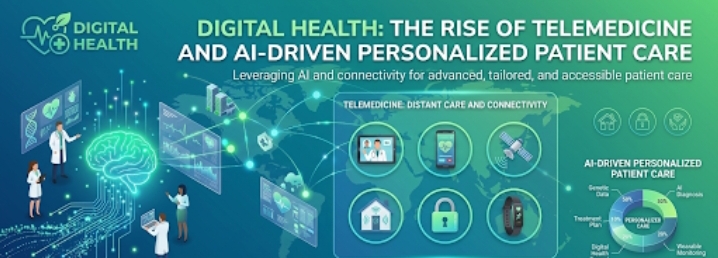
Digital Health: The rise of telemedicine and AI-driven personalized patient care
Posted on 06/03/2026 12:33:37
Audience: 96
Share with friends on:
Healthcare has always been a deeply human endeavor, built on the relationship between a patient and a clinician who listens, observes, and makes judgments shaped by years of training and experience. That relationship is not disappearing, but it is being fundamentally reimagined. The twin forces of telemedicine and artificial intelligence are reshaping how care is delivered, how diseases are detected, and how treatment is tailored to the individual — shifting medicine away from a system designed around institutional convenience and toward one increasingly centered on the patient as a unique biological and social entity.
Telemedicine is not a new concept, but its adoption until recently was sluggish, constrained by regulatory inertia, insurance reimbursement limitations, and a cultural preference among both patients and physicians for the in-person encounter. The COVID-19 pandemic demolished those barriers almost overnight. With hospitals overwhelmed and physical contact suddenly dangerous, health systems across the world were forced to digitize their patient-facing operations at a pace that would have taken a decade under ordinary circumstances. Virtual consultations, remote monitoring, and digital triage became not experimental luxuries but operational necessities. What emerged from that crisis was a patient population that had discovered, often to its own surprise, that a great deal of healthcare could be delivered effectively through a screen — and a health system that could no longer pretend otherwise.
The convenience argument for telemedicine is straightforward and well-documented. Patients in rural or underserved areas who previously faced hours of travel to see a specialist can now access that consultation from their living room. Working parents can attend a follow-up appointment during a lunch break. Elderly patients with mobility difficulties no longer need to navigate transport systems to manage chronic conditions. But the significance of telemedicine runs deeper than convenience. By dramatically lowering the friction associated with accessing care, it has the potential to shift medicine toward earlier intervention — catching conditions before they become crises, maintaining continuity of care for people who previously disengaged from the health system entirely, and reducing the costly emergency presentations that result from deferred treatment.
It is when telemedicine intersects with artificial intelligence that the possibilities become genuinely transformative. AI systems trained on vast medical datasets are now capable of performing diagnostic tasks that would have seemed implausible a decade ago. Deep learning models can detect diabetic retinopathy from retinal images with accuracy matching or exceeding that of specialist ophthalmologists. AI-powered algorithms can identify early-stage cancers in radiology scans that human eyes might miss. Natural language processing tools can analyse clinical notes and flag patients who meet criteria for a rare disease diagnosis that their physicians had not considered. These are not hypothetical future capabilities — they are deployed, or in late-stage clinical validation, in health systems around the world right now.
The deeper promise, however, lies in personalization. For most of medical history, treatment has been population-based rather than individual-based. A physician looks at a patient's symptoms, cross-references them with diagnostic criteria developed through clinical trials conducted on populations, and prescribes a treatment that works for the average patient in that category. The problem is that individual patients deviate from the average in important ways — in their genetics, their microbiome, their lifestyle, their social circumstances, and the complex interactions among all of these factors. AI, drawing on the integration of genomic data, electronic health records, wearable device outputs, and even socioeconomic variables, can begin to construct a far more nuanced model of the individual patient and predict with greater accuracy which treatment protocols are most likely to be effective for that specific person rather than for a statistical abstraction of them.
This vision of precision medicine is already moving from research settings into clinical practice in oncology, cardiology, and psychiatry, among other fields. In cancer care, AI-driven analysis of tumour genomics is informing chemotherapy selection in ways that are meaningfully improving outcomes. In mental health, platforms are beginning to use machine learning to match patients with therapeutic approaches based on patterns in their symptom history and response profiles, moving beyond the trial-and-error that has long characterized psychiatric pharmacology. Wearable devices linked to AI monitoring systems can detect irregular heart rhythms, flag declining respiratory function, or identify the physiological signatures that precede a depressive episode — enabling intervention before a patient even knows something is wrong.
None of this progress is without complication. The digitization of healthcare generates enormous quantities of sensitive personal data, and the questions of who owns that data, how it is stored, and how it can be used are deeply contested and not yet adequately resolved by existing regulatory frameworks. There is a legitimate concern that AI systems trained primarily on data from certain demographic groups may perform less accurately for patients who are older, female, or from ethnic minorities — potentially encoding and amplifying existing health inequities rather than reducing them. The human dimensions of care — empathy, reassurance, the therapeutic value of being truly heard — are not easily replicated by a virtual interface, and there is a real danger that the efficiency gains of digital health come at the cost of the relational depth that often determines whether patients engage with and adhere to their treatment plans.
There is also the question of the clinician's role in a world of AI-assisted medicine. The most thoughtful voices in this debate are not predicting that AI will replace doctors, but rather that it will change what good doctoring looks like — shifting the physician's value away from information retrieval and pattern recognition, which machines can increasingly do faster and more reliably, and toward the interpretive, communicative, and ethical dimensions of care that remain stubbornly, and perhaps permanently, human. That transition requires medical education to evolve, healthcare institutions to redesign their workflows, and regulators to develop frameworks agile enough to keep pace with technology that is advancing faster than legislation has historically been able to move.
What is beyond reasonable dispute is that digital health is no longer a peripheral innovation story. It is becoming the primary story of how healthcare systems in the twenty-first century will survive their own structural pressures — aging populations, workforce shortages, rising chronic disease burdens, and spiraling costs that no amount of traditional efficiency improvement can adequately address. Telemedicine and AI-driven personalized care are not simply making existing medicine faster or cheaper. At their most ambitious, they represent a reinvention of medicine's fundamental operating model — one in which the patient is a continuous data point rather than an occasional visitor, and in which the goal shifts from treating illness after it appears to anticipating and preventing it before it does.
Telemedicine is not a new concept, but its adoption until recently was sluggish, constrained by regulatory inertia, insurance reimbursement limitations, and a cultural preference among both patients and physicians for the in-person encounter. The COVID-19 pandemic demolished those barriers almost overnight. With hospitals overwhelmed and physical contact suddenly dangerous, health systems across the world were forced to digitize their patient-facing operations at a pace that would have taken a decade under ordinary circumstances. Virtual consultations, remote monitoring, and digital triage became not experimental luxuries but operational necessities. What emerged from that crisis was a patient population that had discovered, often to its own surprise, that a great deal of healthcare could be delivered effectively through a screen — and a health system that could no longer pretend otherwise.
The convenience argument for telemedicine is straightforward and well-documented. Patients in rural or underserved areas who previously faced hours of travel to see a specialist can now access that consultation from their living room. Working parents can attend a follow-up appointment during a lunch break. Elderly patients with mobility difficulties no longer need to navigate transport systems to manage chronic conditions. But the significance of telemedicine runs deeper than convenience. By dramatically lowering the friction associated with accessing care, it has the potential to shift medicine toward earlier intervention — catching conditions before they become crises, maintaining continuity of care for people who previously disengaged from the health system entirely, and reducing the costly emergency presentations that result from deferred treatment.
It is when telemedicine intersects with artificial intelligence that the possibilities become genuinely transformative. AI systems trained on vast medical datasets are now capable of performing diagnostic tasks that would have seemed implausible a decade ago. Deep learning models can detect diabetic retinopathy from retinal images with accuracy matching or exceeding that of specialist ophthalmologists. AI-powered algorithms can identify early-stage cancers in radiology scans that human eyes might miss. Natural language processing tools can analyse clinical notes and flag patients who meet criteria for a rare disease diagnosis that their physicians had not considered. These are not hypothetical future capabilities — they are deployed, or in late-stage clinical validation, in health systems around the world right now.
The deeper promise, however, lies in personalization. For most of medical history, treatment has been population-based rather than individual-based. A physician looks at a patient's symptoms, cross-references them with diagnostic criteria developed through clinical trials conducted on populations, and prescribes a treatment that works for the average patient in that category. The problem is that individual patients deviate from the average in important ways — in their genetics, their microbiome, their lifestyle, their social circumstances, and the complex interactions among all of these factors. AI, drawing on the integration of genomic data, electronic health records, wearable device outputs, and even socioeconomic variables, can begin to construct a far more nuanced model of the individual patient and predict with greater accuracy which treatment protocols are most likely to be effective for that specific person rather than for a statistical abstraction of them.
This vision of precision medicine is already moving from research settings into clinical practice in oncology, cardiology, and psychiatry, among other fields. In cancer care, AI-driven analysis of tumour genomics is informing chemotherapy selection in ways that are meaningfully improving outcomes. In mental health, platforms are beginning to use machine learning to match patients with therapeutic approaches based on patterns in their symptom history and response profiles, moving beyond the trial-and-error that has long characterized psychiatric pharmacology. Wearable devices linked to AI monitoring systems can detect irregular heart rhythms, flag declining respiratory function, or identify the physiological signatures that precede a depressive episode — enabling intervention before a patient even knows something is wrong.
None of this progress is without complication. The digitization of healthcare generates enormous quantities of sensitive personal data, and the questions of who owns that data, how it is stored, and how it can be used are deeply contested and not yet adequately resolved by existing regulatory frameworks. There is a legitimate concern that AI systems trained primarily on data from certain demographic groups may perform less accurately for patients who are older, female, or from ethnic minorities — potentially encoding and amplifying existing health inequities rather than reducing them. The human dimensions of care — empathy, reassurance, the therapeutic value of being truly heard — are not easily replicated by a virtual interface, and there is a real danger that the efficiency gains of digital health come at the cost of the relational depth that often determines whether patients engage with and adhere to their treatment plans.
There is also the question of the clinician's role in a world of AI-assisted medicine. The most thoughtful voices in this debate are not predicting that AI will replace doctors, but rather that it will change what good doctoring looks like — shifting the physician's value away from information retrieval and pattern recognition, which machines can increasingly do faster and more reliably, and toward the interpretive, communicative, and ethical dimensions of care that remain stubbornly, and perhaps permanently, human. That transition requires medical education to evolve, healthcare institutions to redesign their workflows, and regulators to develop frameworks agile enough to keep pace with technology that is advancing faster than legislation has historically been able to move.
What is beyond reasonable dispute is that digital health is no longer a peripheral innovation story. It is becoming the primary story of how healthcare systems in the twenty-first century will survive their own structural pressures — aging populations, workforce shortages, rising chronic disease burdens, and spiraling costs that no amount of traditional efficiency improvement can adequately address. Telemedicine and AI-driven personalized care are not simply making existing medicine faster or cheaper. At their most ambitious, they represent a reinvention of medicine's fundamental operating model — one in which the patient is a continuous data point rather than an occasional visitor, and in which the goal shifts from treating illness after it appears to anticipating and preventing it before it does.
Kindly join discussion on this topic on:
} Share with friends on:Related Posts
- Conversational Keywords: Writing for Natural Language Processing
- Trade Resilience: Data on Front-Loaded Shipments and New Bilateral Trade Deals
- Venture Capital in 2026: The Shift from "Growth at All Costs" to "Unit Economics"
- What Is the Force Majeure Clause Released in Bahrain Amidst the US-Israeli-Iranian Conflict
- E-Commerce Integration: Taking Your Local Trade to a Global Audience
- Authoritative Content: How to Become a Primary Source for AI Models
- Interoperability: Connecting Private Blockchains with Public Liquidity
- Smart Cities or Gated Communities? The Social Impact of Tech-Driven Urban Planning
- Social Listening for ROI: How to Spot Market Trends Before They Break
- Agricultural Yields: Impact of Climate-Related Shocks on Global Food Security