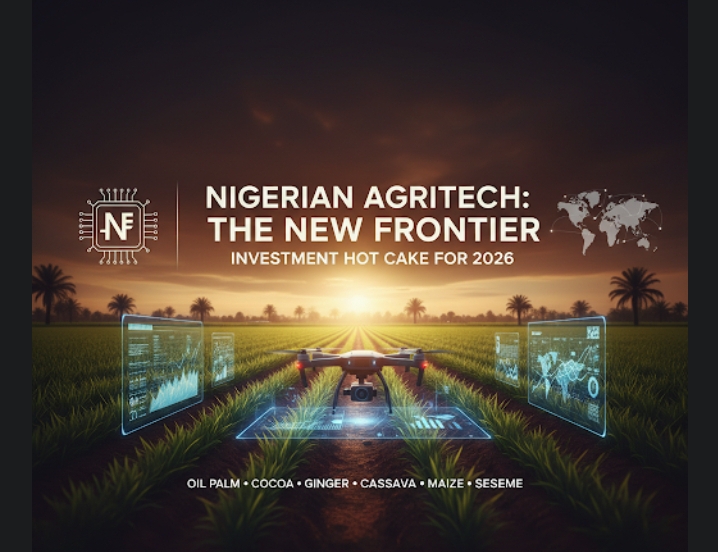
How Tech-driven Investment is Turning Nigerian "Agritech" into a "Hot Cake" for Local and Foreign Investors.
Posted on 20/02/2026 07:15:52
Audience: 103
Share with friends on:
In 2026, the Nigerian agricultural landscape has transcended its traditional roots, evolving into a high-octane "hot cake" for investors through a surge of tech-driven disruption. At the heart of this transformation is the integration of precision farming tools, such as AI-powered drones and satellite imagery, which have turned once-unpredictable farmlands into data-rich assets. Foreign direct investment into the sector has surged by over 400% in recent years, fueled by a global appetite for supply chain transparency and the massive scaling potential of Nigeria's underutilized arable land. Both local venture capitalists and international hedge funds are now pouring capital into platforms that offer blockchain-verified traceability and real-time soil health monitoring, recognizing that "agritech" is no longer just a niche startup scene but the critical infrastructure for Africa's projected $1 trillion agribusiness market by 2030.
The attraction for investors is further sweetened by the rise of "agri-fintech" solutions that bridge the long-standing gap between smallholder farmers and institutional credit. By leveraging alternative data for credit scoring and mobile-money ecosystems, these platforms have de-risked the sector, allowing investors to participate in structured farm cycles with unprecedented visibility. The Nigerian government’s National Agricultural Technology and Innovation Policy (NATIP) has provided a stable regulatory backdrop, encouraging public-private partnerships that focus on high-yield commodities like oil palm, cassava, and livestock. This policy-backed security, combined with the emergence of Special Economic Zones offering 100% foreign ownership and unrestricted capital repatriation, has turned agritech into a premier destination for "patient capital" seeking high returns in a resilient, real-world asset class.
Beyond primary production, the "hot cake" status of the industry is cemented by the explosive growth of the value-added agro-processing and cold-chain logistics sectors. Investors are increasingly targeting the "mid-stream" of the value chain, where tech-enabled storage solutions are drastically reducing post-harvest losses and opening doors to premium export markets in Europe and Asia. As 2026 unfolds, the narrative of Nigerian agriculture has shifted from one of subsistence to one of sophisticated, tech-enabled sovereignty. For the savvy investor, the combination of a massive, youthful population and a digitized food system presents a rare "frontier market" opportunity where the fusion of soil and silicon is delivering some of the most competitive profit margins on the continent.
Briefly checking the most profitable Clcash crops to grow the 2026 fiscal year in Nigeria's may be categorized by a strategic divide between fast-moving domestic staples and high-value export cash crops. Leading the domestic market are tomatoes, bell peppers, and habanero peppers, which continue to offer the highest return on investment for retailers and smallholders due to year-round demand and the premium prices commanded during the dry season. Maize and rice remain foundational, with maize specifically seeing a surge in profitability as it serves as the essential raw material for the expanding poultry and aquaculture sectors, which now account for nearly 70% of feed production costs. Cassava also maintains its "low-risk, high-demand" status, moving beyond simple food use into industrial ethanol and starch production, providing a dependable income stream that thrives in nearly every ecological zone of the country.
For long-term wealth and foreign exchange, oil palm and cocoa stand as the titans of the 2026 fiscal year, benefiting from generational income cycles and a global shift toward sustainable, traceable sourcing. Oil palm remains unmatched for patient investors, yielding consistent returns for up to 30 years through the sale of palm oil and kernel cake. Simultaneously, the spice sector has emerged as a significant "hot cake," with Nigeria positioning itself as a global leader in ginger production and launching a nationwide campaign for large-scale clove cultivation to rival Tanzania. Sesame seeds and cashew nuts also continue to be top-performing exports, increasingly sought after by international food and cosmetic industries. This diversified commodity landscape, supported by improved seed technology and digital traceability, ensures that both quick-turnover horticulture and long-term plantations offer robust margins for the modern agri-investor.
The attraction for investors is further sweetened by the rise of "agri-fintech" solutions that bridge the long-standing gap between smallholder farmers and institutional credit. By leveraging alternative data for credit scoring and mobile-money ecosystems, these platforms have de-risked the sector, allowing investors to participate in structured farm cycles with unprecedented visibility. The Nigerian government’s National Agricultural Technology and Innovation Policy (NATIP) has provided a stable regulatory backdrop, encouraging public-private partnerships that focus on high-yield commodities like oil palm, cassava, and livestock. This policy-backed security, combined with the emergence of Special Economic Zones offering 100% foreign ownership and unrestricted capital repatriation, has turned agritech into a premier destination for "patient capital" seeking high returns in a resilient, real-world asset class.
Beyond primary production, the "hot cake" status of the industry is cemented by the explosive growth of the value-added agro-processing and cold-chain logistics sectors. Investors are increasingly targeting the "mid-stream" of the value chain, where tech-enabled storage solutions are drastically reducing post-harvest losses and opening doors to premium export markets in Europe and Asia. As 2026 unfolds, the narrative of Nigerian agriculture has shifted from one of subsistence to one of sophisticated, tech-enabled sovereignty. For the savvy investor, the combination of a massive, youthful population and a digitized food system presents a rare "frontier market" opportunity where the fusion of soil and silicon is delivering some of the most competitive profit margins on the continent.
Briefly checking the most profitable Clcash crops to grow the 2026 fiscal year in Nigeria's may be categorized by a strategic divide between fast-moving domestic staples and high-value export cash crops. Leading the domestic market are tomatoes, bell peppers, and habanero peppers, which continue to offer the highest return on investment for retailers and smallholders due to year-round demand and the premium prices commanded during the dry season. Maize and rice remain foundational, with maize specifically seeing a surge in profitability as it serves as the essential raw material for the expanding poultry and aquaculture sectors, which now account for nearly 70% of feed production costs. Cassava also maintains its "low-risk, high-demand" status, moving beyond simple food use into industrial ethanol and starch production, providing a dependable income stream that thrives in nearly every ecological zone of the country.
For long-term wealth and foreign exchange, oil palm and cocoa stand as the titans of the 2026 fiscal year, benefiting from generational income cycles and a global shift toward sustainable, traceable sourcing. Oil palm remains unmatched for patient investors, yielding consistent returns for up to 30 years through the sale of palm oil and kernel cake. Simultaneously, the spice sector has emerged as a significant "hot cake," with Nigeria positioning itself as a global leader in ginger production and launching a nationwide campaign for large-scale clove cultivation to rival Tanzania. Sesame seeds and cashew nuts also continue to be top-performing exports, increasingly sought after by international food and cosmetic industries. This diversified commodity landscape, supported by improved seed technology and digital traceability, ensures that both quick-turnover horticulture and long-term plantations offer robust margins for the modern agri-investor.
Kindly join discussion on this topic on:
} Share with friends on:Related Posts
- Conversational Keywords: Writing for Natural Language Processing
- Trade Resilience: Data on Front-Loaded Shipments and New Bilateral Trade Deals
- Venture Capital in 2026: The Shift from "Growth at All Costs" to "Unit Economics"
- What Is the Force Majeure Clause Released in Bahrain Amidst the US-Israeli-Iranian Conflict
- E-Commerce Integration: Taking Your Local Trade to a Global Audience
- Authoritative Content: How to Become a Primary Source for AI Models
- Interoperability: Connecting Private Blockchains with Public Liquidity
- Smart Cities or Gated Communities? The Social Impact of Tech-Driven Urban Planning
- Social Listening for ROI: How to Spot Market Trends Before They Break
- Agricultural Yields: Impact of Climate-Related Shocks on Global Food Security