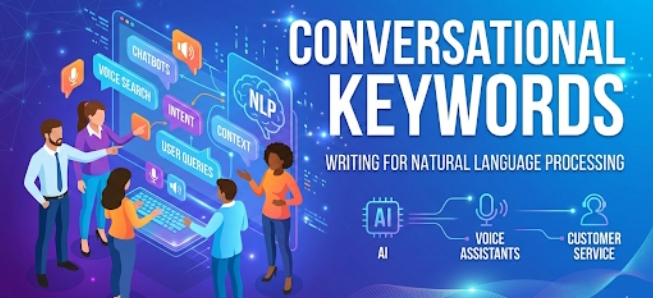
Conversational Keywords: Writing for Natural Language Processing
Posted on 09/03/2026 22:04:51
Audience: 68
Share with friends on:
The way people search for information has undergone a quiet but profound revolution. Where users once typed fragmented, robotic queries into search engines — "best pizza NYC" or "weather tomorrow" — they now speak and type in full, natural sentences. They ask their phones questions the way they would ask a friend. They expect answers, not just results. This shift, driven by the rise of voice assistants, AI chatbots, and semantic search engines, has fundamentally changed what it means to write with keywords in mind. The old model of keyword stuffing and exact-match phrases is giving way to something more human: conversational language designed for Natural Language Processing, or NLP.
Natural Language Processing is the branch of artificial intelligence that enables machines to understand, interpret, and respond to human language. Modern NLP systems, like those powering Google's search algorithm, Amazon's Alexa, or OpenAI's ChatGPT, are no longer looking for isolated words on a page. They are parsing intent, recognizing context, understanding relationships between words, and identifying the emotional tone behind a query. This means that writers and content strategists must now think less like robots feeding data to a machine and more like conversationalists crafting meaningful dialogue. The goal is no longer to satisfy a crawling algorithm but to genuinely communicate with a system sophisticated enough to understand nuance.
At the heart of conversational keyword strategy is the concept of long-tail keywords and question-based phrases. When a person uses a voice assistant or types into a conversational AI interface, they rarely say "flight prices London." They say, "What are the cheapest flights from New York to London in March?" This longer, more specific phrasing carries far more information and far more intent. Writers who incorporate these natural question structures — beginning with who, what, when, where, why, and how — align their content with the way NLP systems parse human curiosity. They signal not just topical relevance but contextual understanding, which modern algorithms reward heavily.
Equally important is the role of semantic relevance, sometimes called latent semantic indexing. NLP systems do not evaluate a piece of writing by counting how many times a keyword appears; they evaluate the entire semantic landscape of the content. A well-written article about "sustainable travel" that also naturally incorporates related terms like carbon footprint, eco-friendly accommodations, slow travel, and responsible tourism sends a rich signal to NLP models that the content is genuinely authoritative and contextually complete. This means that strong conversational writing is, by nature, varied and rich in vocabulary. It avoids repetition not just for the reader's sake but because diversity of language is itself a marker of depth that machines have learned to recognize.
Another dimension of writing for NLP is the careful construction of what is known as featured snippet bait — concise, direct answers to common questions embedded within longer content. Search engines powered by NLP are increasingly designed to extract and surface short, satisfying answers to user queries without requiring the user to visit a page at all. A writer who understands this will structure paragraphs so that a clear, self-contained answer appears near the beginning of a discussion, followed by elaboration. The first sentence of a paragraph answering "What is conversational AI?" should answer that question plainly and immediately. NLP systems are trained on human preferences, and humans prefer directness.
Tone matters more than many writers realize when it comes to NLP optimization. Conversational content tends to perform better in voice search and AI-generated responses because it mirrors the register in which questions are asked. Formal, dense, heavily technical prose may demonstrate expertise, but it often fails the "read aloud" test — meaning it would sound unnatural and awkward if a voice assistant were to speak it back to a user. The best content for NLP environments strikes a balance: it is authoritative enough to establish credibility but accessible enough to be understood and reproduced naturally. Short sentences, active voice, and plain language are not signs of intellectual weakness — they are signals of communicative clarity that NLP systems are specifically trained to favor.
Entity recognition is another layer of NLP that writers can leverage deliberately. Modern language models are trained to identify named entities — people, places, brands, dates, events — and to understand the relationships between them. A piece of content that clearly establishes who is involved, what is happening, when and where it occurred, and why it matters builds a dense network of entity relationships that NLP systems can parse and trust. This is why structured, narrative-driven writing tends to outperform disorganized lists of facts. A story has entities in relationship with one another, and that structure closely mirrors the way language models represent knowledge internally.
Perhaps the most important mindset shift for any writer navigating the NLP landscape is the move from keyword intent to user intent. A keyword is a clue, not a destination. NLP systems are ultimately trying to determine what a user actually wants — whether they are seeking information, trying to complete a transaction, looking for navigation to a specific site, or simply exploring a topic. Writers who begin not with a keyword list but with a genuine question — "What does my reader actually need to know, and how can I say it clearly and completely?" — will find that their content naturally aligns with what NLP is trying to surface. In this sense, the best writing for Natural Language Processing is simply the best writing, period: clear, honest, purposeful, and deeply human.
Natural Language Processing is the branch of artificial intelligence that enables machines to understand, interpret, and respond to human language. Modern NLP systems, like those powering Google's search algorithm, Amazon's Alexa, or OpenAI's ChatGPT, are no longer looking for isolated words on a page. They are parsing intent, recognizing context, understanding relationships between words, and identifying the emotional tone behind a query. This means that writers and content strategists must now think less like robots feeding data to a machine and more like conversationalists crafting meaningful dialogue. The goal is no longer to satisfy a crawling algorithm but to genuinely communicate with a system sophisticated enough to understand nuance.
At the heart of conversational keyword strategy is the concept of long-tail keywords and question-based phrases. When a person uses a voice assistant or types into a conversational AI interface, they rarely say "flight prices London." They say, "What are the cheapest flights from New York to London in March?" This longer, more specific phrasing carries far more information and far more intent. Writers who incorporate these natural question structures — beginning with who, what, when, where, why, and how — align their content with the way NLP systems parse human curiosity. They signal not just topical relevance but contextual understanding, which modern algorithms reward heavily.
Equally important is the role of semantic relevance, sometimes called latent semantic indexing. NLP systems do not evaluate a piece of writing by counting how many times a keyword appears; they evaluate the entire semantic landscape of the content. A well-written article about "sustainable travel" that also naturally incorporates related terms like carbon footprint, eco-friendly accommodations, slow travel, and responsible tourism sends a rich signal to NLP models that the content is genuinely authoritative and contextually complete. This means that strong conversational writing is, by nature, varied and rich in vocabulary. It avoids repetition not just for the reader's sake but because diversity of language is itself a marker of depth that machines have learned to recognize.
Another dimension of writing for NLP is the careful construction of what is known as featured snippet bait — concise, direct answers to common questions embedded within longer content. Search engines powered by NLP are increasingly designed to extract and surface short, satisfying answers to user queries without requiring the user to visit a page at all. A writer who understands this will structure paragraphs so that a clear, self-contained answer appears near the beginning of a discussion, followed by elaboration. The first sentence of a paragraph answering "What is conversational AI?" should answer that question plainly and immediately. NLP systems are trained on human preferences, and humans prefer directness.
Tone matters more than many writers realize when it comes to NLP optimization. Conversational content tends to perform better in voice search and AI-generated responses because it mirrors the register in which questions are asked. Formal, dense, heavily technical prose may demonstrate expertise, but it often fails the "read aloud" test — meaning it would sound unnatural and awkward if a voice assistant were to speak it back to a user. The best content for NLP environments strikes a balance: it is authoritative enough to establish credibility but accessible enough to be understood and reproduced naturally. Short sentences, active voice, and plain language are not signs of intellectual weakness — they are signals of communicative clarity that NLP systems are specifically trained to favor.
Entity recognition is another layer of NLP that writers can leverage deliberately. Modern language models are trained to identify named entities — people, places, brands, dates, events — and to understand the relationships between them. A piece of content that clearly establishes who is involved, what is happening, when and where it occurred, and why it matters builds a dense network of entity relationships that NLP systems can parse and trust. This is why structured, narrative-driven writing tends to outperform disorganized lists of facts. A story has entities in relationship with one another, and that structure closely mirrors the way language models represent knowledge internally.
Perhaps the most important mindset shift for any writer navigating the NLP landscape is the move from keyword intent to user intent. A keyword is a clue, not a destination. NLP systems are ultimately trying to determine what a user actually wants — whether they are seeking information, trying to complete a transaction, looking for navigation to a specific site, or simply exploring a topic. Writers who begin not with a keyword list but with a genuine question — "What does my reader actually need to know, and how can I say it clearly and completely?" — will find that their content naturally aligns with what NLP is trying to surface. In this sense, the best writing for Natural Language Processing is simply the best writing, period: clear, honest, purposeful, and deeply human.
Kindly join discussion on this topic on:
} Share with friends on:Related Posts
- Conversational Keywords: Writing for Natural Language Processing
- Trade Resilience: Data on Front-Loaded Shipments and New Bilateral Trade Deals
- Venture Capital in 2026: The Shift from "Growth at All Costs" to "Unit Economics"
- What Is the Force Majeure Clause Released in Bahrain Amidst the US-Israeli-Iranian Conflict
- E-Commerce Integration: Taking Your Local Trade to a Global Audience
- Authoritative Content: How to Become a Primary Source for AI Models
- Interoperability: Connecting Private Blockchains with Public Liquidity
- Smart Cities or Gated Communities? The Social Impact of Tech-Driven Urban Planning
- Social Listening for ROI: How to Spot Market Trends Before They Break
- Agricultural Yields: Impact of Climate-Related Shocks on Global Food Security