Growing with the New Frontiers in Cryptocurrency
Posted on 01/02/2026 14:13:49
Share with friends on:
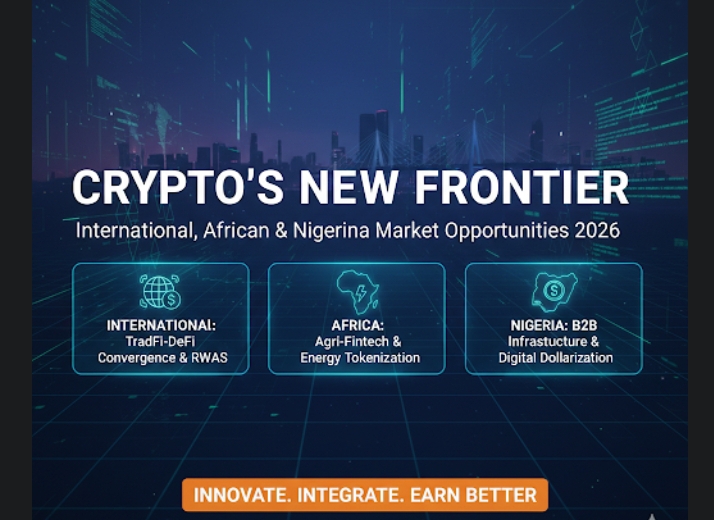
The global cryptocurrency market in 2026 has transitioned from a speculative frontier into a foundational layer of the international financial system. On the international stage, the most significant emerging opportunities lie in the convergence of "Traditional Finance" (TradFi) and "Decentralized Finance" (DeFi). Institutional capital is no longer just observing; it is actively shaping the market through spot ETFs and the tokenization of Real-World Assets (RWAs) like government bonds and private equity.
For investors and businesses, this creates a high-yield environment where digital assets are being integrated into corporate treasuries and institutional rails, offering a level of liquidity and regulatory clarity that was absent in previous years. The focus has shifted toward "utility-first" protocols that support cross-border settlement and modular infrastructure, allowing for a more efficient global movement of value.
Across the African continent, the narrative of crypto has evolved from a tool for survival to a strategic pillar for regional integration and economic empowerment. Africa remains a global leader in grassroots adoption, driven by a youthful, digitally native population that views blockchain as a bridge to the global economy.
The primary opportunities here are centered on "Agri-fintech" and "Energy-tokenization," where blockchain is used to provide credit to underserved farmers or to manage decentralized power grids. By bypassing legacy banking infrastructure that is often slow and expensive, African startups are building localized DeFi protocols that facilitate seamless intra-continental trade.
This shift is turning the continent into a testing ground for real-world blockchain applications that prioritize impact and financial inclusion over mere price speculation.
In the Nigerian market, the landscape is particularly dynamic as the country maintains its position as one of the world’s most active crypto hubs despite macroeconomic challenges. The devaluation of the naira has solidified the role of USD-backed stablecoins like USDT and USDC as essential tools for wealth preservation and "digital dollarization."
For Nigerian entrepreneurs, the most lucrative opportunities are now in B2B infrastructure—building the APIs and payment gateways that allow small and medium enterprises (SMEs) to accept global payments and settle transactions instantly. With the Nigerian SEC now providing clearer licensing pathways, the "informal" P2P market is gradually moving toward regulated exchanges, creating a safer environment for institutional participation and retail investment alike. To earn better within these evolving markets, participants must shift their strategy from short-term "flipping" to long-term "positioning."
In Nigeria and the broader African context, this means focusing on the service layer of the industry—offering crypto-based payroll services, tax advisory for digital assets, or building localized liquidity pools. Internationally, the path to higher earnings lies in "staking" and "yield generation" within regulated environments, where one can earn passive income on assets that are increasingly viewed as "digital gold." By treating cryptocurrency as a specialized financial infrastructure rather than a lottery, individuals and businesses can leverage these emerging trends to build resilient, global-facing wealth portfolios.
For investors and businesses, this creates a high-yield environment where digital assets are being integrated into corporate treasuries and institutional rails, offering a level of liquidity and regulatory clarity that was absent in previous years. The focus has shifted toward "utility-first" protocols that support cross-border settlement and modular infrastructure, allowing for a more efficient global movement of value.
Across the African continent, the narrative of crypto has evolved from a tool for survival to a strategic pillar for regional integration and economic empowerment. Africa remains a global leader in grassroots adoption, driven by a youthful, digitally native population that views blockchain as a bridge to the global economy.
The primary opportunities here are centered on "Agri-fintech" and "Energy-tokenization," where blockchain is used to provide credit to underserved farmers or to manage decentralized power grids. By bypassing legacy banking infrastructure that is often slow and expensive, African startups are building localized DeFi protocols that facilitate seamless intra-continental trade.
This shift is turning the continent into a testing ground for real-world blockchain applications that prioritize impact and financial inclusion over mere price speculation.
In the Nigerian market, the landscape is particularly dynamic as the country maintains its position as one of the world’s most active crypto hubs despite macroeconomic challenges. The devaluation of the naira has solidified the role of USD-backed stablecoins like USDT and USDC as essential tools for wealth preservation and "digital dollarization."
For Nigerian entrepreneurs, the most lucrative opportunities are now in B2B infrastructure—building the APIs and payment gateways that allow small and medium enterprises (SMEs) to accept global payments and settle transactions instantly. With the Nigerian SEC now providing clearer licensing pathways, the "informal" P2P market is gradually moving toward regulated exchanges, creating a safer environment for institutional participation and retail investment alike. To earn better within these evolving markets, participants must shift their strategy from short-term "flipping" to long-term "positioning."
In Nigeria and the broader African context, this means focusing on the service layer of the industry—offering crypto-based payroll services, tax advisory for digital assets, or building localized liquidity pools. Internationally, the path to higher earnings lies in "staking" and "yield generation" within regulated environments, where one can earn passive income on assets that are increasingly viewed as "digital gold." By treating cryptocurrency as a specialized financial infrastructure rather than a lottery, individuals and businesses can leverage these emerging trends to build resilient, global-facing wealth portfolios.
Kindly join discussion on this topic on:
Related Posts
- Fintech, Renewable Energy and More: Emerging Opportunities in Nigerian Economy
- From Infra Boom to Fiscal Shifts: Lagos Nigeria Today
- From Immigration Crackdown to Diplomatic Renewal, USA Today
- Among others, 'Are you dead' App Trends in China
- Expected EPL Table Shakeup As Battles for Survival Continue on Matchweek24
- PayPal Reentering Nigeria's Economy After Two Decades of Labelling
- ADC and the Bank on Unreliable Support-Base
- Social Media Platforms in 2026 and Business Opportunities in Them
- UEFA: From Mourinho's Magic to Arsenal's Historic Moments through the Night of Football Drama
- Agboola Ajayi's Return of a Prodigal Son to APC