ADC and the Bank on Unreliable Support-Base
Posted on 29/01/2026 15:29:12
Share with friends on:
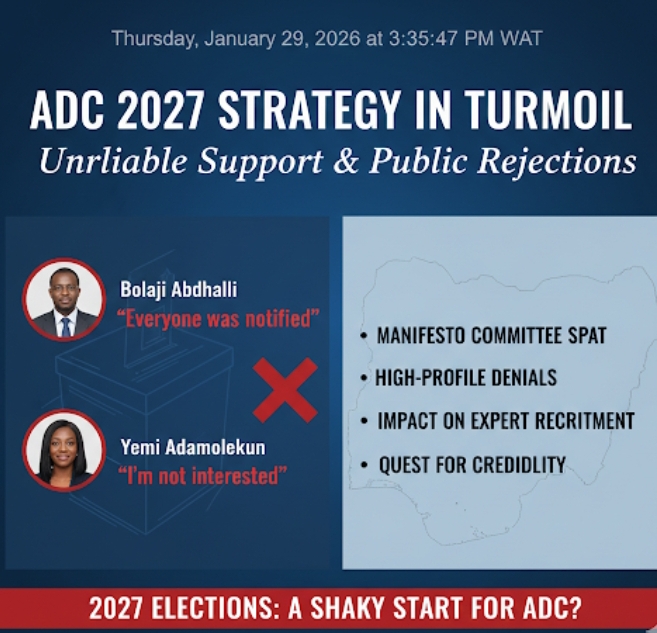
The recent public spat between Bolaji Abdullahi, spokesperson for the African Democratic Congress (ADC), and Yemi Adamolekun, a prominent good governance advocate, has cast a spotlight on the party’s aggressive—yet seemingly disorganized—maneuvering toward the 2027 general elections.
The friction ignited when Adamolekun’s name appeared on the party’s high-profile 50-member "Policy and Manifesto" committee without her prior knowledge or consent, prompting her to publicly question the party's credibility on X (formerly Twitter). From one perspective, the inclusion of such heavyweights as John Oyegun and Pat Utomi signals the ADC’s serious intent to transition from a fringe participant to a formidable contender by assembling a "brain trust" capable of drafting a viable national blueprint.
However, this strategy of "forced association" suggests a desperate attempt to manufacture legitimacy, revealing a party that may be building its 2027 foundation on an unreliable and unverified support base.
This incident is not an isolated case of unrequited political courtship within the ADC. The party has recently been embroiled in a series of "denials" and internal friction involving high-ranking figures.
Reports have circulated regarding the party’s attempts to woo opposition giants like Rabiu Kwankwaso, while internal factions have sparred over the alleged involvement of Atiku Abubakar and Peter Obi, with some party leaders going as far as to warn supporters against "preaching division" or assuming these figures have formal ties to the party. Even within its own leadership structure, the appointment of former Osun State Governor Rauf Aregbesola as Interim National Secretary was met with fierce rejection by a "Concerned Stakeholders" faction, who characterized the move as an undemocratic hijack of the party's original mission.
These recurring public disavowals create a narrative of a party that is more interested in the optics of prestige than the hard work of consensus-building.
The fallout from Adamolekun’s rejection, in particular, may have long-lasting implications for the ADC’s ability to attract the very technocrats it claims to value. In the Nigerian political ecosystem, where trust is a scarce commodity, the act of "name-dropping" a respected civil society leader without consultation is often viewed as a breach of professional ethics. Such blunders risk alienating the intellectual class and policy experts who are wary of being used as "political window dressing." If the ADC cannot master the basic administrative courtesy of securing consent before publicizing its "wise men and women," it may find its 2027 manifesto empty of the diverse, independent voices required to offer a credible alternative to the ruling status quo.
Moving forward, the party’s challenge will be to prove that its policy committee is a functional engine of ideas rather than just a collection of names intended to impress a skeptical electorate.
The friction ignited when Adamolekun’s name appeared on the party’s high-profile 50-member "Policy and Manifesto" committee without her prior knowledge or consent, prompting her to publicly question the party's credibility on X (formerly Twitter). From one perspective, the inclusion of such heavyweights as John Oyegun and Pat Utomi signals the ADC’s serious intent to transition from a fringe participant to a formidable contender by assembling a "brain trust" capable of drafting a viable national blueprint.
However, this strategy of "forced association" suggests a desperate attempt to manufacture legitimacy, revealing a party that may be building its 2027 foundation on an unreliable and unverified support base.
This incident is not an isolated case of unrequited political courtship within the ADC. The party has recently been embroiled in a series of "denials" and internal friction involving high-ranking figures.
Reports have circulated regarding the party’s attempts to woo opposition giants like Rabiu Kwankwaso, while internal factions have sparred over the alleged involvement of Atiku Abubakar and Peter Obi, with some party leaders going as far as to warn supporters against "preaching division" or assuming these figures have formal ties to the party. Even within its own leadership structure, the appointment of former Osun State Governor Rauf Aregbesola as Interim National Secretary was met with fierce rejection by a "Concerned Stakeholders" faction, who characterized the move as an undemocratic hijack of the party's original mission.
These recurring public disavowals create a narrative of a party that is more interested in the optics of prestige than the hard work of consensus-building.
The fallout from Adamolekun’s rejection, in particular, may have long-lasting implications for the ADC’s ability to attract the very technocrats it claims to value. In the Nigerian political ecosystem, where trust is a scarce commodity, the act of "name-dropping" a respected civil society leader without consultation is often viewed as a breach of professional ethics. Such blunders risk alienating the intellectual class and policy experts who are wary of being used as "political window dressing." If the ADC cannot master the basic administrative courtesy of securing consent before publicizing its "wise men and women," it may find its 2027 manifesto empty of the diverse, independent voices required to offer a credible alternative to the ruling status quo.
Moving forward, the party’s challenge will be to prove that its policy committee is a functional engine of ideas rather than just a collection of names intended to impress a skeptical electorate.
Kindly join discussion on this topic on:
Related Posts
- Social Media Platforms in 2026 and Business Opportunities in Them
- UEFA: From Mourinho's Magic to Arsenal's Historic Moments through the Night of Football Drama
- Agboola Ajayi's Return of a Prodigal Son to APC
- Osun LG Crisis Enters New Phase As Senior Staff Become Tool of Warfare
- UEFA Pundit: 18 Final Groups Matches, Same Start Time
- EPL Matchday 23: Drama as Arsenal, Liverpool Go South
- Torchlight on Tinubu's Reversal of Appointments
- Fubara's Impeachment Process Locked
- Veto Power or Stalled: Options Amid Fubara's Impeachment Update
- 1980s to Date: Moments Alaafin and Olubadan Clashed Publicly