Seven Biggest Inconsequential Mega-Probes by EFCC
Posted on 03/02/2026 12:30:08
Share with friends on:
The history of Nigeria’s Economic and Financial Crimes Commission (EFCC) is marked by a recurring pattern of high-decibel investigations that frequently culminate in a whimper rather than a bang. Since its inception, the commission has launched numerous "mega-probes" into the financial dealings of the nation's political and corporate elite, yet many of these cases have become inconsequential due to judicial technicalities, political interference, or administrative lapses.
Perhaps the most glaring example is the investigation into former Rivers State Governor Peter Odili. In 2007, a perpetual injunction was granted by a Federal High Court, effectively barring the EFCC from ever investigating or prosecuting him for his tenure as governor. Despite the gravity of the initial allegations involving billions of naira, the probe was rendered legally toothless, creating a blueprint for how high-profile accountability can be permanently stalled by the judiciary.
Similarly, the case of James Ibori, the former Governor of Delta State, serves as a stark reminder of the agency's domestic limitations. In 2009, a Nigerian court dismissed all 170 charges of corruption and money laundering against him, despite the EFCC presenting evidence of a $15 million bribe attempted by Ibori to stop the probe. While Ibori was eventually convicted and jailed in the United Kingdom for the same crimes, the Nigerian probe remained largely inconsequential on home soil until his eventual return.
This trend continued with the investigation into Lucky Igbinedion of Edo State; though the EFCC secured a conviction, the resulting plea bargain was widely criticized as "mockery." He was ordered to pay a fine of approximately ₦3.5 million—a fraction of the ₦2.9 billion he was accused of embezzling—allowing him to walk away without significant prison time, thus stripping the probe of its deterrent value.
In the aviation and power sectors, probes into figures like Stella Oduah and Olu Agunloye have followed a familiar trajectory of endless adjournments and jurisdictional challenges.
The investigation into the ₦255 million "bulletproof car" scandal involving Oduah moved at a snail's pace, with the trial repeatedly stalled by the non-service of court processes and other administrative bottlenecks. Likewise, the massive probe into the $6 billion Mambilla Power Project, which implicated Agunloye, has faced significant legal hurdles that keep the substantive issues from being resolved.
Even more recent investigations, such as the probe into Sadiya Umar-Farouq regarding the ₦37.1 billion humanitarian fund, have seen the accused fail to appear for questioning or enter long-drawn-out legal battles over bail and health status, often leading the public to view these high-stakes investigations as mere "media trials" that lack a definitive conclusion.
Finally, the EFCC’s recurring probes into the Nigerian National Petroleum Company Limited (NNPCL) and various former Group Managing Directors often highlight the systemic difficulty of prosecuting "big oil" corruption. Recent efforts to investigate officials over nearly $3 billion in refinery rehabilitation funds are already facing the same headwinds of bureaucracy and "missing" records that plagued previous attempts to audit the subsidy regime.
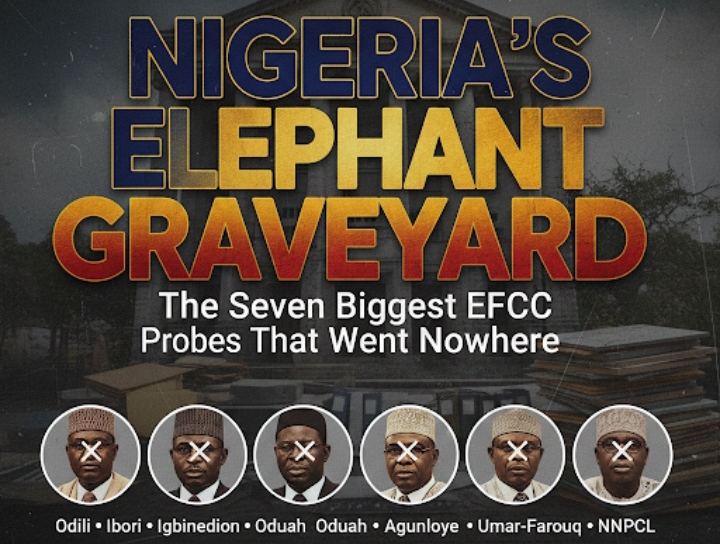
Across these seven major instances—Odili, Ibori, Igbinedion, Oduah, Agunloye, Umar-Farouq, and the NNPCL chiefs—the pattern remains consistent: the initial headlines are explosive, but the actual impact on the treasury or the legal status of the accused remains minimal. These "inconsequential" outcomes underscore the gap between the agency's investigative intent and the complex reality of Nigeria's legal and political landscape.
Perhaps the most glaring example is the investigation into former Rivers State Governor Peter Odili. In 2007, a perpetual injunction was granted by a Federal High Court, effectively barring the EFCC from ever investigating or prosecuting him for his tenure as governor. Despite the gravity of the initial allegations involving billions of naira, the probe was rendered legally toothless, creating a blueprint for how high-profile accountability can be permanently stalled by the judiciary.
Similarly, the case of James Ibori, the former Governor of Delta State, serves as a stark reminder of the agency's domestic limitations. In 2009, a Nigerian court dismissed all 170 charges of corruption and money laundering against him, despite the EFCC presenting evidence of a $15 million bribe attempted by Ibori to stop the probe. While Ibori was eventually convicted and jailed in the United Kingdom for the same crimes, the Nigerian probe remained largely inconsequential on home soil until his eventual return.
This trend continued with the investigation into Lucky Igbinedion of Edo State; though the EFCC secured a conviction, the resulting plea bargain was widely criticized as "mockery." He was ordered to pay a fine of approximately ₦3.5 million—a fraction of the ₦2.9 billion he was accused of embezzling—allowing him to walk away without significant prison time, thus stripping the probe of its deterrent value.
In the aviation and power sectors, probes into figures like Stella Oduah and Olu Agunloye have followed a familiar trajectory of endless adjournments and jurisdictional challenges.
The investigation into the ₦255 million "bulletproof car" scandal involving Oduah moved at a snail's pace, with the trial repeatedly stalled by the non-service of court processes and other administrative bottlenecks. Likewise, the massive probe into the $6 billion Mambilla Power Project, which implicated Agunloye, has faced significant legal hurdles that keep the substantive issues from being resolved.
Even more recent investigations, such as the probe into Sadiya Umar-Farouq regarding the ₦37.1 billion humanitarian fund, have seen the accused fail to appear for questioning or enter long-drawn-out legal battles over bail and health status, often leading the public to view these high-stakes investigations as mere "media trials" that lack a definitive conclusion.
Finally, the EFCC’s recurring probes into the Nigerian National Petroleum Company Limited (NNPCL) and various former Group Managing Directors often highlight the systemic difficulty of prosecuting "big oil" corruption. Recent efforts to investigate officials over nearly $3 billion in refinery rehabilitation funds are already facing the same headwinds of bureaucracy and "missing" records that plagued previous attempts to audit the subsidy regime.
Across these seven major instances—Odili, Ibori, Igbinedion, Oduah, Agunloye, Umar-Farouq, and the NNPCL chiefs—the pattern remains consistent: the initial headlines are explosive, but the actual impact on the treasury or the legal status of the accused remains minimal. These "inconsequential" outcomes underscore the gap between the agency's investigative intent and the complex reality of Nigeria's legal and political landscape.
Kindly join discussion on this topic on:
Related Posts
- Detailed Breakdown of Total Spending by EPL 'Big Six' at January Transfer Window
- Last-minute Transfer Window Shocker Across European Leagues
- Niki Minaj vs Trevor Noah, Jay-Z: Story from the Source
- Who wins what at the Grammy Awards 2026
- Cities Buzzing Amid Late-Minute January Transfer Deals by Football Clubs
- Growing with the New Frontiers in Cryptocurrency
- Fintech, Renewable Energy and More: Emerging Opportunities in Nigerian Economy
- From Infra Boom to Fiscal Shifts: Lagos Nigeria Today
- From Immigration Crackdown to Diplomatic Renewal, USA Today
- Among others, 'Are you dead' App Trends in China