Understanding Irregular Bleeding with Family Planning Implants
Posted on 04/02/2026 06:21:09
Share with friends on:
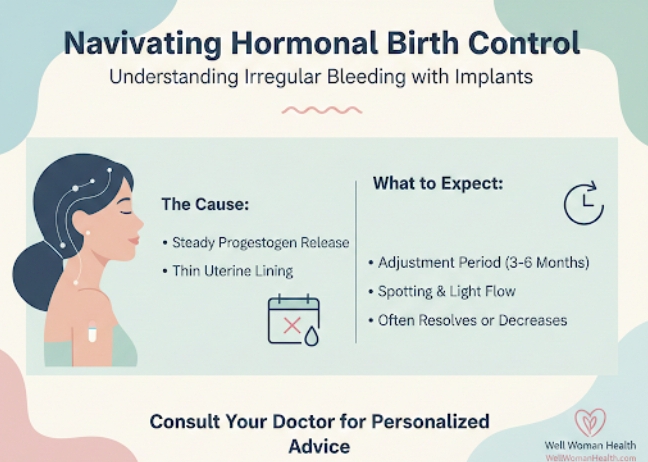
When an individual first receives a contraceptive implant, the body undergoes a significant hormonal shift that fundamentally alters the menstrual cycle. The primary cause of irregular spotting or "staining" is the continuous release of progestogen, which works to prevent pregnancy by suppressing ovulation and thinning the lining of the uterus.
Unlike a typical menstrual cycle where the uterine lining builds up and sheds in a heavy, predictable flow, the implant keeps the lining thin and fragile. This fragility results in "breakthrough bleeding," where small amounts of the lining shed irregularly. Because this flow is so light, it often manifests as a persistent, low-volume stain rather than a standard period, and it can linger for many days as the body slowly processes the minor discharge.
This experience is remarkably common, particularly during the first three to six months as the body enters an adjustment phase. During this time, the reproductive system is essentially recalibrating to the constant presence of hormones. For many, this first "period" after insertion is the most confusing, but clinical data suggests that about one-third of users will eventually stop bleeding altogether, while others will settle into a pattern of infrequent spotting. It is important to view these early months as a transition period rather than a permanent state.
While the daily staining is inconvenient, it is generally not a sign that the contraceptive is failing or that there is an underlying injury; it is simply the physical manifestation of the hormone doing its job to keep the uterine lining suppressed.
To manage this, the most effective initial step is patience, as many healthcare providers recommend a "wait and see" approach for at least one full 90-day cycle. However, if the daily staining becomes a significant burden on her quality of life, there are medical interventions available. A doctor may sometimes prescribe a short course of non-steroidal anti-inflammatory drugs (NSAIDs) or even a temporary cycle of combined oral contraceptive pills to help stabilize the uterine lining and "reset" the rhythm. She should also ensure she is staying hydrated and maintaining her iron levels if the spotting is exceptionally prolonged.
While this side effect is normal, she should always seek a professional consultation if she experiences sharp pelvic pain or if the bleeding becomes heavy enough to soak through a pad in an hour, as these could indicate issues unrelated to the implant itself.
Unlike a typical menstrual cycle where the uterine lining builds up and sheds in a heavy, predictable flow, the implant keeps the lining thin and fragile. This fragility results in "breakthrough bleeding," where small amounts of the lining shed irregularly. Because this flow is so light, it often manifests as a persistent, low-volume stain rather than a standard period, and it can linger for many days as the body slowly processes the minor discharge.
This experience is remarkably common, particularly during the first three to six months as the body enters an adjustment phase. During this time, the reproductive system is essentially recalibrating to the constant presence of hormones. For many, this first "period" after insertion is the most confusing, but clinical data suggests that about one-third of users will eventually stop bleeding altogether, while others will settle into a pattern of infrequent spotting. It is important to view these early months as a transition period rather than a permanent state.
While the daily staining is inconvenient, it is generally not a sign that the contraceptive is failing or that there is an underlying injury; it is simply the physical manifestation of the hormone doing its job to keep the uterine lining suppressed.
To manage this, the most effective initial step is patience, as many healthcare providers recommend a "wait and see" approach for at least one full 90-day cycle. However, if the daily staining becomes a significant burden on her quality of life, there are medical interventions available. A doctor may sometimes prescribe a short course of non-steroidal anti-inflammatory drugs (NSAIDs) or even a temporary cycle of combined oral contraceptive pills to help stabilize the uterine lining and "reset" the rhythm. She should also ensure she is staying hydrated and maintaining her iron levels if the spotting is exceptionally prolonged.
While this side effect is normal, she should always seek a professional consultation if she experiences sharp pelvic pain or if the bleeding becomes heavy enough to soak through a pad in an hour, as these could indicate issues unrelated to the implant itself.
Kindly join discussion on this topic on:
Related Posts
- Seven Biggest Inconsequential Mega-Probes by EFCC
- Detailed Breakdown of Total Spending by EPL 'Big Six' at January Transfer Window
- Last-minute Transfer Window Shocker Across European Leagues
- Niki Minaj vs Trevor Noah, Jay-Z: Story from the Source
- Who wins what at the Grammy Awards 2026
- Cities Buzzing Amid Late-Minute January Transfer Deals by Football Clubs
- Growing with the New Frontiers in Cryptocurrency
- Fintech, Renewable Energy and More: Emerging Opportunities in Nigerian Economy
- From Infra Boom to Fiscal Shifts: Lagos Nigeria Today
- From Immigration Crackdown to Diplomatic Renewal, USA Today